

























































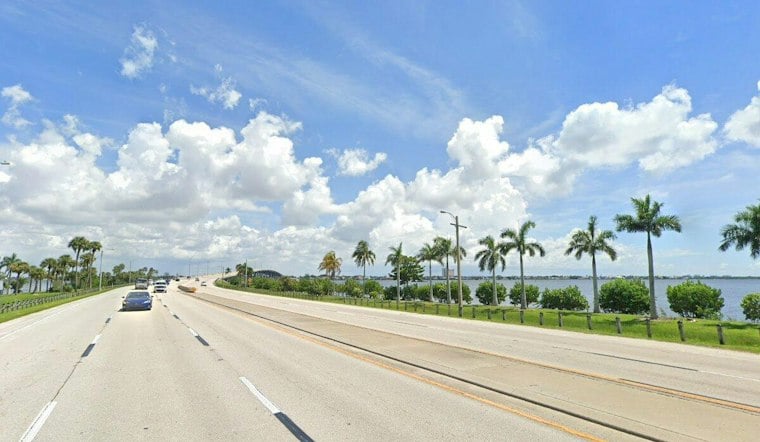
The Cape Coral Bridge, which carries roughly 50,000 trips a day across the Caloosahatchee River, is at the center of a renewed federal funding push after U.S. Representative Greg Steube threw his support behind Lee County's bid for infrastructure money. The plan calls for replacing the span's two existing structures and expanding the crossing from four lanes to six, a project local officials say is meant to unclog daily commutes, boost storm evacuation capacity and improve access to regional corridors and Southwest Florida International Airport.
Steube sent a letter to the Federal Highway Administration supporting Lee County's application through the federal Bridge Investment Program, according to the Tampa Free Press. “Southwest Florida is growing, and our infrastructure needs to keep up,” Steube said, according to the outlet. He added that Lee County “put forward a strong proposal” and that “the federal government should support the investment,” and said families “should not have to endure endless traffic or doubt road capacity during the next major hurricane.”
The county has discussed an aggressive strategy to land as much as $250 million in federal support, a figure Lee County commissioners weighed during a March work session, according to the Lea Nes Suarez Group. Under the federal Bridge Investment Program, Large Bridge Project Grants are reserved for bridges with total eligible costs above $100 million, carry a $50 million minimum award, and cap out at half of total eligible project costs, per the Federal Highway Administration. The program itself funds planning and construction work that replaces or protects aging and at-risk bridges, according to the U.S. Department of Transportation.
Two Spans, Two Different Ages, One Fix
The project would replace the bridge's aging westbound span, built in 1963, and its eastbound span, built in 1989, with two new three-lane structures, per the Lea Nes Suarez Group's reporting. The redesign is meant to accommodate far more traffic than the bridge handles today: the current crossing averages 50,000 vehicles daily, while the new design is projected to handle between 67,000 and 75,000 vehicles per day, according to WGCU.
Lee County began the Project Development and Environmental study for the bridge back in April 2022, the Cape Coral Breeze reported. That study is overseen by the Florida Department of Transportation and is designed to comply with the National Environmental Policy Act, supporting the project's eligibility for federal dollars, according to the Cape Coral Bridge Project's own site. As of mid-March, engineering and planning work was reported as 90% complete, per the Lea Nes Suarez Group.
Cost and Timeline Estimates Vary Widely
Exactly how much the project will cost and when construction will begin remain unsettled questions across available reporting. The Lea Nes Suarez Group has put the total estimated cost at $547.9 million, while WGCU has reported a figure of $325.48 million tied to a 2031 completion for expanding the crossing to six lanes. A separate report from Bridge Design & Engineering cited commissioners endorsing a $301 million replacement bridge. Construction start dates have likewise varied, with the Lea Nes Suarez Group reporting that major construction is slated to begin in 2028 and WGCU describing a 2027 start following the design phase's expected conclusion this year.
The Federal Highway Administration has not announced award decisions for the current funding cycle, according to the Tampa Free Press. The bridge project ranked third on the list of “Roadway Needs” in the Lee County Metropolitan Planning Organization's 2045 Long-Range Transportation Plan, per the Cape Coral Bridge Project.
A Broader Lee County Funding Squeeze
The Cape Coral Bridge is one piece of a much larger funding puzzle for Lee County. The county estimates it needs $4.3 billion in transportation funding in the foreseeable future to avoid major traffic congestion, with just over $1 billion in projects currently funded and more than $3.3 billion unfunded over roughly the next 30 years, WGCU reported. Other major projects compete for the same scarce dollars: county road planners have recommended pausing plans to widen the Midpoint Bridge, a project estimated to cost at least $600 million, and the county faces a roughly $137 million shortfall on a $151 million project to replace three aging Hickory Boulevard bridges.
If Lee County lands the federal grant for the Cape Coral Bridge, it could reallocate money originally set aside for that project toward the $226 million Burnt Store Road widening, according to the Lea Nes Suarez Group. That road widening has become a priority because the roughly six-mile stretch serves as a hurricane evacuation route; it currently carries up to 14,000 vehicles daily and is projected to carry as many as 42,000 vehicles a day within 20 years, per WGCU. Signing contracts soon could lower that project's cost to about $180 million, compared with roughly $280 million if the county waits several years, the outlet reported.
Commuters have also raised concerns about how construction on the Cape Coral Bridge itself will affect daily travel between Cape Coral and Fort Myers while the work is underway, according to WGCU. County officials have framed the broader push, including the bridge and Burnt Store Road, as part of an effort to increase roadway capacity, ease existing congestion, accommodate growth and improve safety and connectivity, the Cape Coral Breeze reported.





