

























































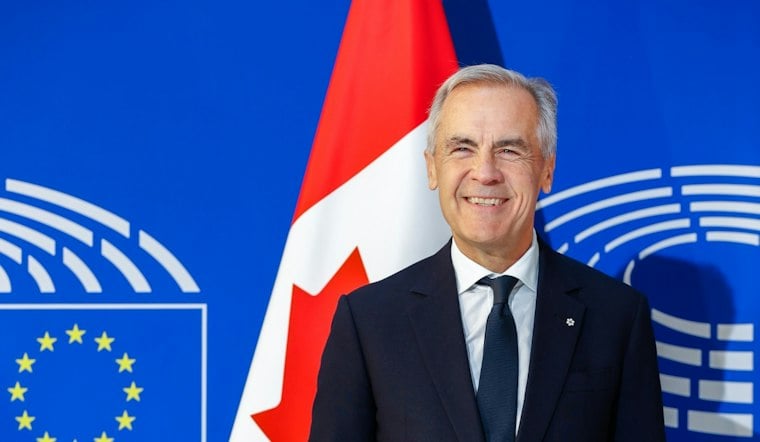
Canadian Prime Minister Mark Carney says President Donald Trump's tariffs have driven up costs for American families and upended a trade relationship that took decades to build, even as a new dispute over alleged Canadian meddling in next month's U.S. midterm elections threatens to further strain ties between Washington and Ottawa. The comments came as Carney and Ontario Premier Doug Ford unveiled a massive new spending plan aimed at protecting the province's steel, auto and critical-minerals industries from the fallout of the trade war.
Carney Says Tariffs Are Punishing Both Countries
“Trump's tariffs have driven up costs for American families and upended a decades-old trade relationship,” Carney said, according to the Washington Post. The prime minister argued that the tariffs have weakened industries and reduced choice for families on both sides of the border, framing Canada's response as defensive rather than provocative. “We've responded to those to protect Canadian jobs, to protect Canadian companies and develop our economy,” Carney said, per CBC News.
According to the Associated Press, Carney has maintained that the United States initiated the trade war and that Canada is simply protecting its own economy. The AP reports that trade negotiations between the two countries collapsed in August 2026 after the two sides had appeared close to a deal, and that Trump subsequently imposed 50% tariffs on roughly $20 billion of Canadian goods, prompting Canadian retaliation. The outlet also reports that Carney spoke with Trump by phone this week for an extended period covering trade along with Middle East developments and Ukraine, topics the two leaders had discussed days earlier as well.
Billions Flowing Into Steel, Autos and Mining
Carney and Ford's action plan, announced Wednesday, directs $8.7 billion toward strategic industries battered by the tariffs, according to a news release from the Prime Minister's Office. The centerpiece is a five-year Joint Steel Action Fund combining $3.55 billion from the federal government and $1.67 billion from Ontario, the release states. An additional $2.5 billion over two years is earmarked for automotive-industry capital projects in Ontario, and Ottawa says it has already delivered more than $25 billion in support to Canadian workers and businesses hurt by the tariffs.
A separate accounting from Euronews describes the package's value at US$6.2 billion, with US$3.7 billion directed to steelmakers over five years and US$1.8 billion to automakers—currency conversions of the federal government's CA$8.7 billion total, CA$5.2 billion for steel and CA$2.5 billion for autos. Euronews also reports that Canadian auto exports to the U.S. have fallen more than 10% while U.S. exports to Canada have dropped more than 20%, the same decline the AP attributes to the broader trade disruption.
Ottawa's plan also includes up to $1 billion in federal funding for roads into Ontario's mineral-rich Ring of Fire region, which the government says will be matched by Ontario's own commitment. The administration has described critical minerals as essential to U.S. auto manufacturing, batteries and defense industries, noting that the United States remains Canada's largest market for them. The federal government says Canada's automotive sector alone supports more than 120,000 direct jobs and contributes over $16 billion annually to the country's GDP, per the pm.gc.ca release.
US Vehicles Losing Ground on Canadian Lots
The spending push comes as Canadian consumers pivot away from American-made vehicles. The Globe and Mail reports that the Canadian market share of U.S.-made vehicles fell 20% in the first half of 2026 compared with a year earlier, dropping to 28.4% of sales from 35.4%. Canadian-made vehicles also lost ground, falling 9% to an 11.5% share, while Mexican-made vehicles rose 22% to capture 22.2% of the Canadian market and Japanese vehicles climbed 21% to 16.6%, the newspaper's analysis found.
Industry trade publication Canadian Auto Dealer reports that automakers have shifted vehicle sourcing to assembly plants in other countries specifically to avoid Canadian counter-tariffs applied to U.S.-built vehicles. Canada exported $78.6 billion in automotive products globally in 2025 while importing $143.1 billion worth of vehicles, parts, trailers and machinery, with nearly 95% of its automotive exports bound for the U.S. market that year, the outlet notes. TD Economics has separately noted that North American auto parts cross the three countries' borders up to seven or eight times before a vehicle is finally assembled, and that average U.S. retail car prices could rise by roughly $3,000 under the tariffs depending on how Canada and Mexico retaliate.
US Embassy Accuses Officials of Election Meddling
Tensions escalated further this week when the U.S. Embassy in Canada released a fact sheet accusing Canadian politicians, including Ford and Industry Minister Mélanie Joly, of seeking to influence American politics ahead of next month's midterm elections. CBC reports that the embassy's release lists a number of statements by Ford, Joly and other officials as examples of attempted interference, singling out Ford for airing a U.S. advertisement featuring Ronald Reagan criticizing tariffs and Joly for discussing retaliatory tariffs targeting Republican-led states.
Ford flatly denied the accusation, telling reporters he has “no interest at all interfering in American elections,” according to CBC. Joly, for her part, said Canada would never engage in election interference and would “never accept that also being done to us in Canada,” per the same report. Carney also rejected the suggestions of improper Canadian interference, according to the Associated Press, which reported that the embassy's fact sheet cited Canadians charged with or sentenced for illegal voting in U.S. elections dating back to 2012 but provided no evidence linking those voting cases to the Canadian government.
The feud has also drawn public backlash in Canada. The AP reports that more than 275,000 people have signed a parliamentary petition calling for the removal of U.S. Ambassador Pete Hoekstra. Ford has said Canada's relationship with the United States has changed permanently and that the country will not return to its previous footing with Washington regardless of who controls the White House or the outcome of the midterms, the AP reports.
A Cooling North American Auto Partnership
Carney has said an integrated North American auto industry would benefit both countries, but has also acknowledged that such integration may no longer be a priority in Washington, according to the AP. Trump, for his part, has said he wants automakers to move production out of Canada and into the United States. The AP reports that Trump has also threatened to make Canada the 51st U.S. state, a posture the wire service says has helped fuel a surge in Canadian nationalism.
Despite the rupture, Carney has said Canada remains ready to negotiate trade with Washington, even as he prioritizes reducing the country's economic dependence on the United States and has set a goal of doubling Canadian exports to other markets over the next decade, according to the AP. TD Economics notes that Canada remains deeply intertwined with the American economy regardless — the country was the largest U.S. export market during the first three quarters of 2024, with nearly $350 billion in goods and services crossing the border, and still supplies roughly 8% to 9% of the vehicles Americans buy each year, compared with about 50% built domestically in the U.S.





