

























































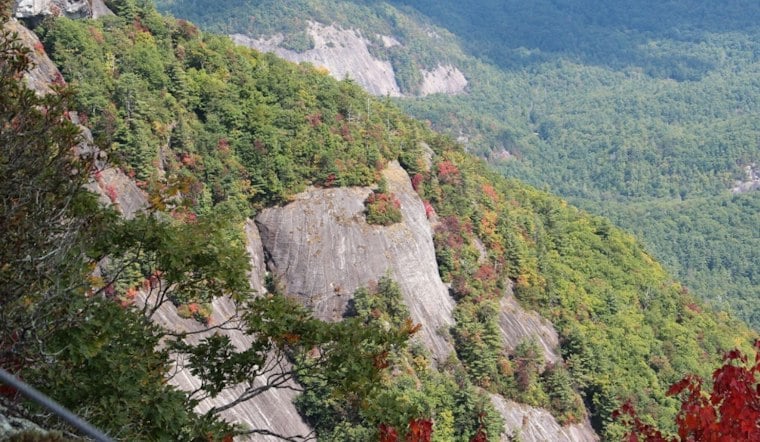
Every clear afternoon this time of year, a shadow shaped unmistakably like a black bear begins climbing the sheer rock face of Whiteside Mountain near Cashiers, North Carolina, drawing carloads of leaf-peepers to a narrow highway shoulder to watch it happen. The display starts around 5:30 p.m. and lasts roughly 30 minutes before fading, and it only shows up for a few weeks each fall — a window that is quickly closing for 2026.
A Southern Living Pick With a Short Shelf Life
The phenomenon, known locally as the Shadow of the Bear, recently landed on a list of must-see North Carolina fall traditions from Southern Living, as reported by the Charlotte Observer. According to that report, the shadow is generally visible from mid-October through early November, and it only appears on clear afternoons — cloudy weather blocks it from forming at all. The Observer's report also notes that visitors hoping to catch it should pick as clear an afternoon as possible to improve their odds.
The best-known vantage point is Rhodes Big View Overlook, a recommended viewing spot along US Highway 64 between Cashiers and Highlands, the Charlotte Observer reports. More precisely, the overlook sits roughly 4.3 miles west of Cashiers and 5 miles east of Highlands in Jackson County, according to VisitNC.com. The spot was designed for limited crowd capacity, per the Observer's reporting, and visitors are urged to arrive well before the shadow is expected and to avoid walking along Highway 64 when possible.
No Parking Lot, Just a Busy Shoulder
That crowding concern is not hypothetical. The Jackson County Tourism Development Authority cautions that Rhodes Big View Overlook has no official parking lot or dedicated visitor facilities, requiring people to exercise caution along the narrow, high-traffic road, according to the Jackson County Tourism Development Authority. Jackson County's own fall travel guide repeats the same warning about the overlook's lack of facilities, underscoring it as a persistent seasonal headache for local officials trying to keep sightseers safe along the roadside.
Beyond the shadow itself, the view from the overlook takes in the surrounding mountain landscape, with Jackson County's fall foliage turning around the same time the bear begins to show, the Charlotte Observer notes. Whiteside Mountain itself rises to an elevation of nearly 5,000 feet, towering over the valley below.
The Rock Face Behind the Phenomenon
What makes the shadow possible is the mountain's dramatic geology. Geologists estimate Whiteside Mountain, composed of metamorphosed granitic gneiss along the Eastern Continental Divide, to be between 390 million and 460 million years old, according to the Blue Ridge Highlander. Its sheer vertical cliffs drop 750 feet, making them among the highest sheer rock faces in eastern North America, per the U.S. Forest Service. That immense, precisely angled wall of stone is what allows the late-day sun to project such a crisp, bear-shaped silhouette.
Hikers who want a closer look can access the mountain's two-mile cliff-top loop trail through the Whiteside Mountain Recreation Area, which the Forest Service manages within Nantahala National Forest for a $3 daily vehicle fee. The land was not always public: before the Forest Service acquired Whiteside Mountain in the 1970s, the peak operated as a private tourist attraction complete with a shuttle bus route and a mountaintop post office where visitors could mail postcards, according to Brook and Holler.
Falcons, Folklore and a Winter Encore
Part of that cliff face goes off-limits to climbers for much of the year. To protect nesting peregrine falcons reintroduced to the area in the 1980s, the Forest Service enforces seasonal closures on select rock faces annually from January 15 through August 15, a schedule confirmed by the Highlands Chamber of Commerce.
The mountain carries deep cultural weight as well. Known in Cherokee as Sanigilâ'gĭ, Whiteside Mountain is the setting of the Cherokee legend of Spearfinger, a stone-skinned shape-shifting ogress said to inhabit its high ridges, according to the chamber's account. Separately, in Cherokee tradition the black bear is revered as a sacred guardian entity, which has led to local stories framing the shadow itself as a symbolic protector of the valley, per Laurel Magazine.
For those who miss the fall window or want to dodge the crowds entirely, the shadow is not a once-a-year event. The phenomenon also occurs in late winter, appearing on clear afternoons from mid-February through early March, according to VisitNC.com — a quieter second chance to catch the bear climb the cliff before it vanishes again until the following fall.



