

























































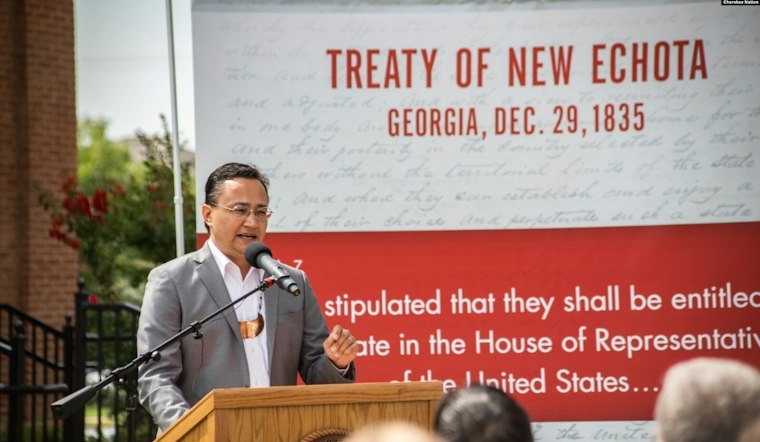
Seven Cherokee families have new keys in hand after the Cherokee Nation opened its first affordable rental housing project in north Tulsa this week, a seven-unit apartment complex on North Harvard built specifically for tribal citizens who had been waiting, in some cases for years, for a spot closer to home.
The Cherokee Nation celebrated the opening Wednesday, according to tulsaflyer.org, with each of the seven two-bedroom, one-bathroom units — all 840 square feet — going to a Cherokee citizen pulled from the Housing Authority of the Cherokee Nation's waiting list. Rent at the complex is income-based. As KTUL reports, the apartments were offered to Cherokee citizens already on the low-income rental housing waiting list for the tribe's Catoosa project, previously the closest such development to north Tulsa.
Principal Chief Chuck Hoskin Jr. said applicants had piled up on that waiting list for a long time, and the seven families moving in on North Harvard got the first real shot at relief, per KTUL's reporting. The City of Tulsa helped fund the project, while Green Country Habitat for Humanity handled construction, according to the same tulsaflyer.org report. Fox23 reports that the Housing Authority of the Cherokee Nation has agreed to manage the seven units and purchase them outright by the end of 2026, and that three of the apartments are ADA-accessible, with one further equipped for residents with visual and hearing impairments.
A Tribe Weighing Its Footprint In North Tulsa
Hoskin estimated more than 10,000 Cherokee citizens live in north Tulsa specifically, though he acknowledged he did not have an exact count, KTUL reports. The tribe's broader estimates put roughly 28,000 Cherokee citizens within Tulsa city limits and about 54,000 across the greater Tulsa metropolitan area, according to the same KTUL report.
Ashley Grant, a Cherokee Nation Tribal Council member representing District 5, told KTUL that north Tulsa faces an affordable housing crisis of its own, and that the tribe has discussed how the area has been somewhat neglected over the years. She said bringing awareness and housing options to Cherokee citizens there matters, and that she hopes the North Harvard apartments are just the beginning of further investment in the area.
Hoskin was blunter about the scale of the problem, telling KTUL that rents across the region are too high while housing supply and quality remain too low. He added that no single entity will solve Tulsa's housing issues on its own and that partnerships — like the one behind the North Harvard project — can accomplish more than any one government or organization working alone.
More Investment Promised, Including Flat Rock Ridge
The seven new apartments add to the available housing supply in north Tulsa, but KTUL's reporting is explicit that the project alone will not resolve the area's larger housing shortage. Hoskin promised more investments were coming to north Tulsa, according to tulsaflyer.org, and the tribe has already sketched out several next steps.
Those plans include mortgage assistance for Cherokee citizens purchasing homes at Flat Rock Ridge, along with purchasing lots for 45 new units there, per tulsaflyer.org's reporting. That project remains in the planning phase, the outlet notes. KTUL additionally reports that the Cherokee Nation is considering participating in a second phase of the Flat Rock Ridge development and has identified eligible citizens on its waiting list who could pursue homeownership through the tribe's mortgage assistance program.
The tribe is also weighing whether its north Tulsa community property could support additional services and housing geared toward older adults. Hoskin discussed the possibility of building three duplexes for elders, though KTUL reports that idea remains under consideration rather than confirmed. The Cherokee Nation is separately evaluating whether its human services and career services offices sit where citizens can easily reach them, and Hoskin said the tribe needs to think harder about health care access in north Tulsa, noting the Cherokee Nation already has a presence there and can assess what additional services might be needed.
Funding for this kind of housing work flows in part through the Cherokee Nation Housing, Jobs and Sustainable Communities Act, which commits $40 million in tribal funds every three years to housing and community infrastructure, according to a separate tulsaflyer.org report. That funding comes on top of federal housing dollars, per the same report. The Housing Authority of the Cherokee Nation, created in 1966 to provide housing within the Cherokee Nation, has used similar tools elsewhere, including a lease-to-own subdivision in Tahlequah offering 24 homes with a 30-year payoff, according to ictnews.org.
North Tulsa's Deeper Housing Gap
The North Harvard opening lands against a backdrop of serious need across Tulsa. The city says it must develop nearly 13,000 new housing units over the next decade, including a shortfall of 6,000 affordable units, according to the City of Tulsa's housing office. Nearly 46% of Tulsa renters are considered cost-burdened, the city's housing office reports.
More than 12,000 people sit on Tulsa Housing Authority waiting lists for the River West Community and the Section 8 Housing Choice Voucher Program, and some applicants face waits of up to two years, according to News On 6. An independent study found a $2.45 billion gap in housing investment citywide, estimating roughly $245 million a year over a decade would be needed to close it, per the Housing Solutions Tulsa study.
Other affordable housing efforts are underway elsewhere in north Tulsa, including the Phoenix at 36 North project at 36th Street North and Peoria, which was reported as more than 80% complete and will eventually offer 100 units of one- and two-bedroom affordable apartments with rent set at one-third of each household's income, according to KJRH. Hoskin said the Cherokee Nation is serious about making up for lost time in north Tulsa, framing partnerships as essential to chipping away at a housing problem too large for any one agency or government to fix alone.





