

























































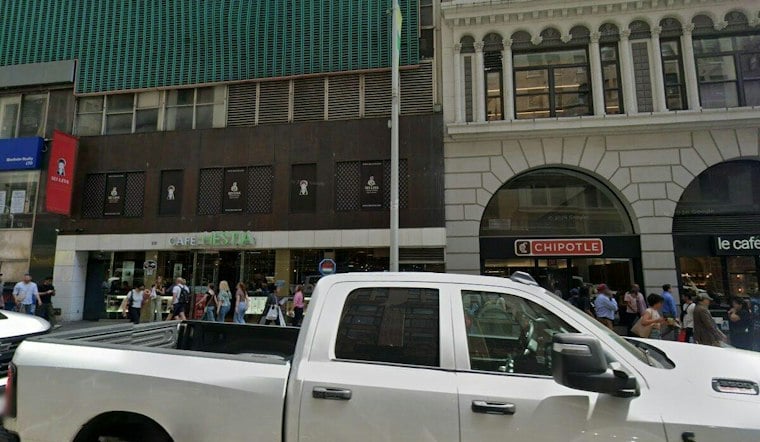
Two Midtown office towers long controlled by a partnership of Joseph Moinian, Edward Minskoff, Joseph Chetrit and Meyer Chetrit have been returned to their lender in a foreclosure auction, according to court documents, closing out a years-long debt saga at 500 and 512 Seventh Avenue in the Garment District. The buildings carried more than $356 million in debt, and the fallout has exposed just how strained the Chetrit side of the partnership has become.
The foreclosure, first reported by The Real Deal, comes as Christian Becker, an attorney with Kasowitz LLP who represents Moinian and Minskoff, has asked the court for permission to withdraw as counsel. According to court filings, the attorney-client relationship suffered an irretrievable breakdown after Moinian and Minskoff failed to pay a substantial balance of legal fees owed to the firm.
Chetrit Group Says It Is Falling Apart
The Chetrits held a 56 percent stake in the Seventh Avenue buildings, and Meyer Chetrit testified that his Chetrit Group was falling apart, telling the court it had not paid employees, attorneys or lenders. Meyer Chetrit, who kept offices at 512 Seventh Avenue, valued the Chetrit Group portfolio at negative $80 million — a stunning reversal from a valuation of a billion dollars less than four years earlier.
Meyer Chetrit is also facing mounting personal bills. He and Joseph Chetrit face $31 million in judgments from an affiliate of Mack Real Estate Group, and Meyer Chetrit was separately ordered to pay a $132 million judgment to an affiliate of Maverick Real Estate Partners. Those figures sit alongside other recent Chetrit family legal troubles tracked by Hoodline, including a Manhattan court placing Meyer Chetrit in civil contempt over a subpoena tied to a $39 million judgment stemming from a 2016 Midtown showroom fire, as reported by The Real Deal.
Lender Alleged Self-Dealing by the Borrower
The lender accused the borrower of self-dealing in the case, noting that the Chetrit Group had not been paying $42,000 in rent for its offices at the property — a claim Meyer Chetrit confirmed. According to the lender, the borrower also transferred $1 million in security deposits to external accounts, including accounts associated with other Chetrit projects.
The properties at the center of the dispute are substantial: 512 Seventh Avenue is a 45-story building with 544,300 rentable square feet, while 500 Seventh Avenue is an 18-story building with 676,500 rentable square feet. A smaller five-story commercial building at 228 West 38th Street, with 10,000 rentable square feet, was also included on the loan. The borrower had just 17 years remaining on its land lease at the time of the foreclosure.
That land lease points to a structural wrinkle underlying the whole dispute — the developers never owned the ground beneath their towers outright. Solil Management, which manages the real estate portfolio of the late Sol Goldman, owns the land beneath 500 Seventh Avenue, 512 Seventh Avenue and 228 West 38th Street under a ground lease, according to The Real Deal. The borrower partnership had purchased that ground lease in 1999 for $140 million, and friction with Solil dates back more than a decade — in March 2015, Joseph Chetrit sued the landowner seeking a Yellowstone injunction to block termination of the lease over alleged Department of Buildings infractions and unpaid contractors, after Solil had threatened eviction with a cure deadline for the violations.
A Recurring Pattern of Debt Trouble
This was not the complex's first brush with default. The developer partnership previously avoided default on the Seventh Avenue complex by negotiating short-term CMBS loan extensions on $211 million in debt in August and December 2016, a workout advised by Iron Hound Management Company, per Commercial Observer. A $285.5 million AIG pre-foreclosure filing involving a Chetrit property added to the pattern.
The loss adds to a string of recent setbacks for Chetrit-linked entities across the city. Hoodline has reported on the 26 Broadway loan trouble, where a $290 million CMBS loan on the Chetrit-owned Standard Oil Building was transferred to special servicing in June after occupancy dropped to 75 percent, as well as the September sale of SoHo's 428 Broadway for $47 million to Sagehall after the Chetrit Organization lost the asset following WeWork's bankruptcy exit. In a different outcome that same month, the Chetrit Organization managed to retain control of its 404 Fifth Avenue office building by submitting a credit bid during a foreclosure sale to erase nearly $84 million in outstanding debt.
The broader office market has not made recovery easy for the Chetrit side of the business. Persistent post-pandemic distress among older Midtown office properties, as flight-to-quality trends favor newer buildings, has made refinancing leveraged, aging leasehold assets like 500 and 512 Seventh Avenue an increasingly difficult proposition.
Family wealth and operating distress present a stark contrast within the Chetrit organization. Jacob Chetrit, who ran the Chetrit Organization alongside his brother Juda, died in January 2025 leaving an estate valued in probate court filings at over $825 million, even as creditor enforcement against family-linked real estate entities continues. Moinian, Minskoff and Kasowitz LLP did not immediately respond to a request for comment, according to The Real Deal.



