

























































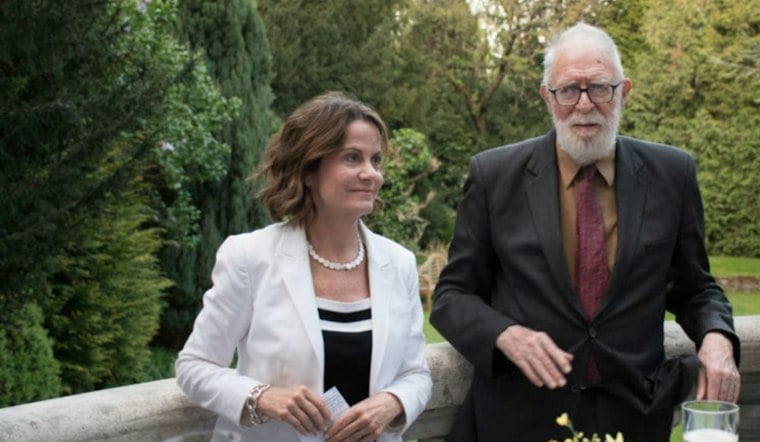
Monroe E. Price was born in Vienna in 1938 into a middle-class Jewish family and left the city as a seven-month-old infant, the first step in an escape from Nazi persecution that eventually carried him to Cincinnati, where he came of age. He died on March 16, 2026, at the age of 87.
Price’s family fled to New York City in 1939 before resettling in Macon, Georgia, and then Cincinnati, Ohio, according to Penn’s Almanac. It was in Cincinnati that Price finished high school, graduating with the Walnut Hills High School class of 1956 — a detail reported by Axios, whose account of his life was written by his son, Asher Price. As Price himself recalled of his path to Yale, in a remembrance published by yale60.org, “I was a senior from Walnut Hills High School in Cincinnati” when he first visited the campus that would shape his future.
A Childhood Rooted in Cincinnati’s Jewish Neighborhoods
Cincinnati in those decades was home to a Jewish community in motion. Jewish residents moved first into South Avondale, where trolleys carried people downtown, before many families continued on to Bond Hill and Roselawn, and some eventually reached Amberley Village, Blue Ash and Montgomery, per the same wvxu.org account cited above. By the 1950s, Roselawn had at least five kosher butcher shops along or near Reading Road, along with bakeries established by Jewish refugees who had fled Europe, the station’s report notes.
That refugee experience had deep roots in the neighborhood. The former New Hope Synagogue in Roselawn had once housed Jewish refugees who escaped Nazi Germany during the 1930s and 1940s, according to the same wvxu.org report. Those enclosed, tight-knit communities offered postwar immigrants a sense of shared language and security — what one observer described, per the outlet, as “sort of leftover from living in enclosed communities and ghettos and things in Europe.”
Barriers and Institutions Jewish Cincinnatians Built
Discrimination shaped the community’s institutions as much as migration did. Losantiville Country Club was founded specifically because Jewish residents could not obtain membership at Cincinnati’s already-established clubs, according to the Jewish Cincinnati Bicentennial Historical Timeline. Years earlier, the city’s broader Jewish population had shifted from the West End toward Avondale, where much of the community remained concentrated from 1926 to 1950, according to a National Park Service account, though that detail carries lower confidence than other sourcing in this story.
From Yale to the Supreme Court
Price graduated from Yale in 1960, then joined Robert Wagner’s mayoral campaign in New York before attending law school at the University of Virginia and, later, Yale Law School, Penn’s Almanac reports. After finishing his legal education, he worked on the Warren Commission Report and then clerked for U.S. Supreme Court Justice Potter Stewart — a justice who, notably, also hailed from Cincinnati, according to Axios’s account of the family history.
Price’s academic career spanned decades and institutions. He joined UCLA’s law faculty before being named dean of the Benjamin N. Cardozo School of Law at Yeshiva University in 1982, a post he held until 1991, per the same Almanac report. He later joined the University of Pennsylvania’s Annenberg School in 2004, where in 2006 he founded the Center for Global Communication Studies, remaining active there until his retirement in 2020.
A Memoir of Vienna and America
Price chronicled his family’s journey in a memoir titled Objects of Remembrance: A Memoir of American Opportunities and Viennese Dreams, according to Johns Hopkins University Press’s Project MUSE. The book traced the arc from his infancy in Vienna through the family’s escape and resettlement in the United States, work that sits alongside the detailed account of his death and career published by Penn’s Annenberg School, which confirmed he passed away at 87 on March 16, 2026.





