

























































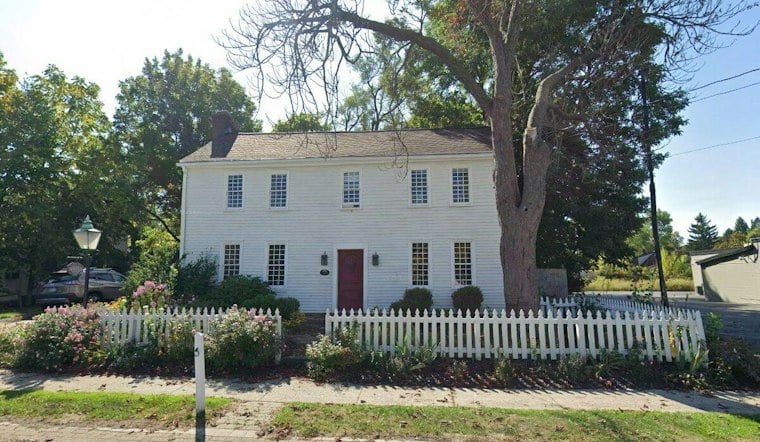
A weathered log house tucked at 10897 Main St. in Clarence Hollow has been nominated for the New York State and National Registers of Historic Places, and if the listing goes through, it would mark the first individually recognized house of its kind for the Town of Clarence. The Brace House, long known to locals simply as a quirky old homestead, may turn out to be something far more significant — possibly even older than Buffalo itself.
The nomination was reported by Bee Group Newspapers, which noted that the New York State Board for Historic Preservation recommended the Brace House nomination on Sept. 9. The New York Almanack reported that the Brace House was one of 23 properties and districts recommended in this latest round.
Before National Park Service review, the state commissioner must approve the recommendation and the property must be placed on the State Register. After that, the nomination may be reviewed by the National Park Service, which may approve the Brace House's national listing. If that happens, the house would become the Town of Clarence's first individually listed house on the National Register of Historic Places. The J. Eshelman and Company Store in Clarence Center and the former Automobile Club of Buffalo building in Clarence Town Park are both already listed, but neither is a standalone historic house.
A House Older Than Its Own Records
What makes the Brace House compelling isn't just its age — it's how little anyone actually knows about it. The house has no known records identifying its original builder or earliest occupants, and there's no documented family living there before 1850, according to the Bee Group Newspapers report. The New York State Office of Parks, Recreation and Historic Preservation has described it as the oldest of three surviving two-story log houses in Western New York, built with large hewn logs and construction details that have somehow survived intact.
Historian John Conlin, per the same report, called the house a significant example of post-colonial architecture in Western New York. The structure sits on what's been described as a stuffed foundation, which has raised the possibility that the house may have been moved from its original location at some point in its history.
Could This Be the Lost Asa Ransom Tavern?
A 1917 newspaper account cited in the Bee Group Newspapers report claimed the Brace House was older than Buffalo and built before the War of 1812, describing it as having once served as a roadside inn or tavern. That detail has fueled a theory among some historians that the Brace House may actually be the former Asa Ransom Tavern, a two-story log structure built in Clarence Hollow in 1799 that played a role in the area's early settlement, reportedly housing Joseph Ellicott and serving as the Holland Land Company's first operational office in Western New York before it disappeared from the historical record.
Nobody can currently prove the connection. That's where dendrochronological testing comes in — researchers are pursuing tree-ring analysis to estimate when the Brace House's original logs were cut, a method that could offer scientific evidence of the building's true construction date. The results, if conclusive, could help clarify whether the Brace House really is linked to the vanished Asa Ransom Tavern, and potentially determine whether it's the oldest surviving house in Western New York.
A Family's Decades-Long Push for Recognition
The push to protect the Brace House didn't start this year. The house was designated under the Town of Clarence's historic preservation law back in 2008, after Patricia Brace requested the local designation. At a public hearing that year, she said the house was important to her family and that she hoped historic recognition would help preserve it for future generations.
State and National Register listing, beyond the honor itself, can open doors for property owners — the New York Almanack notes that such designations make properties eligible for public preservation programs, matching state grants and federal historic rehabilitation tax credits. The nomination materials themselves are still considered drafts under New York State Parks guidance, which typically require additional text, maps, photography and corrections before being finalized. Other Western New York sites swept into this same nomination cycle, according to FingerLakes1.com, include the Limerick School and Hall in Newstead, Buffalo's Shoreline Apartments Complex and the East Aurora Downtown Historic District.
For now, the Brace House remains a question mark wrapped in log walls — a building whose true age, builder and purpose are still unknown, pending both bureaucratic review and the results of scientific testing still to come.





