

























































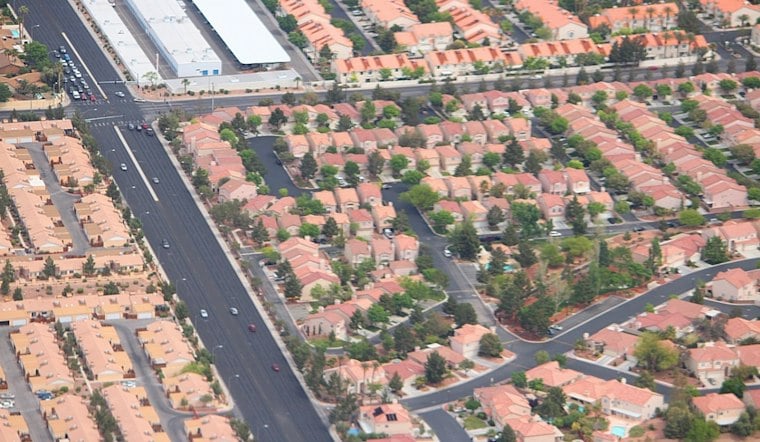
Clark County home prices dropped 5% year over year in the third quarter of 2026, placing it among the steepest declines in the nation as Las Vegas-area housing inventory swelled past 10,000 listings for the first time in more than a decade. The slide comes as mortgage rates remain stuck above 7% and sellers across the valley compete for a shrinking pool of buyers.
The 5% drop ties Clark County with Miami-Dade County, Florida, for the fourth-largest home-value decline among the nation's most populous counties, according to a report from ATTOM. Only three counties fared worse: Middlesex County, Massachusetts, where prices fell 11%, Orange County, Florida, down 10%, and Duval County, Florida, down 8%, per the same report. Nationally, the median home sales price was $368,000 in the third quarter, down 1% from the second quarter and 2% from a year earlier, ATTOM found.
Affordability pressure is showing up locally as well. As Nevada Current reported, Las Vegas Realtors logged more than 10,000 homes for sale, an inventory level the industry group said has not been seen since 2014, in the aftermath of the Great Recession. The same report cited an MLS count showing 161 new listings, 210 price reductions, and 83 homes sold in a single day last Friday — a sign that sellers are cutting asking prices faster than buyers are closing deals.
Listings Pile Up Across the Valley
The surge in supply isn't limited to one data source. The Las Vegas Review-Journal reported that the Valley had 10,344 homes for sale at the end of August, the first time that figure topped 10,000 since 2014; before that, inventory last crossed that threshold in 2009, in the wake of the Great Recession, according to the Review-Journal. By early October, the paper's follow-up reporting put months of supply at roughly 6.2 months, the highest level in four years, matching a stretch in October 2022 when prices fell for several months afterward.
Despite the glut of listings, prices in the region have held relatively steady so far. The median single-family sales price in August was $485,000, unchanged from both the prior month and the same month a year earlier, the outlet's reporting notes. Under-contract activity and new escrow activity, meanwhile, have declined for five straight months even as prices hold, a pattern David Brownell described as the market correcting through volume before price, according to the same report.
Rates and Rising Costs Squeeze Buyers
Mortgage rates remain a central culprit. The average 30-year fixed rate stood at 7.32% as of October 22, down slightly from 7.40% the week before but still well above the 6.19% recorded a year earlier, per Freddie Mac. Rates above 7% have made homeownership more expensive and constrained both buyers and sellers, the Review-Journal's reporting states.
Nationally, the squeeze is broad. ATTOM's analysis found that homes were less affordable than historical averages in 98% of the counties it studied, and major monthly expenses exceeded historical norms in 570 of 583 counties analyzed. Monthly homeownership costs on a median-priced U.S. home would consume 31.8% of a typical worker's wages, the firm reported, with affording that home requiring an annual wage of $90,191 based on a $294,400 loan and a 28% debt-to-income ceiling. Still, wages grew faster than prices in 58.9% of the counties ATTOM studied, suggesting the picture varies widely by market.
In Southern Nevada specifically, the Review-Journal reported a median sale price of $470,000 for single-family homes in September, down from the all-time record of $490,000 set in June. Local market conditions also vary sharply by neighborhood: homes in Lake Las Vegas took an average of 108 days to sell, compared with 185 days in The Ridges and just 24 days in Anthem, according to data cited in the outlet's reporting.
Nevada Current's reporting, citing Nevada Current, included local agents describing a market that has cooled after years of rapid appreciation, with sales and price reductions moving in opposite directions following a recent rate increase and talk of another hike. That account also noted that one real estate agent cautioned sellers against testing inflated asking prices in the current climate, while attributing some of the earlier price run-up to pandemic-era remote workers relocating from pricier California markets.





