

























































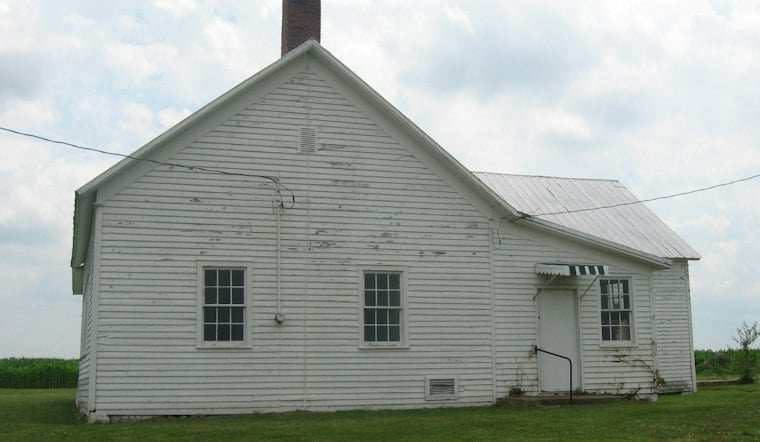
A one-room schoolhouse that sat forgotten behind a Clarksburg lumber yard for decades is now open to the public on weekends, the result of a 12-year restoration effort that has turned the 1883 building into a free community museum. The schoolhouse, believed to be the second-oldest in Clarksburg, now welcomes visitors Saturdays and Sundays from 11 a.m. to 3 p.m. at 36446 Riverview Drive, with no admission charge.
According to CBS Sacramento, the Clarksburg community has worked to restore the historic building for more than a decade in the Sacramento-San Joaquin River Delta town. Steve Heringer, of the Heringer winery family, has spent 12 years on the project and told the station that the restoration has demanded the same persistence the area's farmers bring to their fields. Per the 1883 Clarksburg Schoolhouse organization, the structure sat largely untouched at the Noah Adams Lumber Yard from its 1923 closure until it was rediscovered and moved.
From Lumber Yard Relic to Living Classroom
The nonprofit's own accounting shows the heaviest lifting is finished: acquisition of the building and its site, the physical relocation, and the renovation itself are all listed as done, with landscaping and outdoor exhibits still described as in progress. The group, sponsored by the Friends of the 1883 Clarksburg Schoolhouse and run by a volunteer board of directors, says the goal is a community education and resource center rather than a static museum piece. CBS Sacramento's report notes that the restored classroom has been designed to resemble its turn-of-the-20th-century appearance, and the schoolhouse now offers student tours in addition to weekend public hours.
Heringer said the project aims to preserve both the original building and its surrounding grounds, letting visitors experience Delta history firsthand rather than just read about it. Restoration plans call for keeping the schoolhouse's original pole, and the grounds will eventually include a Native American site alongside historic farming equipment. Among the artifacts are clam buckets dating to the late 1880s, which Heringer said reflect the grueling labor that went into building the region's roads and levees.
A New Exhibit Confronts Wartime Incarceration
The grounds are also planned to include an outdoor Japanese rock garden, and an exhibit will explore Japanese Americans' experiences in the Clarksburg area, including their forced incarceration during World War II. That history is anchored by Executive Order 9066, which President Franklin D. Roosevelt issued in 1942; the order and the Civilian Exclusion Orders that followed it authorized the removal and incarceration of people of Japanese ancestry, according to the 1883 Clarksburg Schoolhouse's Japanese Families page. That same project material says the exhibit tells Clarksburg's Japanese American story through voices, photographs and personal histories.
Steve Hiromoto, who serves as a guide for the exhibit, told CBS Sacramento that his own family was among those forcibly removed and given only weeks to dispose of their possessions and settle their affairs. Hiromoto said several hundred Japanese American families once lived in the Clarksburg area before the war, and that, by his account, only 10 to 15 percent of those families returned after the camps closed. Hiromoto is president of Holland Doshikai and a board member of the schoolhouse project; the Clarksburg-based Abridged profile notes his family has lived in the town for four generations. A Japanese community building in Clarksburg, established around 1926 as a social and cultural hub, housed a Japanese language school whose students came from about a 25-mile radius, according to an interview with Hiromoto archived by the Densho Digital Archive.
The restored schoolhouse now features an exhibit called Roots of Resilience, documenting that Japanese American history in the Clarksburg area, and it's expected to remain on display for the next few months. Organizers say they hope the exhibits help visitors grasp both the community's achievements and its harder chapters. Local Eagle Scouts have pitched in to improve parts of the property, and Heringer credited strong community support for keeping the long project moving, calling the result fabulous and something he expects Clarksburg to cherish for centuries.
A Celebration — and a Fundraising Push — This Weekend
A Celebration of Place is scheduled for Sunday at 2:30 p.m. at the schoolhouse, with proceeds going toward the restoration's ongoing work. The event arrives as the building settles into its new routine of weekend tours, giving visitors a chance to see the finished classroom and the developing exhibits in person.
Clarksburg's project fits a wider pattern of small towns racing to save aging schoolhouses before they're lost for good. In Sacramento, a long-vacant historic school has drawn a separate proposal to become a community center, as The Sacramento Bee has reported, while a group restoring the 100-year-old North Sacramento School has described similar hopes of building a community hub, according to KCRA. Not every old schoolhouse gets that second life — Sacramento's historic Old Schoolhouse was slated for removal as part of a waterfront project making way for a children's play area, per the Sacramento City Express.





