

























































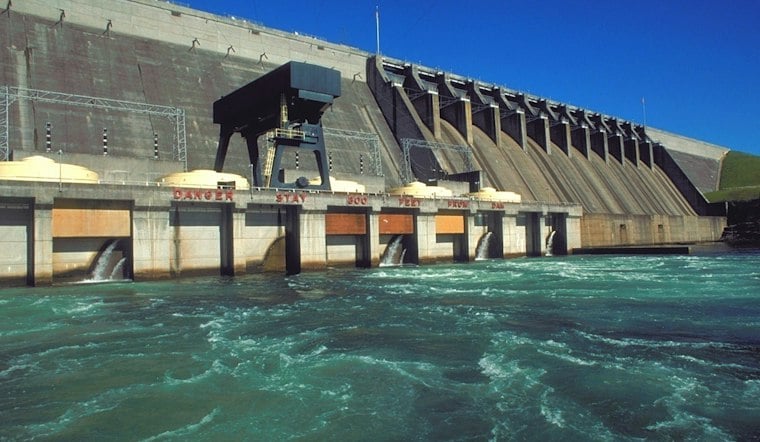
Lake Hartwell sits at roughly 649 feet right now, nearly 11 feet below its typical summer pool of 660 feet, and officials say it could take as long as 10 years before the reservoir returns to normal. The reason is a crumbling piece of infrastructure called the Clemson Saddle Dike, where engineers have confirmed active erosion eating away at the structure's foundation.
The update came Thursday at the Lake Hartwell Association's annual meeting in Anderson County, South Carolina, where representatives from the U.S. Army Corps of Engineers addressed a crowd of concerned residents and lake-area property owners. As reported by WYFF4, the Corps reported serious concerns found along the lake's edge near Clemson, where the Saddle Dike has protected the campus from damaging floods during storms for decades.
Kate Dickson, addressing the crowd on behalf of the Corps, said seepage and voids have been discovered in the natural ground below the dike, according to WYFF4's report. Those leaks were first discovered in 2015, and left unaddressed, officials warned the erosion could eventually weaken the dike enough that it gives way. Dickson was careful to tell residents there is no immediate threat of failure, the station's report notes.
Why the Dike Was Never Fixed Before
The Saddle Dike is part of the broader Clemson Protective Works, a system built between 1955 and 1963 alongside two diversion dams that reroute the Seneca River and keep Lake Hartwell from flooding low-lying Clemson University land, according to The Post and Courier. The nearby Upper and Lower Clemson Diversion Dams got concrete slurry cutoff walls in the early 1980s after they began seeping almost immediately when Lake Hartwell filled in 1962, per the Army Corps of Engineers Savannah District. The Saddle Dike had few seepage issues, and the current issue was discovered in 2015.
This year's Issue Evaluation Study confirmed what engineers had suspected: an active internal erosion pathway, known as piping, running under the dike's foundation. Water moving through the soil has been slowly washing away fine sediment, and the finding was serious enough to reclassify the dike to a higher dam-safety risk level, per the Army Corps of Engineers Savannah District. During Hurricane Helene, a rapid six-foot rise in the lake forced water mixed with soil material out at the toe of the dike, confirming the erosion accelerates under pressure, the Corps has said.
If the Saddle Dike were to fail without warning, official Corps safety evaluations indicate roughly 1,700 acres of lower Clemson could flood 35 to 50 feet deep, knocking out the campus sewage treatment plant and forcing an extended university shutdown, with an emergency drawdown of the entire lake to follow. That scenario is the backdrop for the 656-foot operating cap the Corps put in place in August, a restriction meant to reduce hydrostatic pressure on the dike during heavy rainfall, as reported by FOX 5 Atlanta.
A Long Road Before Repairs Can Begin
At Thursday's meeting, one attendee, Chris Clement, asked what it would take to finish the repair in a single year with no limitations — a question that underscored residents' frustration with a process that officials themselves have called slow. Dickson said the engineering work simply takes time, and funding has to come through before it can move forward, per WYFF4. The Army Corps of Engineers will start a formal Dam Safety Modification Study once that funding is secured, and neither the Corps nor the Lake Hartwell Association could say what the project's total cost will ultimately be.
Corps leaders described the nearly decade-long timeline as the best and safest way to protect people, even as they acknowledged it is unfortunate. Officials encouraged residents worried about the pace of repairs to reach out to their congressional and state leaders directly, WYFF4 reported.
In the meantime, the Corps plans to keep the lake at its lowered level to gather more information before developing a full repair plan. Drought conditions already had Lake Hartwell running low this year independent of the dike restriction, according to 92.1 WLHR, meaning the 656-foot cap mostly limits how high the water can climb once rain returns rather than actively draining the reservoir further.
Ripple Effects Across the Region
Lake Hartwell is no small body of water — a 56,000-acre reservoir stretching across the South Carolina-Georgia border with 962 miles of shoreline. The lower water level could affect local businesses and lake-access property values.
Lower water levels also leave more of the shoreline exposed. For now, residents and officials alike are left waiting on federal funding to even begin the formal study that would set the repair in motion.




