

























































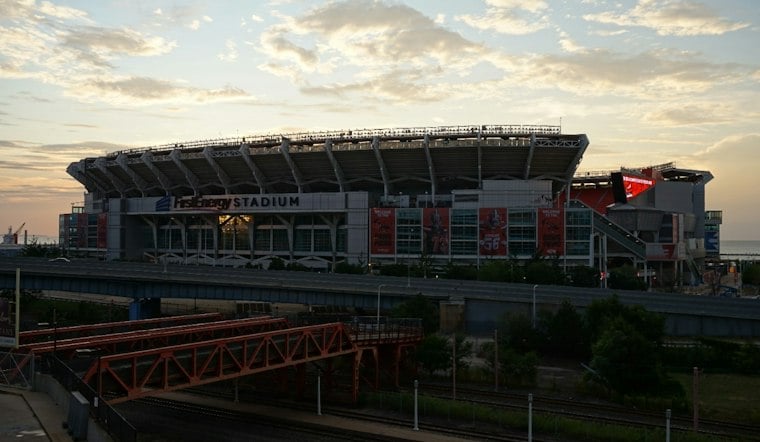
Cleveland officials on Monday unveiled a draft framework for transforming the 50-acre lakefront site now occupied by Huntington Bank Field into a brand-new neighborhood, once the Browns depart for a planned stadium in Brook Park. The conceptual plan sketches out roughly two dozen city blocks of housing, offices, hotels, restaurants and public space where the football field currently sits, though it leaves the exact mix of uses to future market conditions.
The draft was released by the North Coast Waterfront Development Corporation, according to Ideastream Public Media, which described it as a new draft framework plan for the downtown lakefront unveiled the same day. The site in question is the one FOX 8 News describes as 50 acres of prime lakefront land that the Browns will vacate for their new home in Brook Park. Per Ideastream, the framework envisions the site accommodating about two dozen blocks filled with apartments, offices, hotels and other uses, though no specific unit counts or square footage targets have been attached to those categories.
A Park Where the Field Used to Be
One of the plan's most visible gestures is symbolic: a roughly 1.3-acre pedestrian park would occupy the current footprint of the Browns' playing field, Ideastream reports. The broader redevelopment would feature a grid of streets lined by housing, offices and restaurants, according to cleveland.com, which also describes a proposed Lake Erie Plaza designed to accommodate markets, events and various gatherings year-round.
Public-space totals in the framework vary slightly depending on the source: Ideastream reports the plan identifies roughly 7.4 acres of public spaces, or nearly 15 percent of the development area, while cleveland.com describes the framework as identifying about 7.5 acres of public and green space. Either figure would mark a significant share of the overall footprint set aside for parks and gathering spots rather than buildings.
Connecting Downtown to the Shoreline
A proposed lakefront connector pedestrian bridge would link downtown with the 50-acre site, crossing rail lines and the Ohio 2 Shoreway, per the same Ideastream analysis. Separately, News 5 Cleveland reports that the North Coast project team is recommending a modified land bridge span connecting Mall C to the area in front of the Great Lakes Science Center, rather than extending all the way to the Rock Hall. The same station notes that the current city-owned stadium is set for demolition once the Browns leave.
Roughly $300 million could be available to build that kind of key infrastructure, according to Ideastream's reporting. The framework's authors are not pinning down exactly how those dollars get divided among the bridge, a reconfigured Shoreway and other elements, and News 5 Cleveland notes the broader proposal does not spell out how much retail, office space or housing there should eventually be, leaving those decisions to market conditions as the project unfolds.
Money Already Moving, Years of Work Ahead
DiGeronimo Development of Brecksville was chosen as the project's master developer back in December 2025, cleveland.com reported at the time. The Browns' relocation agreement includes $45 million from the team earmarked for the lakefront, with the first $25 million installment arriving on Dec. 9, 2025, according to the same cleveland.com report. A city release separately stated that the Haslam Sports Group's $100 million contribution would bring total lakefront redevelopment funding to more than a quarter-billion dollars under what Cleveland officials call the Cleveland ERA Plan, per the City of Cleveland.
None of that money guarantees a fast timeline. The North Coast Waterfront Development Corporation expects the overall lakefront buildout to take two decades or longer, Ideastream reports in a separate piece, and cleveland.com similarly describes the framework as intended to guide streets, public spaces and infrastructure over the next 10 to 20 years while leaving individual building designs for later phases. Construction on parts of the plan could start as soon as late 2027, according to Ideastream, with News 5 Cleveland reporting that the city specifically aims to begin building the land bridge and a reconfigured Cleveland Memorial Shoreway that same year.
Scale of What's Possible
To put the potential density in perspective, Ideastream calculated that if the district were built at five stories per block with 20,000 square feet per floor, it could eventually contain about 2.4 million square feet of enclosed space — roughly as much as two Key Towers combined. That figure is illustrative rather than a commitment, since the framework intentionally avoids locking in building heights or uses this early in the process.
The draft framework still has several hurdles ahead before anything resembling that vision breaks ground. The Cleveland Planning Commission will be briefed on the framework on Nov. 6, according to cleveland.com, with formal city approval expected to be sought early next year. Cleveland City Council had already approved the terms and conditions in a settlement term sheet tied to the Browns' relocation to Brook Park, according to the Cleveland City Council, setting the stage for the lakefront negotiations now playing out on paper.




