

























































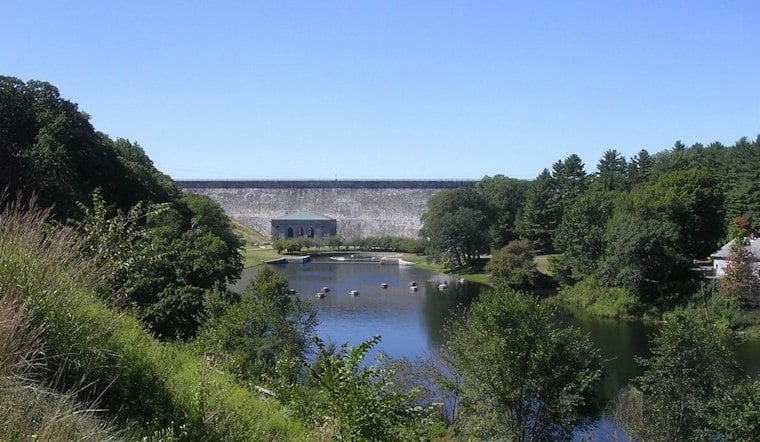
Most days, the Wachusett Dam in Clinton sits behind locked gates, closed off to anyone without official business guarding one of the largest unfiltered drinking water supplies in the country. This Sunday, for a few hours, that changes. The Massachusetts Department of Conservation and Recreation is opening the dam to walkers for Dam Day, one of only two times each year the public can set foot on the century-old structure.
Dam Day runs from 10 a.m. to 1 p.m. on October 11, giving visitors a window to walk across the dam, snap photos, and take in the view, according to CBS Boston. The dam only opens to the public twice annually — once over Mother's Day weekend in the spring, and again over the Columbus Day/Indigenous Peoples' Day weekend in the fall, per the same report. For the rest of the year, it stays closed because of water supply security and public safety concerns tied to the reservoir behind it.
Ahead of the official opening, DCR watershed staff are also hosting a guided morning hike along the North Dike leading up to the dam, running from 9 a.m. to 10 a.m., according to the Massachusetts Department of Conservation and Recreation. The walk gives early arrivals some historical context before the dam itself opens for crossing at 10 a.m. Parking for Dam Day is set up about a mile away at Clinton High School, and visitors are asked not to bring pets or bags, per the station's report.
A Structure Twice As Big As It Looks
What visitors see from the road is only half the story — literally. The dam measures 1,423 feet including its abutments and stands just over 200 feet tall, but it also extends 112 feet below ground, meaning roughly half of the structure is hidden beneath what's visible to the eye, the station notes. Excavation on the dam began in 1900 and construction wrapped up in 1906, making it a fixture of the landscape for well over a century.
The dam itself is described as the world's largest hand-laid dam, a distinction tied to the sheer scale of manual stonework involved in its construction. The reservoir it holds back stretches across 37 miles of shoreline and contains 65 billion gallons of water, supplying roughly 40% of Massachusetts residents, per the same account. Katherine Parent told CBS Boston that Dam Day will be great, a sentiment echoed by locals who treat the twice-yearly opening as something of a local tradition.
Water for More Than 3 Million People
The reservoir behind the dam delivers drinking water to more than 3 million people spread across 53 eastern Massachusetts communities, fed by a subterranean, gravitational aqueduct that moves water without the need for pumps. That scale of responsibility explains why access is so tightly controlled the rest of the year. The Wachusett-fed water system is one of the few public surface water supplies in the country operating without full filtration under federal exemptions, according to Mass.gov, which is why strict watershed protection rules govern nearly everything that happens near the water.
For Dam Day, visitors are asked not to bring pets or bags.
Built on Displaced Towns and Immigrant Labor
The reservoir's creation came at enormous human cost to the valley communities that once stood where the water now sits. Building it required clearing more than 4,000 acres of land, demolishing roughly 500 buildings, and reinterring 4,000 graves, according to the Freedom's Way National Heritage Area. Crews removed 6.9 million cubic tons of soil to make way for the project.
The main construction contract went to the Chicago-based McArthur Brothers in fall 1900, and the firm's labor force relied heavily on Italian and Irish immigrants along with Black Americans to carry out dangerous underground drilling and blasting work, per the Freedom's Way account. Many descendants of those Italian immigrant laborers stayed in the Clinton area after the dam was finished, leaving a lasting demographic imprint on the town that persists today.
One visible reminder of the flooded valley still stands at the reservoir's edge. The Old Stone Church in West Boylston, built in 1891 and closed in 1902 as the reservoir filled, was listed on the National Register of Historic Places in 1973, according to MassLive. The church remains a monument to the submerged communities that once filled the valley, visible year-round even when the dam itself is locked.
A Reservoir With a World Record
When the reservoir was filled in May 1908, it became the largest hand-made public water supply reservoir in the world, according to the Amherst Historical Society. Wachusett remains the second-largest body of water in Massachusetts today. The Wachusett Dam Historic District was added to the National Register of Historic Places in January 1990, recognizing the architectural work of Shepley, Rutan and Coolidge alongside landscape design tied to the Olmsted Brothers, per Wikipedia.
In recent years, the Massachusetts Water Resources Authority completed a rehabilitation of the dam's historic bastion, adding ADA-compliant railings while preserving the original granite masonry, according to engineering firm Kleinfelder. The dam hosts two public events each year. For those curious about the dam's construction history, Mass.gov describes a historical photograph collection spanning 1876 to 1930.



