

























































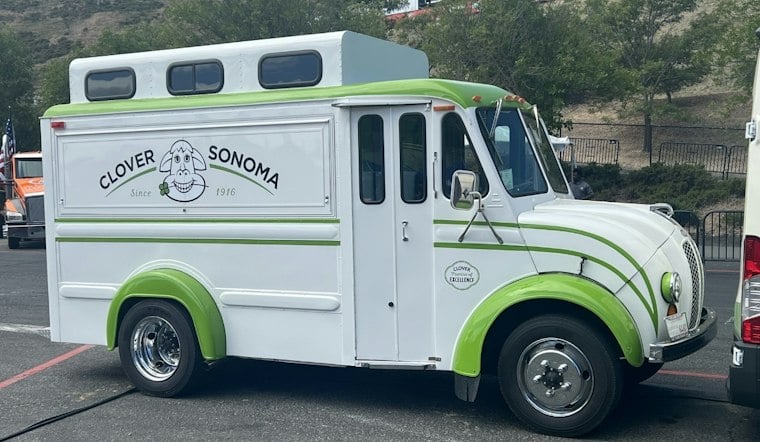
Clover Sonoma is putting $30 million into its Petaluma operations over the next two years, a bet on the North Bay's shrinking dairy sector just as the century-old creamery explores growth in Greek yogurt and expands into super premium ice cream. The plan includes facility-wide upgrades, an expanded refrigerated warehouse, and a push for new land near Petaluma to build a culture and innovation facility focused on cultured dairy products. Clover has also added 21 jobs in milk plant production and warehouse work as part of the buildout.
The investment, first reported by The Press Democrat, lands at a precarious moment for North Bay dairy farming. Sonoma and Marin county farmers produced about 32 million gallons of milk in 2025, according to the outlet — a 62% decline from the 86 million gallons produced in 2020. Still, 87% of that 2025 production was organic. The Crop Report showed organic milk values climbed even as overall volume fell.
Petaluma Mayor Kevin McDonnell called the investment plan a statement of confidence in Petaluma and south county agriculture, according to the same report, adding that the Petaluma City Council prioritizes economic development. For Jennifer Beretta, whose family dairy is located in Santa Rosa and has worked with Clover Sonoma since 2010, the expansion gives her and other producers confidence heading into an uncertain stretch for the industry.
A Shrinking Herd, a Growing Organic Niche
Clover opened its current Petaluma milk processing facilities in 1991 and has operated in the region for more than 100 years. As of 2018, 47 of Sonoma County's 56 licensed dairies were certified organic, and the county's dairy landscape has only tilted further in that direction: Smith told the Press Democrat in July that Sonoma County now has 47 cow milk dairies, more than 80% of them organic.
The numbers behind that shift tell a mixed story. Sonoma County's total milk production value rose 17% in 2025 to $71 million, up from $61 million in 2024, driven largely by a 24% jump in organic milk value, per the Press Democrat's reporting. Conventional milk value moved the opposite direction, falling from $8.3 million in 2024 to $5.9 million in 2025. North Bay dairies have a long history of transitioning to organic production, while Clover seeks conventional milk elsewhere.
Coletta's Diversification Push
Clover Sonoma CEO John Coletta, who took over the role in 2024 after more than 30 years in consumer packaged goods and food and beverage leadership — including senior posts at Peet's Coffee and Quiznos — wants a larger share of Clover's sales to come from products beyond milk, including Greek yogurt. Milk still accounts for about 80% of Clover's sales, and the company uses conventional milk for nearly half of its products, paying what Coletta described to the Press Democrat as above-market prices for that conventional supply.
Clover has started shipping to Southern California and gets less than 10% of its milk from outside California depending on the month, Coletta said, with just 1% of its sales coming from outside the state. That's a far cry from the nationwide expansion the company planned after Colombia-based Alpina Productos Alimenticios acquired a 70% stake in Clover in 2021 — ambitions that, per the Press Democrat, have not materialized. Coletta said the new Petaluma investment signals Clover's full commitment to hyperlocal agriculture instead.
Animal Welfare Criticism Persists
Clover's sustainability credentials run deep on paper. The company became the first U.S. dairy processor to earn American Humane Certified status for its animal welfare program in 2000, according to Down to Earth Hawaii, and it marked 10 years as a certified B Corporation in 2026 after first achieving that status in 2016 with a score of 92.5 points, per B Lab. In April 2024, Clover joined the Environmental Defense Fund's Dairy Methane Action Alliance, pledging to publicly report methane emissions and cut methane intensity 30% by 2035 from a 2023 baseline, according to the Environmental Defense Fund.
Yet the company continues to face pushback from animal rights advocates. Factory Farm Watch claims Clover sources milk from multiple large feedlot-style dairy operations in the San Joaquin Valley, and specifically alleges that supplier Mertens Dairy confines cows on a barren dirt lot without pasture access. In a 2024 op-ed, Samantha Faye wrote that three of the 27 dairies supplying Clover that year would qualify as CAFOs.
Coletta pushed back on that framing in his comments to the Press Democrat, saying sustainable land maintenance matters more to Clover than the sheer number of animals on a property. Clover maintains California's largest organic acreage of regeneratively farmed dairy land. He said Clover evaluates its dairies through an annual third-party audit of certified animal care and maintains a dairy team that independently observes supplier operations. Clover partners with local dairies seeking to improve soil health, while UC Cooperative Extension offers soil resources.
Context From Measure J's Defeat
The debate over large dairy operations isn't new to Sonoma County. In November 2024, county voters overwhelmingly rejected Measure J, a ballot initiative that sought to prohibit and phase out large Concentrated Animal Feeding Operations, with 85% voting against it, according to AGPROfessionals. That lopsided result followed a campaign that generated sharp debate between animal rights organizations and local agricultural groups, and it frames the backdrop against which Coletta's commitment to hyperlocal sourcing is now being weighed.
The investment also arrives amid broader strain on Sonoma County's agricultural economy. The county's total gross agricultural production value fell 9.5% in 2025 to $758.5 million, down from $837.9 million the year before, per the County of Sonoma Department of Agriculture. Even so, a separate 2026 county economic report found that local agriculture generated $5.8 billion in total economic activity in 2024 once processing, direct employment, and multiplier effects were factored in — a reminder of how much weight plants like Clover's carry beyond raw farm output.
Clover isn't alone among Petaluma's dairy processors navigating turbulence this year. Petaluma-based organic competitor Straus Family Creamery voluntarily recalled select organic ice cream products across 17 states in May over potential metal fragment contamination, as Hoodline reported at the time. Clover, meanwhile, announced its own expansion into super premium ice cream and California cheese lines at Natural Products Expo West in March, part of Coletta's broader strategy to lean less on fluid milk sales that have historically made up the bulk of the company's revenue.





