

























































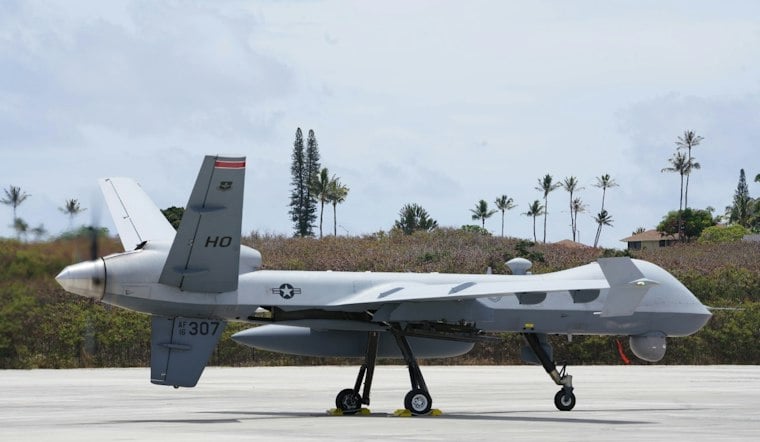
The U.S. Coast Guard has placed its first-ever order for long-range unmanned aircraft, agreeing to pay $247.8 million for four MQ-9B SeaGuardian drones from General Atomics that can stay airborne for more than 30 hours and patrol roughly 1,200 nautical miles from shore. The order, finalized on September 25, also includes ground control stations and supporting equipment, and was announced by the service on October 9.
According to The SOFX Report, the Coast Guard placed the order through an existing Customs and Border Protection contract with General Atomics, piggybacking on a sole-source agreement CBP has used since the mid-2000s to operate its own fleet of MQ-9 aircraft out of a joint program office in Texas. CBP expanded that same contract with a $265.5 million modification in March, the outlet reports. A service spokesperson confirmed the SeaGuardian will remain unarmed, and General Atomics describes the aircraft as providing real-time situational awareness throughout the maritime domain.
That unarmed status is not just a design choice — it is required by law. Congressional budget language tied to the Coast Guard's funding explicitly bars the Department of Homeland Security from equipping its new MQ-9B fleet with offensive missiles or armaments, according to Envanter Medya.
Built to Fly Alongside Commercial Traffic
Unlike earlier generations of military drones that needed segregated airspace, the MQ-9B family was engineered to comply with NATO STANAG 4671 airworthiness standards and Federal Aviation Administration civil airspace rules, using onboard detect-and-avoid collision radar to operate near civilian air traffic, per Defense Advancement. The same detect-and-avoid radar capability is what allows the aircraft to fly in civil airspace, the SOFX report notes.
That endurance edge is the whole point of the purchase. A Coast Guard HC-130 can stay up for about 14 hours and a Navy P-8 for roughly 10, but the MQ-9B's 30-plus-hour flight time lets crews rotate on the ground while the aircraft keeps watching, Cmdr. Andrew Denning said in September 2025, according to the SOFX report. The Coast Guard has not announced a delivery schedule or an in-service date for the four aircraft.
Part of a Bigger Spending Wave
The purchase is funded through the fiscal 2025 budget reconciliation package and fiscal 2026 appropriations, with the reconciliation bill alone directing nearly $25 billion to the Coast Guard. Using reconciliation money, the Coast Guard has ordered approximately $16.3 billion in new assets and capabilities, including six baseline C-130J Super Hercules aircraft in an order placed September 24 worth up to $735 million, according to Aviation Shop.
Anthony Antognoli, who leads the service's drone and robotics acquisitions, said the investment will give Coast Guard crews longer-range maritime awareness and help them detect threats earlier, make better-informed decisions, and act faster, per the SOFX report. Antognoli serves as Program Executive Officer for Robotics and Autonomous Systems and oversees the service's autonomous technology acquisitions under its Force Design 2028 initiative, according to reporting from HS Today. The Robotics and Autonomous Systems Program Executive Office was stood up in August 2025, the same month the Coast Guard winged its first drone pilot.
Drones Already Paying Off at Sea
CBP's existing MQ-9A aircraft — flown alongside Joint Interagency Task Force South — have already demonstrated what long-range drones can do for interdiction. In fiscal 2026, those aircraft contributed to drug seizures valued at $306 million and the seizure of about 60,700 pounds of illegal drugs, while helping lead to the apprehension of around 20 people, according to the SOFX report. In one case from November 2023, crews at the Texas program office used a CBP drone to locate a disabled vessel with four people aboard off Corpus Christi after helicopters and boats had already searched for it without success.
The Coast Guard is pursuing a similar payoff with smaller, shipboard drones. It awarded Shield AI a $198 million contract for V-BAT intelligence, surveillance and reconnaissance services, following operational testing completed in July 2025, according to Shield AI.
A Two-Decade Effort Finally Lands
This moment has been decades in the making. The Coast Guard's MQ-9B purchase follows roughly two decades of experience alongside CBP's drone operations, though an earlier attempt at shipboard vertical-takeoff drones was canceled in 2007 due to cost growth and technical challenges, according to sUAS News and the Coast Guard Aviation Association. The MQ-9B order brings the land-based, long-endurance capability to the service.
Allied maritime forces have already blazed this trail. The Japan Coast Guard agreed to acquire two MQ-9B SeaGuardians in August 2024, Breaking Defense reported. The UK Royal Air Force is expected to be the first to operate the MQ-9B Protector, according to European Security & Defence. The Indian Navy has two MQ-9B SeaGuardians on lease and 15 more on order, per Naval Technology.





