

























































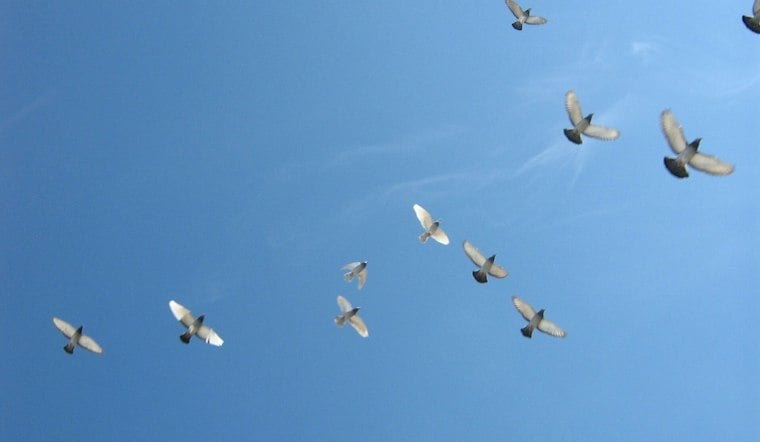
A cold front rolling through Washington, D.C. on Friday could do more than drop temperatures — forecasters say it may launch nearly 480 million birds into flight across the country overnight, with the D.C. region sitting squarely in the path of a potential wave of migrating songbirds, geese, and ducks.
BirdCast, the migration-tracking project out of the Cornell Lab of Ornithology, predicts that Friday night's movement could be the biggest flight of the year, according to WJLA. The station reports that Friday's weather may bring storms and a sharp cooldown to the D.C. area, and that winds are expected to turn north once the front clears — a shift that often sends large numbers of birds moving south in a single night.
Adrian Dokter, a research associate at the Cornell Lab of Ornithology and lead for the BirdCast project, told WJLA that north winds could trigger a major bird flight: “These northerly winds, that’s what these birds have been waiting for,” he said, adding, “then you get a big push.” Fall migration is currently at its peak, with robins at peak migration around D.C. and sparrows and some warblers already moving through the region, per the same report. Geese and ducks are also expected to pass through the D.C. area, though migration timing varies by species.
How Radar Tracks a Flight No One Can See
Weather radar can detect birds the same way it detects storms, but it does not show individual birds or identify which species are aloft. Researchers instead use the radar signals to estimate how much bird activity is in the air along with flight altitude and speed, a method that has let scientists monitor migration patterns across the entire country, the station notes.
That same radar record has turned up a worrying trend: researchers, including Dokter, have found roughly a 2% decline in the number of birds detected in the air, even as they've seen little evidence of major route changes among songbirds — migration routes can still shift somewhat depending on the weather. The decline tracks with a much larger pattern documented by the Cornell Lab of Ornithology and partner institutions, whose research published in the journal Science found that North American bird populations dropped by 2.9 billion breeding adults — a 29% total loss — between 1970 and 2019, with more than 90% of losses coming from 12 avian families, including sparrows and warblers.
Friday's surge would follow a record-setting night just over a year ago: on September 25, 2025, BirdCast recorded the largest single-night migration in its history, tracking more than 1.2 billion birds migrating across the continental United States that night, according to the Cornell Lab of Ornithology. That flight surpassed the previous billion-bird record set in October 2023.
Why Nighttime Lights Are So Dangerous for Migrants
More than 80% of North American migratory bird species travel at night, typically launching into flight 30 to 45 minutes after sunset and reaching peak density two to three hours later, according to BirdCast data cited by Sparkbird. Flying at night lets birds dodge daytime predators and ride cooler, calmer air — but it also puts them on a collision course with brightly lit cities. In the eastern United States, fall migratory flights tend to cruise at lower altitudes than western flights, averaging between 1,300 and 1,600 feet above ground, a pattern linked largely to prevailing winds and tailwind layers.
That low-altitude traffic is exactly what makes nighttime lighting in a city like Washington so hazardous. Artificial light pollution draws disoriented, low-flying birds into the built environment, where reflective glass becomes a deadly hazard, according to City Wildlife. Building collisions are estimated to kill between 365 million and 988 million birds annually, with residences responsible for roughly 44% of strikes.
The danger isn't limited to physical impact, either. A study led by North Carolina State University researchers, drawing on 20 years of Smithsonian Migratory Bird Center data from the Washington, D.C. area, found that higher levels of nighttime artificial light were linked to lower survival rates for local gray catbirds and house wrens, as the light disrupts sleep and natural foraging behavior.
D.C.'s Response: New Rules for New Buildings, Grants for Old Ones
Washington has already moved to address the hazard through its own building codes. Under the District's Migratory Local Wildlife Protection Act of 2022, building permit applications filed on or after January 1, 2025 for new construction or major exterior alterations must use bird-friendly materials up to 100 feet above grade, according to the District of Columbia Department of Energy and Environment. The requirement covers commercial, institutional, multi-unit residential, and D.C.-owned buildings.
Retrofitting older buildings remains voluntary, however. The department announced a $150,000 Bird Friendly Buildings Grant program in February to fund education and financial subsidies for voluntary window retrofits on existing structures not covered by the 2025 construction mandate. City Wildlife's Lights Out DC program sends volunteers on predawn walks through downtown routes during spring and fall migration to collect bird specimens.
What Residents Can Do Friday Night
WJLA reports there are simple steps people can take at home to help migrating birds survive the push south. Providing cover, water, and native plants with berries gives birds a place to rest and refuel, while keeping cats away from feeding areas reduces predation risk. Making windows more visible with decals or other treatments can cut down on collisions, and turning off unnecessary lights at night reduces the pull that bright city skies exert on disoriented flocks.
Residents curious about what's passing overhead can also report sightings through Birde. And on a night with hundreds of millions of birds aloft, WJLA notes that stepping outside after dark might be enough to catch the faint chirps of migration happening overhead, even if the birds themselves are too high and too many to see.





