

























































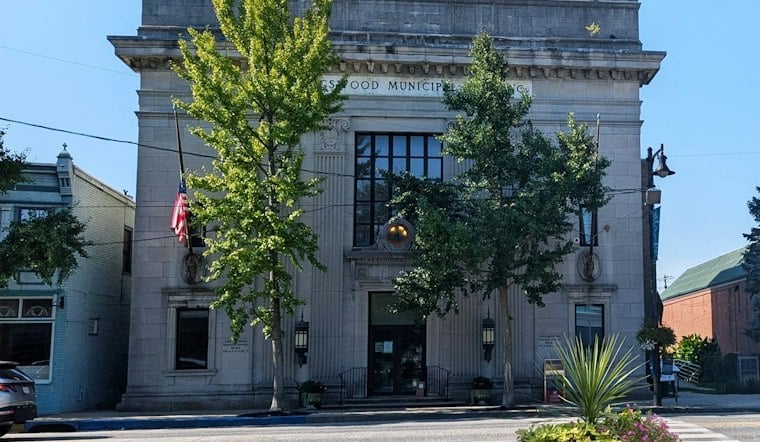
Collingswood's deputy mayor says she voted to send tens of thousands of dollars to the nonprofit that runs the borough's historic Scottish Rite Auditorium without being told the money could never be paid back. Amy Henderson Riley says she cannot account for where that taxpayer money has gone, even as the theater's operator still owes the borough nearly $5 million stemming from a 2003 loan.
According to NJ.com, Collingswood has sent the Collingswood Foundation for the Arts more than $100,000 in payments described as loans since Henderson Riley took office in 2025. She says she was later told those payments were not loans at all and would not be repaid, and that she has requested the foundation's financial records without receiving them. Henderson Riley, who has acted in and directed shows at the theater herself, says she simply cannot trace where the money went.
The debt traces back to 2003, when Collingswood borough commissioners approved borrowing $5 million in bonds to lend to the foundation for renovations at the Scottish Rite Auditorium, a theater built in 1931, as reported by the Philadelphia Inquirer. Taxpayers finished paying off those bonds in 2016. Jim Maley, now the foundation's president and a sitting borough commissioner, and Louis Cappelli Jr. signed the original loan agreement, and Maley told the Retrospect at the time that event revenue would maintain the property and repay the debt.
Conflicting Accounts of What the Loan Actually Was
Accounts of what that 2003 deal actually required diverge sharply. Maley has since said the $5 million bond was labeled as a loan but carried no expectation that the borough would ever be repaid, telling the Retrospect, “It absolutely was labeled as a loan with no expectation that we would be repaid,” according to the Retrospect. Maley also said no specific loan terms were ever set for the renovation money and that the borough's investment in the theater was made in public view with wide support, characterizing it as an investment to create a community amenity rather than a straightforward debt.
Mayor Daniela Solano-Ward has offered a different explanation, saying borough officials could not locate any documentation establishing a repayment schedule. “There was no paper evidence that the $5 million bond was a loan,” she told the Retrospect in a separate report. The 2003 ordinance itself specified that loan terms would be set in a separate agreement, but the borough solicitor said that agreement had not been located, the Retrospect reported. Solano-Ward has said borough auditors told her Collingswood had clean audits for nine years with no concerns raised about the 2003 bond, and that more information would be available by the next meeting.
Despite the uncertainty over the original terms, borough audits from 2011 through 2016 listed $4,992,466.33 owed by the foundation and stated that no payment plan had been established. The foundation reported that same debt on its federal tax return in 2019.
A System That Worked Until It Didn't
Separate from the renovation debt, the borough routinely lent the foundation operating money that was generally repaid by year's end using revenue from weddings and other events, Maley has said. That system supported itself for 22 years, according to the Retrospect, but the COVID-19 pandemic reduced bookings and event revenue and left the foundation with no way to repay the borough, as officials described to the Inquirer. Theater operations never generated enough revenue to repay the renovation money, per Maley's account.
The pandemic-era shortfalls hit the borough's budget directly. Collingswood paid $250,000 in 2020 and $55,000 in 2021 to cover theater deficits, the Inquirer reported, and in 2025 the borough paid the theater $200,000 just to keep it operating, along with another $100,000 to help it apply for a state renovation grant. The borough has also sought a state CAFE grant that could provide up to $5 million for renovations, though no award has been made, according to the Retrospect.
Tax-Exempt Status Lost, Then a Scramble to Fix It
Compounding the financial questions, the foundation's federal tax-exempt status was revoked by the IRS in 2024 after the nonprofit failed to file its required annual reports since 2020, the Inquirer reported. The foundation's last return on file covers 2020. A foundation representative has blamed an outside accountant for the missed filings, and both Maley and Solano-Ward have said returns for 2021 through 2025 have since been prepared and are awaiting action on the group's tax-exempt status. Solano-Ward has noted that draft filings not yet accepted by the state are not normally posted publicly. Separately, nonprofit tracker ProPublica notes the organization is not listed in the IRS's most recent list of tax-exempt organizations, though ProPublica still maintains data tied to its employer identification number.
Camden County Weighs Taking Over the Theater
Camden County is now considering taking over the Scottish Rite Auditorium altogether, and county officials say they could decide by the end of 2026. Louis Cappelli, director of the Camden County Board of Commissioners and one of the foundation's three original trustees back in 1999, has said a county takeover would likely dissolve the foundation. State filings listed Cappelli as the foundation's vice president every year until an October 2025 filing removed his name. Cappelli has said no draft agreement currently exists and that the future of the theater's operator and its employees remains uncertain, a point echoed in a separate Inquirer report on the ongoing talks between the county and borough.
The county is currently inspecting the building and reviewing its finances, but officials say a draft agreement does not yet exist and the county still has to complete a financial evaluation before deciding whether it will fund or take responsibility for the theater, according to a report from the Inquirer. Officials have not publicly stated what would happen to the nearly $5 million owed if the foundation is ultimately dissolved.
Who Owns What, and Who Pays for Repairs
The building itself is owned by the Scottish Rite Freemasons, who lease it to the borough for just $1 a year under an arrangement that runs through 2092. Under that lease, Collingswood is responsible for repairs including the roof and structure, while the borough in turn contracts with the private nonprofit foundation to operate the theater and ballroom day to day. Solano-Ward has said the borough may be able to transfer the lease to Camden County without needing the landlord's approval, and that talks between the county and borough include setting aside dates each month for community use, with Solano-Ward noting that users otherwise pay full price when they book the building. She has also said Camden County has already invested in the property, including air-conditioning upgrades, and the theater has continued hosting school and community events in its renovated space.
Public concern over the arrangement surfaced at a recent meeting, where a Cherry Hill resident asked whether county taxpayers would end up absorbing costs after contrasting $100 tickets at the venue with reports of free use by some groups. Kate Delany, a Collingswood resident of nearly 20 years and president of the South Jersey Progressive Democrats, warned that a county takeover would shift the cost of what she characterized as a mismanaged theater onto taxpayers across the whole county. Delany also said residents may never learn what happened to the money if the theater moves further from public view.
The debate over the Scottish Rite's finances comes as Collingswood voters prepare to weigh in on an unrelated ballot question on Nov. 3, asking whether the borough should allow liquor licenses.



