

























































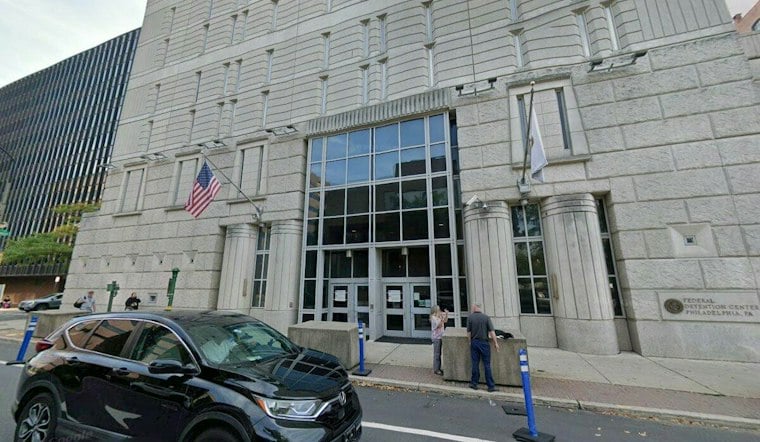
A Turnersville man with two prior federal convictions for mail fraud is facing new charges after authorities say he tried to pull off an audacious scheme to claim $12 million in unclaimed hedge fund money from a Texas state account, while simultaneously reviving an old scam mailing fake invoices to schools. Robert Armstrong, 56, was charged with bank fraud and mail fraud and remains in federal detention in Philadelphia awaiting court appearances.
A $12 Million Target and a Declined Check
According to federal authorities and court documents, Armstrong tried to defraud companies and organizations into sending him money, with his biggest target being $12 million tied to a 2003 hedge fund investment held by a Texas-connected bank. As reported by NJ.com, the hedge fund investment payments began being returned in 2012, and the bank that paid those investors held the returned payments before sending $9,251,641.71 to the State of Texas after three years under the process known as escheatment — the transfer of unclaimed money to the state.
Armstrong allegedly filed a claim with Texas for the funds using the names of the original investment bank's president and CFO, prompting the state to request more information. He is accused of uploading documents including his own New Jersey driver's license, a Yahoo email address, and a copy of a declined $2,806,524 check — and postal detectives reportedly traced those uploads to an IP address used by Armstrong. Texas ultimately denied his claim, though he allegedly called the Texas Comptroller of Public Accounts Unclaimed Property Division repeatedly, inquiring about it as recently as September 1.
Allegations of Impersonation and a Fictitious Company
Separately, according to New Jersey Globe, Armstrong allegedly impersonated an authorized representative of a financial institution in a bid to obtain $2.8 million in unclaimed investment proceeds held by a bank, and allegedly created a fictitious company while impersonating a former financial institution executive to support his claims. The outlet reports the bank issued a $2,806,524 check, which Armstrong deposited into an account he controlled.
NJ.com's account adds further detail: Armstrong mailed paperwork to the bank's Pittsburgh office, set up a New Jersey company and business bank account with a name similar to the bank holding the funds, used the company name Asset Recovery, and relied on a postal box at the Blackwood post office. He also allegedly set up an address in Dallas in January 2024 using physicaladdress.com, a service that provides mail forwarding to another address selected by a customer, along with addresses in Laguna Beach, California. He allegedly claimed he was authorized to recover the funds before a three-year threshold. The cashier's check itself was deposited at a bank branch in Sewell on November 19, 2025, with federal postal inspectors later obtaining security camera footage of the transaction — though the bank ultimately declined the deposit because it could not verify the funds.
Fake Book Invoices Return, Echoing a 2014 Scheme
Alongside the Texas and bank allegations, Armstrong is accused of mailing more than 36,000 fraudulent invoices to schools in the United States and Canada in a 2026 effort, separate from his earlier school scam involving more than 73,000 invoices, paying for bulk invoice mailings five separate times between February and August of this year. Each check sent by a victim school was written for $263, and schools invoiced under the name Scholastic School Supply, LLC were billed $647.50 for workbooks. At the time he was charged, at least 43 schools had paid the invoices, resulting in $11,309 in losses, the New Jersey Globe reports.
Postal Inspector Michael Marro Jr., who also investigated Armstrong's 2014 scheme, described the new invoices as nearly identical to the ones previously recovered during that prior investigation, per NJ.com's reporting. Marro reportedly spoke with school officials in Oyster Bay, New York; St. Paul, Minnesota; and San Francisco, California as part of the probe, and found that Armstrong had allegedly returned to the fake book invoice tactic years after his first conviction.
A Long History of Fraud Convictions
This is not Armstrong's first brush with federal fraud charges — Marro charged Armstrong on October 30, and agents arrested him on November 4. Armstrong has served two prior prison terms for financial mail crimes, the outlet notes.
In the earlier school-invoice case, Armstrong pleaded guilty to mail fraud involving $612,774 taken from schools nationwide, according to CBS News. That scheme saw Armstrong mail more than 70,000 fraudulent invoices to 938 schools beginning in July 2014, with hundreds of school administrators in at least 36 states writing checks and mailing them to his drop boxes in Las Vegas and Sewell. More than 900 schools fell for that earlier invoice scam, and Armstrong took a plea deal agreeing to serve 44 months in prison and spent nearly five years imprisoned beginning in late 2015. He received a sentence of more than five years in 2020 for his medical-supplies scam.
Despite that record, Armstrong worked as a behavioral technician in mid-2023 and, while on federal supervised release, is accused of creating a medical supplies scam using the company name Pinnacle Medical Supply. Under that scheme, he allegedly sent more than 10,000 fraudulent invoices to hospitals and medical offices, with more than 943 medical providers responding and sending him $214,495. He is also accused of creating fake documents, including a power of attorney, to support his various schemes. Armstrong's lawyer did not immediately return a request for comment, per NJ.com.





