

























































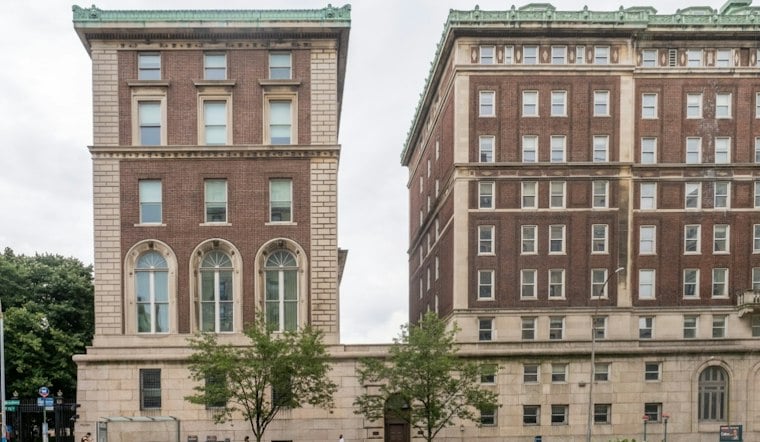
Columbia University's journalism school has paused admissions to its Master of Arts program for a full year, and four sources say Trump administration visa policies played a role in the decision even though the school's public explanation focuses on curriculum reform. International students make up roughly half of the M.A. program's enrollment, and four people familiar with the matter said international applications had fallen sharply ahead of the pause.
A Dean's Explanation, and a Deeper Story
Columbia's journalism school announced it was pausing M.A. admissions to conduct what it called a critical evaluation of the program, according to Reuters. Dean Jelani Cobb said the pause would last one year while the school reworks a degree created in 2005, and he acknowledged that visa dynamics were part of the consideration. The connection between the admissions pause and U.S. visa policy was reported for the first time in that account, which cited four unnamed sources saying Trump administration visa policies contributed to the decision — though the exact size of the decline in international applications was not disclosed.
One case highlighted in the reporting involves Kaushik Raj, an Indian journalist who, per the Reuters account, was denied a U.S. student visa in 2025. His rejection letter said he had not shown sufficient ties to India to establish that he would return home after his studies. Raj was separately admitted to Columbia's M.S. program in data journalism, a distinct track the university is not pausing.
Federal Pressure Predates the Pause
The visa troubles didn't emerge in a vacuum. The Trump administration temporarily halted new student-visa appointments in 2025 before resuming them with expanded screening of applicants' online activity, saying the checks were needed to identify potential threats to national security. The U.S. Embassy and Consulates in Mexico confirmed that mandatory online presence reviews took effect for F-1, M-1, and J-1 applicants in June 2025, requiring five years of social media handles and public profile settings for consular vetting.
Columbia itself had been targeted by the federal government over the 2024 pro-Palestinian campus protests in New York City. The university agreed to pay over $200 million to settle federal investigations and regain most of its suspended federal funding, a figure that, per Columbia's own account of its federal resolution agreement, totaled $220 million — $200 million for civil rights investigations and $21 million for EEOC probes. Under that July 2025 settlement, the university explicitly committed to examining its business model and reducing its financial reliance on international student tuition, according to the Columbia Daily Spectator. International students accounted for roughly 39 percent of Columbia's total student body during the 2024-2025 academic year, the highest share among Ivy League schools, though foreign enrollment varies widely across Columbia's individual graduate programs.
A Legal Fight Still Playing Out
The regulatory landscape kept shifting into this year. A new federal rule in 2026 sought to limit how long foreign students and journalists could stay in the U.S. without extensions, capping F-1 visas at four years and foreign media visas at 240 days. A federal judge blocked the rule before it took effect, calling its national-security rationale exceptionally weak. U.S. District Judge F. Dennis Saylor IV's September 14 preliminary injunction, detailed by Forbes, preserved the decades-old duration-of-status framework for now, a ruling Hoodline covered in its own report on the Boston judge's visa delay. Even as that case proceeds, the Times of India reported that the State Department expanded mandatory public social-media profile reviews to foreign media representatives applying for I nonimmigrant visas starting October 1, 2026, timed to the start of the federal fiscal year.
Cost and Scale of the M.A. Program
The M.A. program itself is geared toward mid-career journalists seeking expertise in politics, business and science, combining seminars across those areas during the 2024-2025 academic year, and it is smaller than Columbia's M.S. program, which the university is not pausing. The nine-month course carries an estimated $120,000 in attendance costs before financial aid for the 2026-2027 academic year, according to Nieman Lab, compared with roughly $130,000 for the foundational M.S. program and about $180,000 for the M.S. in Data Journalism. Columbia says about 80 percent of its graduate journalism students receive financial assistance in the form of grants, loans and scholarships drawn from institutional, federal and private funds. In December 2025, the school expanded loan repayment assistance and committed nearly $10 million in scholarship funds under its CJS2030 Access Initiative, according to Columbia Journalism School.
Cobb said the journalism school wants a new fundraising strategy for the M.A. program and is considering a part-time version of the degree going forward. He also pointed to a separate initiative: a two-year, part-time online Master of Science in Journalism, launched this month, that could let Columbia enroll international students without requiring visas at all. Cobb said that online program was unrelated to the M.A. admissions pause.
An Industry Already Under Strain
The pause also lands amid broader turmoil in journalism employment. At least 3,434 journalism jobs were cut across the U.K. and U.S. in 2025, and both the BBC and CBS News announced layoffs in 2026. Columbia's journalism school saw international applications fall ahead of the pause. Columbia, which administers the Pulitzer Prize, has not disclosed the precise decline in international applications that preceded this year's pause — a detail that, per Reuters' reporting, remains undisclosed even as visa difficulties and immigration policy uncertainty are described as having deterred prospective students from abroad.
The episode follows other detentions involving Columbia students: an undergraduate was detained in 2026, while a graduate student was detained in a separate incident the prior year.





