

























































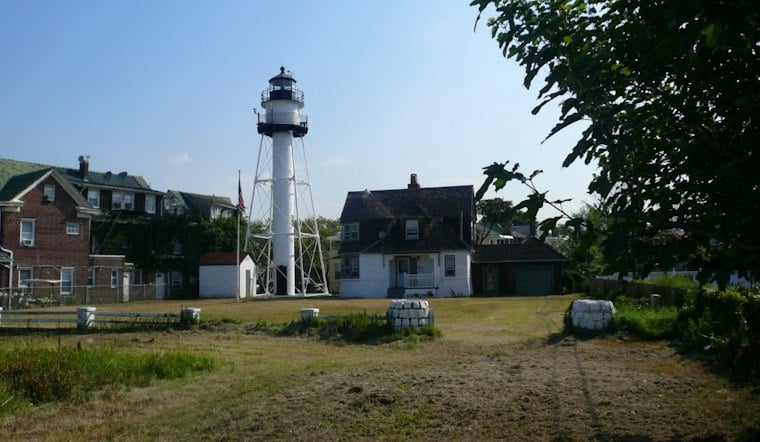
New York City's Landmarks Preservation Commission has voted to calendar Coney Island Light for consideration as an individual landmark, a step that could make the 1890 beacon in Sea Gate, Brooklyn the first landmarked lighthouse the borough has ever had. The 70-foot skeletal iron tower still flashes over Gravesend Bay today, guiding ships into one of the busiest ports in the country even as preservationists push to formally protect it.
A Borough Without a Landmarked Lighthouse
If the commission ultimately approves the designation, Coney Island Light would break new ground for Brooklyn, since New York City's six existing landmarked lighthouses are split only between Staten Island and Manhattan, according to 6sqft. Staten Island holds three of those designated lighthouses, and Manhattan has three more, including the Statue of Liberty, per the outlet's reporting. None of the existing landmarked lighthouses include a freestanding keeper's house, according to the LPC, which makes the Coney Island site's pairing of tower and cottage unusual among the city's protected maritime landmarks.
The lighthouse itself was designed by Major David Porter Heap of the U.S. Lighthouse Service and prefabricated in early 1890 by the Phoenix Iron Company in Trenton, New Jersey. Its central steel cylinder encloses an 87-step spiral staircase, according to documents filed with NYC.gov. The structure was built to guide boats and barges at a time of increasing ferry traffic, and 6sqft reports it was modeled after the former Throg's Neck Lighthouse.
A Cottage Modeled on Rhode Island Design
Also up for landmark designation is the adjacent two-story Queen Anne-style brick keeper's cottage, clad in wood shingles with a steeply pitched asymmetrical roof and a rounded corner bay. The same NYC.gov filing notes the cottage was modeled directly after the 1880s Gould Island Keeper's House in Rhode Island, giving the residential half of the property its own distinct architectural pedigree.
Getting the site built at all wasn't simple. Congress authorized $25,000 for the Coney Island lighthouse station in 1889, but when private landowners demanded twice the property's estimated value, federal authorities condemned the Norton's Point site and ultimately acquired it for $3,500, according to the Coast Guard Historian's Office. The original fourth-order Fresnel lens, lit by kerosene and floated in mercury to eliminate mechanical friction, produced a red flash every five seconds visible up to 16 nautical miles until it was removed in 1989 and sent to Coast Guard Headquarters in Washington, D.C., the historian's office notes.
Frank Schubert's 43 Years at the Light
No figure looms larger over the site's history than Frank Schubert, who became keeper of Coney Island Light in 1960 and lived in the keeper's cottage with his family for 43 years until his death in 2003, per 6sqft's reporting. He was the country's last civilian lighthouse keeper. Beyond that distinction, Schubert joined U.S. Coast Guard service in 1939 and was credited with saving 15 lives over the course of his maritime career, according to Wikipedia.
The station's duties went beyond the optical beacon. A 1,000-pound fog bell historically guided ships through heavy fog, and keepers could manually strike it with a sledgehammer if the power went out, according to Lighthousefriends.com. That kind of hands-on backup system underscores just how central the Schubert family's daily presence was to keeping ships safe in the harbor for more than four decades.
Still Working, Still Fenced Off From the Public
The lighthouse remains active today. It was fully automated in 1989 and now incorporates a radio beacon used to calibrate navigational signals, per 6sqft. Coast Guard lighthouse technicians reported in 2024 that the tower's original internal mechanical systems remain intact and fully functional, running alongside modern equipment without mechanical issues, according to CBS News. The beacon anchors navigation at Norton's Point along Gravesend Bay for the Port of New York and New Jersey, the second-largest commercial port in the United States and one that ranks among the top 20 worldwide, CBS News reports.
Despite that active role, most New Yorkers can't walk up and see it. The Coast Guard owns the lighthouse but leases it to the Sea Gate Association, which has leased the site since the association's founding in 1899, 6sqft reports. Sea Gate is closed to non-residents, and the gated community is home to about 8,000 residents, according to the association. Whether landmark designation would eventually open the site to the public remains unclear, per 6sqft's reporting.
Preservationists involved in the push say the stakes go beyond architecture. Matthew Postal said the lighthouse and keeper's house recall the Coast Guard's role in maritime history and New York Harbor's importance to the city, according to 6sqft. Lisa Kersavage said she was delighted the first step toward landmark recognition was underway, adding that the lighthouse and keeper's house are among Coney Island's oldest surviving structures and recall New York Harbor's role in the city's history.
What Happens Next
The Landmarks Preservation Commission will hold a public hearing on the proposed landmark before voting on the designation. The lighthouse property falls within the jurisdiction of the NYPD's 60th Precinct, which patrols 3.4 square miles covering Coney Island, Brighton Beach, West Brighton Beach, and Sea Gate, a boundary Hoodline detailed in coverage of a recent assault near Coney Island. For now, the tower keeps flashing over Gravesend Bay as it waits to find out whether it will become Brooklyn's first landmarked lighthouse.





