

























































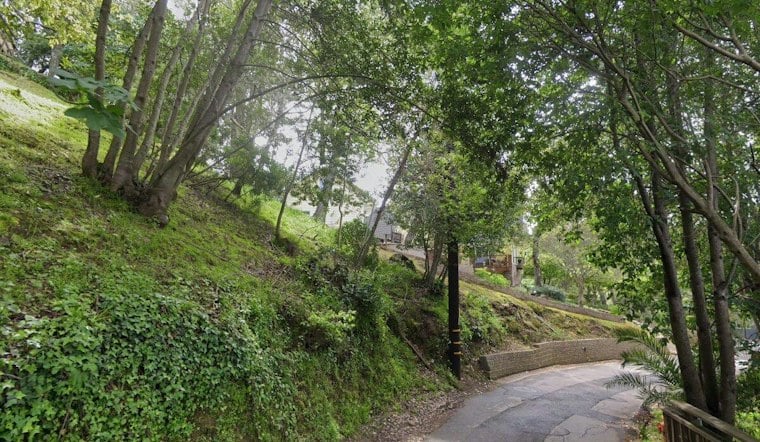
A fight over a single driveway at one of Marin County's most storied estates has spilled into lawsuits, leaked closed-door secrets and a referral to the district attorney. The so-called Guitar House at 800 Corte Madera Ave., an 11-acre hilltop property once owned by rock impresario Bill Graham, sits at the center of a dispute that has split neighbors, consumed Town Council meetings, and now landed in court.
The current owners requested town approval in 2024 to build a second, 445-foot driveway connecting Alta Terrace to a rear service road on the property, according to the San Francisco Chronicle. The plan was pitched as offering both convenience and emergency wildfire egress, but it immediately ran into fierce neighborhood opposition. As reported by Marin Independent Journal, the project called for removing 47 trees, replacing 32 of them, and building retaining walls ranging from half a foot to more than 12 feet tall, along with a new entry gate, drainage improvements and onsite grading.
Central Marin Fire Department officials weighed in on the emergency-access question, saying the driveway would improve access but was not required under current rules, the same account notes. Fire Chief Ruben Martin reportedly supported the project and said that if a home the Guitar House's size were built today, it would need two access points — a detail that became a flashpoint in the broader debate over whether convenience or necessity was really driving the request.
A Paper Road Becomes a Battleground
The proposed route would have paved roughly half of a 40-foot-wide strip for about 120 feet across a wooded dirt path known as Alta Woods, according to the Chronicle's reporting. That path, which runs about 100 yards from Alta Terrace to a fence, traces its origins to a 1906 Chapman Park subdivision map that marked a future street called Alta Way — a road that was planned but, per the map, never actually built. Neighbors describe the roughly 600-foot wooded stretch as the only place in the area to walk, according to Pacific Sun, and say it's used daily by dog walkers, neighborhood children and other residents.
Ownership of that path is itself contested. Todd Williams, who represents the Corte Madera Property Trust that owns the estate, has said Alta Way was intended to be a road and has been maintained by property owners for more than 40 years, and that the estate owners believe their property extends to the center line of the path, giving them the right to build on it. The trust claims it owns half of Alta Way with an easement over the rest, though the same Pacific Sun report notes it has produced no evidence of that ownership, and a 2023 survey filed with Marin County by BFK Engineers shows the 800 Corte Madera property line actually stops at Alta Way.
Town officials have taken a different view. Amy Lyle has said Corte Madera found no records supporting a claim that Alta Way is a public road, and that the town itself does not have rights to the paper road — treating the dispute as a civil matter among Chapman Park property owners rather than a municipal one. Williams has maintained that walking and driving can coexist on the road, and estate owners say they intend for walking access to remain after construction.
Appeal, Reversal and a Lawsuit
Opponents didn't wait for construction to begin. Neighbors hired an attorney and appealed the Planning Commission's approval of the driveway, and the Town Council ultimately sided with them, voting 3-2 to find that the project's environmental impacts outweighed its benefits, according to Marin Independent Journal. Karen Lorentson, one of the neighbors involved, has said residents were never shown proof of ownership and that any acceptable compromise would not cross Alta Woods.
The property trust responded by suing the town. On March 2, 2026, the trust filed suit over the council's decision to uphold the neighbors' appeal, per Pacific Sun. Residents have since pushed the town not to finalize any settlement involving the property until questions about ownership, easements and the path's longstanding public use are addressed publicly, according to a report from Citizen Portal.
Meetings Turn Hostile, Councilmember Faces Referral
The dispute has not stayed confined to legal filings. Town and neighborhood meetings have grown belligerent, per the Chronicle's account, and estate owners at one point requested police presence after residents allegedly leveled insults and threats. Representatives for the property owners have also collected surveillance footage and documents they say allege official misconduct.
At the center of that misconduct allegation is council member Pat Ravasio, who opposes the driveway project and believes the area should be preserved as open space. Ravasio disclosed confidential information from a closed-door council meeting to driveway opponents, prompting the town to refer the matter to the Marin County District Attorney's Office and civil grand jury. Ravasio has acknowledged making a minor error but has called the referral frivolous.
Environmental groups have also weighed in on the tree removal tied to the original plan. The Marin Audubon Society sent the town two letters raising concerns about the loss of trees and potential impacts on northern spotted owl habitat, adding another layer to a fight that now touches wildlife, property law and town governance all at once.
A Storied Estate With a Complicated Past
The Guitar House earned its nickname from a guitar-shaped living room designed by architect Sim Van der Ryn, a feature that has long made the estate a local landmark. Bill Graham bought the property in the late 1970s, and after his death it sold for nearly $6 million in 1991. WeWork co-founder Adam Neumann bought it for $21.4 million in 2018 and sold it three years later, in 2021, for $22.4 million to the current owners, according to the Chronicle.
With the lawsuit pending and no finalized settlement, the fight over a few hundred feet of driveway shows no sign of resolving quickly. The Chronicle reports the matter may see a closed-door conclusion sometime this fall, though what that resolution might look like — and whether it addresses the ownership questions neighbors have raised — remains unclear.




