

























































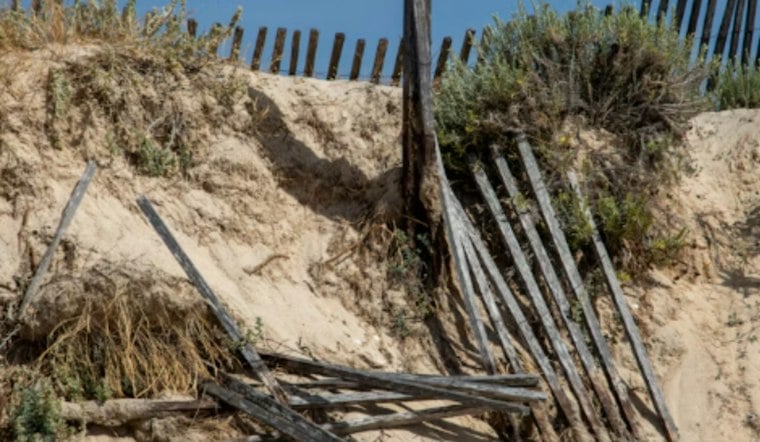
Currituck County says a recent nor’easter tore into its oceanfront dune system, leaving sand dunes eroded, beach walkovers damaged and debris like compromised sand fencing scattered along the shoreline. Now the county is walking oceanfront property owners through a tangle of permitting rules before anyone can so much as push sand back into place.
According to Currituck County, recent nor’easter conditions have caused significant erosion and damage to portions of the county’s oceanfront dune system. The county says it is working with the North Carolina Division of Coastal Management and other state and federal agencies to identify options for restoring damaged dunes, protecting coastal resources, and helping oceanfront property owners understand available permitting pathways.
Property owners must obtain all required approvals before beginning beach bulldozing, sand placement, or other dune restoration work, as reported by The Outer Banks Voice. Dune restoration may use suitable beach sand moved into place, compatible imported sand, or a combination of both, but the station notes that sand placement still requires applicable permits and environmental requirements. Whether any of it is feasible at all depends on site-specific conditions, including sand availability and compatibility, beach and dune design and slope requirements, available space, and environmental constraints.
Three Permit Pathways, Depending on Where the Work Happens
The permitting pathway depends on work location, the extent of erosion, and the type of activity planned, the outlet’s report explains. A CAMA minor permit may cover dune restoration with compatible sand placement and certain beach bulldozing in the dry-sand beach area, and those are processed and issued by Currituck County’s own local permit officers in the Planning & Inspections Department.
A CAMA general permit under 15A NCAC 07H .1800 may cover beach bulldozing between the high-tide and low-tide boundaries, and that one is processed through the DCM Elizabeth City District Office, with Martin Mitchell listed as the contact at 252-621-6454 and [email protected]. Beach bulldozing below the low-tide boundary requires a CAMA major permit and other applicable state and federal authorizations, with Ron Renaldi serving as district manager and contact for that permit at 252-621-6450 and [email protected]. Meeting a 20-foot distance criterion does not automatically authorize beach bulldozing, the same report cautions — each property still requires individual evaluation.
An Exemption for Imminently Threatened Homes
Property owners with imminently threatened homes may qualify for a beach bulldozing exemption under 15A NCAC 07K .0103(b), subject to meeting all criteria. A home may be considered imminently threatened when its foundation or associated septic system is less than 20 feet from the erosion scarp, though imminent-threat eligibility may also consider homes farther than 20 feet away or without an obvious erosion scarp, including those with flat beach profiles or accelerated erosion. The exemption does not automatically extend to swimming pools, dune decks, structural beach accessways, or other accessory structures based solely on their being damaged or threatened by erosion.
Currituck County Planning & Inspections Department staff can assist property owners in determining whether the exemption may apply, and anyone who believes their home is imminently threatened should contact the county or DCM before beginning any work to discuss eligibility, options, and approvals.
Sea Turtle Moratorium Complicates the Timing
Beach bulldozing is generally restricted during the annual sea turtle nesting moratorium, which runs from April 1 through November 15, according to the North Carolina Department of Environmental Quality’s rule governing beach bulldozing in the ocean hazard area. A separate NC DEQ page describes the restriction as a federal moratorium tied to sea turtle nesting season running May 1 through November 15. Either way, bulldozing before the moratorium ends may require additional agency coordination and authorization, and the county says it can coordinate with DCM, which may in turn consult the North Carolina Wildlife Resources Commission and U.S. Fish and Wildlife Service about moratorium relief and conditions. An emergency consultation process may be available for qualifying projects.
Currituck County has requested activation of an emergency general permit under 15A NCAC 07H .2500, which would provide a broader pathway to address storm-related beach and dune damage. The state has not indicated it will activate that emergency general permit at this time. A comparable mechanism was used in 2015, when NC DEQ offered oceanfront property owners an emergency CAMA permit for beach and dune erosion after weekend storms, though that earlier episode is not confirmation of how the current request will be resolved.
Storm Also Hit Roads and a Major Nourishment Project Farther South
The damage in Currituck wasn’t isolated. The same nor’easter flooded and damaged N.C. Highway 12 elsewhere on the Outer Banks while halting work on a $42 million beach nourishment project in Buxton, according to WRAL. Crews contracted by Great Lakes Dredge & Dock Company pulled their equipment off the beach ahead of the storm, and roughly 1.8 million of the project’s 2 million cubic yards of sand had already been placed before the storm hit, the station reported.
No approval of a particular restoration approach in Currituck is guaranteed, and site-specific review may still result in changes to proposed work or additional permitting requirements. Property owners considering beach bulldozing before November 15 should contact the county as soon as possible to allow time for permitting and agency coordination, since dune restoration work requires applicable permits, environmental protections, and agency requirements regardless of the method chosen.
Oceanfront property owners are encouraged to contact the Currituck County Planning & Inspections Department at 252-232-3055 or [email protected]. The county suggests that anyone reaching out should explain whether they plan to move existing beach sand, import compatible sand, or use both, and that photographs of current beach and dune conditions may help staff evaluate potential approaches. Currituck County says it will continue working with state and federal partners to identify practical dune restoration options while protecting coastal resources.





