

























































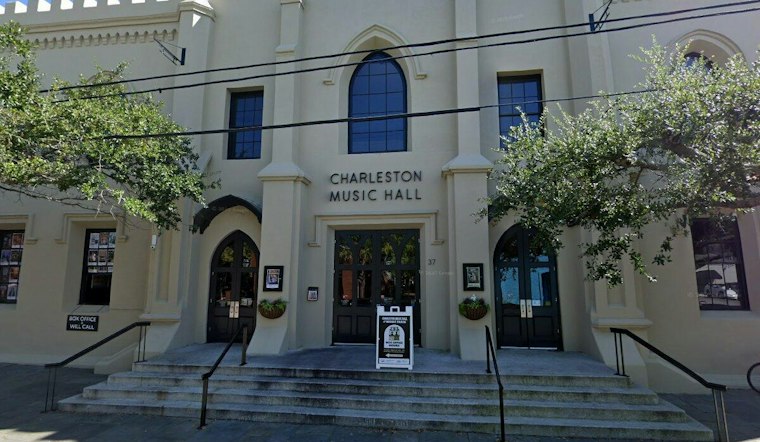
Robots with four legs and the faces of Danny McBride and Beeple walked onto the stage at Charleston Music Hall on October 21, kicking off an hour-long conversation between the two Lowcountry artists about artificial intelligence and its creeping presence in Hollywood. Beeple joked that he figured they should get the creepy stuff out of the way first. What followed was a wide-ranging back-and-forth between a filmmaker known for raunchy television comedies and a digital artist who once sold a single piece of art for $69.3 million.
A Distinguished Lecture Gets Weird Fast
The event was part of the Gibbes Museum of Art's Distinguished Lecture Series, billed as a chance to explore AI's impact on visual media and its growing role in film and digital art, according to the Gibbes Museum. Tickets ran from $25 to $80 through the Charleston Music Hall. The museum described McBride and Beeple as two artistic visionaries based in the Lowcountry, and as reported by The Daniel Island News, the two described themselves as kindred spirits who found their creative footing in Charleston.
McBride first came to the city in 2015 to shoot Vice Principals, per the same account, and he and his family fell in love with the place enough that he eventually moved his work and several longtime collaborators from Los Angeles to Charleston. He said the decision to put down roots there for the past decade has been the best choice he and his team ever made. McBride praised Beeple's willingness to experiment and build ambitious creative projects in the city, saying that after visiting Beeple Studios, he saw a kindred spirit.
From Kenny Powers to Synthetic Theatre
McBride is the filmmaker behind HBO's Eastbound & Down, Vice Principals and The Righteous Gemstones, and he created Kenny Powers, the foul-mouthed baseball player at the center of Eastbound & Down. Beeple, whose real name is Mike Winkelmann, said Charleston's lack of a major digital art scene pushes him to think more about how people outside tech and NFT communities experience his work. His exhibition space sits along Clements Ferry Road, and the two artists said they created Synthetic Theater, an experimental production exploring AI and creativity, about a year before the Gibbes conversation.
That collaboration has since grown into a larger live show. Danny McBride and Beeple are now working together on Synthetic Theatre, a production that fuses dance, music, comedy and film with AI, according to The Post and Courier. McBride hosted the show, which featured Edi Patterson, Dan O'Connor and Holly Herndon, staged at Winkelmann's 50,000-square-foot exhibition space off Clements Ferry Road. A version of the event, described by Beeple Studios as an immersive evening where artificial intelligence, generative art and performative spectacle intersected in real time, ran October 3 and 4.
McBride's Case for Using AI as Research, Not a Replacement
During the Charleston Music Hall conversation, McBride distinguished between artistic inspiration and copyright infringement or unauthorized use of someone's likeness, the paper reports. He said that once a creation is released into the world, it becomes partly beyond its creator's control. He uses AI himself for research, he said, particularly when a historical scene demands specific period details, but he enjoys the actual process of writing and creating too much to let a tool replace it.
McBride was blunt about the tool's limitations, describing AI as essentially a more advanced version of Google. He criticized it for flattering users and producing writing that sounds convincing on the surface but lacks real depth, noting that it tends to list things in threes and lean on phrasing like it's not this, it's that. Still, he said ignoring AI entirely would be a mistake given how aggressively Hollywood studios are experimenting with it, and he argued that artists may simply need to work harder, stay authentic and try to outpace the technology.
Studios Learning What AI Can Replace
McBride said Hollywood studios have not required him to use AI in his own productions, but he acknowledged that studios are learning what the technology can do and may eventually use it to replace workers, particularly as visual effects work increasingly incorporates AI tools. That caution lines up with broader industry findings. A Los Angeles Times survey of roughly 250 publicly available film-studio job postings in late June found that around 30 appeared connected to AI, according to the Los Angeles Times.
That reporting suggested Disney, Netflix and Amazon are building repeatable AI workflows for visual effects, animation, sound and dubbing, while Universal, Paramount, Warner Bros. and Sony appeared to be using AI mainly for marketing, distribution and audience analytics. Netflix, for instance, was advertising a Manager, Generative Workflows role aimed at integrating more AI into its films. None of the postings the Times reviewed sought to create AI that writes scripts or creates AI actors, the outlet noted.
A Shrinking Industry Turns to AI Gig Work
The anxiety behind those hiring trends shows up in harder numbers elsewhere. Shoot days in Los Angeles fell 48% between 2021 and 2025, according to FilmLA Research cited by The Guardian, and U.S. employment in the motion picture and sound recording industries dropped 28%, from 450,000 jobs in July 2022 to 326,000 by May 2026, per Bureau of Labor Statistics figures the paper reported. Netflix has said it used AI in 300 of its 1,000 titles in 2026.
Amid that contraction, the Guardian reported that Hollywood writers, directors and producers have begun taking temporary gig work training AI models to replicate their own professional skills. One company, Micro1, advertised work for producers to design AI evaluation tasks simulating production-management scenarios, paying up to $85 an hour.
Guild Protections and the Limits of Consent
Writers covered by the Writers Guild of America do have some contractual guardrails. The 2023 Memorandum of Agreement established AI protections for WGA-covered writers, according to the Writers Guild of America, including a rule that companies cannot require a covered writer to use AI software for writing services. Companies must also disclose to writers when material they're given has been generated by AI or incorporates AI-generated content.
The guild has also reserved the right to argue that using writers' material to train AI violates its agreements or other law, and WGAW joined other organizations in filing an amicus brief arguing that AI training on copyrighted material without consent is not fair use. McBride's own audiobook for Thrilling Tales of Modern Men reportedly includes language prohibiting AI training on its contents, a small but concrete example of an artist trying to draw his own line around the technology.
For Beeple, who argued when his NFT artwork sold at Christie's in 2021 that digital work can carry just as much craft, message, nuance and intent as anything made on a physical canvas, AI represents something closer to opportunity than threat. He described the technology as a way to unlock creativity for people who lack technical skills. Whether that optimism and McBride's wariness end up pointing toward the same future remains, for now, an open question the two Charleston neighbors are still working out together, onstage and off.



