

























































David Williams was diagnosed with tremor-dominant Parkinson’s disease on April 16, 2025, a date he says he will never forget. Rather than scale back his life, Williams kept pushing forward with a fitness routine that had already helped him shed 108 pounds and complete his first full marathon at age 56.
“April 16, 2025 became a date I’ll never forget,” Williams said, according to a profile published by Parkinson’s Foundation. His health transformation began in his 50s, and by the time he received his diagnosis he had already lost 108 pounds and crossed the finish line of a marathon. “Parkinson’s was going to be part of my life — but it was not going to run my life,” he said.
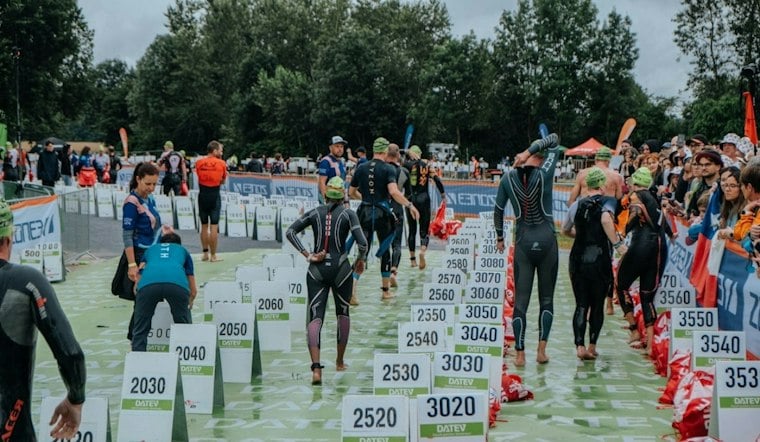
Williams has continued swimming, biking and running since his diagnosis, telling the Parkinson’s Foundation that exercise is central to how he copes. “Exercise became non-negotiable. Movement is my medicine,” he said. As of the writing of his story, he said he was training for the Augusta Ironman 70.3 — a triathlon consisting of a 1.2-mile swim, a 56-mile bike ride and a 13.1-mile run. “I’m currently training for my biggest race of the year — the Augusta Ironman 70.3,” he said. “That’s a 1.2-mile swim, a 56-mile bike ride and a 13.1-mile run.”
Training as a Daily Reminder of Capability
Williams framed his training regimen not just as physical preparation but as a mental exercise in proving to himself what he can still do. “I train to remind myself that I’m still capable,” he said. He also noted that he would turn 60 in 2026, identifying himself simply: “I turn 60 in 2026, and I’m a triathlete.”
Beyond his own training, Williams has taken on a public role within the Parkinson’s community. He became a Parkinson’s Champion in 2025 and has continued supporting outreach efforts for the Parkinson’s Foundation’s Carolinas chapter, which also credits him with raising more than $10,000 for the organization’s Moving Day fundraising walk.
Exercise Guidance Backs Up His Approach
Williams’ emphasis on movement lines up with newly updated national guidance for people living with the disease. The Parkinson’s Foundation and the American College of Sports Medicine announced updated recommendations for safe and effective exercise for people with Parkinson’s, according to ACSM. Those recommendations span four domains — aerobic activity, strength training, stretching, and balance, agility and multitasking — and address how exercise dose, intensity and timing should shift as the disease progresses, per the same organization.
The ACSM notes that people with Parkinson’s who exercise tend to see improvements in quality of life, symptom management, endurance, strength, balance and mobility. The disease affects more than one million Americans, with nearly 90,000 new cases diagnosed in the U.S. each year, according to ACSM. A separate systematic review cited by PubMed examined the effects of endurance exercise training on the motor and non-motor features of parkinsonism, part of a growing body of research into how physical activity interacts with the disease.
Not the Only Endurance Athlete Facing Parkinson’s
Williams is not the only endurance athlete to keep competing after a Parkinson’s diagnosis. An Ohio doctor diagnosed with the disease completed a full 140.6-mile Ironman triathlon, telling USA Today that people with the disease can still be active. A separate profile from Mayo Clinic News Network described another athlete who kept competing in Ironman and other triathlons after her own diagnosis, treating it as simply the next challenge to train through.
The Augusta Ironman 70.3 that Williams was preparing for has become a fixture for the region's economy as well as its athletes. Since its launch in 2009, the race has generated more than $76 million in economic impact for the Augusta area, according to the Augusta Sports Council.
A Message Rooted in Daily Movement
Williams has described his approach to recovery and training as built on exercise, a positive mindset, supportive community and faith, according to the Parkinson’s Foundation profile. He has also become a source of encouragement for others navigating the disease, using his race participation to raise awareness and funds for the organization. His story adds to a small but growing record of endurance athletes who say that staying in motion, even after a difficult diagnosis, remains central to how they define themselves going forward.





