

























































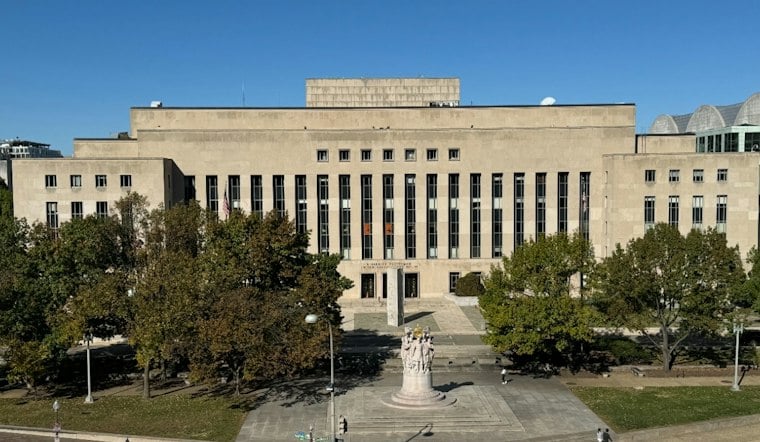
Washington, D.C. gun owners who want to challenge the city's ban on magazines holding more than 10 rounds currently face a daunting choice: risk a felony prosecution first, or stay out of court entirely. The Firearms Policy Coalition is now asking the full U.S. Court of Appeals for the D.C. Circuit to tear down that barrier, filing an en banc petition on October 15 in a case called Wehr-Darroca v. District of Columbia.
The petition asks the full D.C. Circuit — meaning all of its active judges, not just a three-judge panel — to reverse the dismissal of the lawsuit and let it proceed, according to the Firearms Policy Coalition. As The Daily Caller reported, the coalition argues that plaintiffs should not have to show a specific threat of arrest just to establish standing in a pre-enforcement challenge to D.C.'s gun laws, according to the petition itself. The case centers on D.C.'s ban on magazines capable of holding more than 10 rounds of ammunition.
That ban, enacted under the Firearms Registration Amendment Act of 2008, is codified at D.C. Code § 7-2506.01(b), according to court filings posted to GovInfo. In 2019, the D.C. Council raised the stakes considerably: possessing a high-capacity magazine went from a misdemeanor to a felony carrying up to three years in prison and a $12,500 fine under D.C. Code § 7-2507.06(a)(4), according to a legal explainer from Koehler Law.
A Decades-Old Standing Rule Under Fire
The coalition's petition traces the current standing problem back to Navegar v. United States, a 1997 ruling, according to the petition. That decision held that firearm manufacturers could not challenge federal gun prohibitions before enforcement without showing an individualized, specific threat of prosecution directed at them, per the Cato Institute's account of the case's legal legacy.
The D.C. Circuit extended that logic to individual gun owners in 2005's Seegars v. Gonzales, ruling that general enforcement threats do not confer standing — a holding that drew a pointed dissent at the time from Circuit Judge David Sentelle, who warned against creating what he called a hierarchy of Bill of Rights protections that singles out Second Amendment claims, per the same account. That nearly 30-year lineage is exactly what FPC's petition is now asking the full D.C. Circuit to dismantle.
FPC President Brandon Combs framed the stakes bluntly. “D.C. uses felony prosecution and imprisonment threats against gun owners possessing standard firearm magazines” while relying on “a court-created rule to deny them court access,” Combs said, per the petition. He called the standing rule a “constitutional Catch-22,” adding, “The government does not get to tell Americans they must either surrender their rights or risk prison just to challenge an unconstitutional law.” He also insisted that “the Second Amendment is not a second-class right” and gun owners “are not second-class citizens.”
How One District Court Case Already Found a Narrow Opening
The underlying lawsuit has already traveled a winding procedural path. U.S. District Judge Rudolph Contreras dismissed Wehr-Darroca for lack of subject-matter jurisdiction on September 22, 2025, noting that binding circuit precedent required it — but the plaintiffs explicitly conceded the point in order to fast-track an en banc appeal or a potential Supreme Court challenge, according to court records filed on GovInfo.
In a related ruling also captioned Hanson v. District of Columbia, Contreras addressed Yzaguirre’s denied application and the scope of his claim.
FPC's brief in the current petition also asserts that D.C. has not disavowed enforcement of its magazine ban, and the plaintiffs allege they would possess magazines larger than what D.C. allows if not for fear of criminal penalties and disarmament, according to the brief.
The Merits Fight Already Lost Once — And a National Split Is Growing
Notably, the D.C. Circuit already ruled on the merits of the magazine ban itself in the original Hanson v. District of Columbia decision, issued October 29, 2024. That panel upheld the ban, finding that extra-large capacity magazines are consistent with historical traditions of regulating dangerous weapons — a ruling the U.S. Supreme Court declined to review in June 2025, according to Justia Law. That means FPC's en banc petition is aimed squarely at the standing bottleneck, not a renewed attack on the ban's constitutionality — at least not yet.
Meanwhile, D.C.'s own local court system is wrestling with a parallel fight. A panel of the District of Columbia Court of Appeals struck down the same 10-round magazine ban under the Second Amendment on March 5, 2026, in Benson v. United States, but the full local court granted en banc rehearing on April 22, 2026, vacating that ruling and keeping the ban in effect pending re-argument, according to Product Law Perspective.
Nationally, New Jersey has appealed a Third Circuit ruling that struck down its own ban on modern semiautomatic firearms and magazines holding more than 10 rounds. That July 17 en banc decision, a 10-5 vote in Association of New Jersey Rifle & Pistol Clubs v. Attorney General, created a direct circuit split with the Ninth Circuit, which upheld California's magazine cap in Duncan v. Bonta — a case Hoodline detailed at the time. The Supreme Court has considered taking up Duncan v. Bonta for more than 24 conferences and had not announced a decision as of Tuesday, per the Daily Caller's report.
That growing split could eventually force the Supreme Court's hand. As of 2026, 14 states and the District of Columbia still maintain statutes capping magazine capacity, typically at 10 or 15 rounds, according to data compiled by LegiScan.



