

























































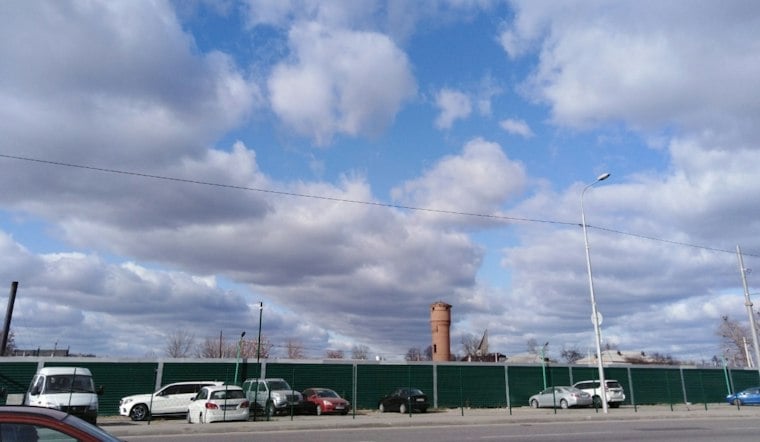
Water service has returned to Staryi Saltiv after two water towers near Kharkiv were rebuilt, but the wider system still needs major repairs. The $50,000 project was funded by Jim Good, a Washington-area water-industry veteran, and is one response to the damage residents have faced since the towers were destroyed.
Good, president of Parkview Advisors and a 35-year water-industry professional, began looking for ways to apply his expertise after Russia invaded Ukraine on February 24, 2022, according to WTOP News. Through Washington connections, he was introduced to Britta Ellwanger, Ukraine project director at forPeace, a small U.S. nonprofit working with people in the country, the American Water Works Association reports.
Ellwanger had experience working with Ukrainian anti-corruption agencies and understood the country's approval procedures, Good said — qualities that mattered once he learned that two water towers near Kharkiv had been destroyed during shelling and heavy fighting, leaving area residents to haul water manually from a nearby river. ForPeace identified the affected communities as Staryi Saltiv and Molodova, both located less than 10 miles from the Russian border, per the station's report.
Raising $50,000 From His Own Network
Good raised the $50,000 from his own network. He said handling the fundraising outside a large government aid agency helped the money reach Ukraine more quickly. Contracts were awarded through open bidding, and Ukrainian vendors fabricated the towers, according to WTOP.
The restored towers were expected to stabilize water service for nearly 2,000 households and 32 small businesses, WTOP reported. Good and his wife watched the final construction work on a livestream from their D.C. home at 4 a.m.
A Pattern of Grassroots Repairs Across a Damaged System
Good's project is one piece of a much larger problem. UNICEF reported in April 2022 that 1.4 million people in eastern Ukraine lacked access to safe water altogether, with another 4.6 million living with only limited access, and documented at least 20 separate incidents of damage to water infrastructure in the region alone, according to UNICEF. The agency has cited U.N. Security Council Resolution 2573 as requiring parties to armed conflicts to protect civilians and civilian infrastructure, including water facilities.
In Staryi Saltiv, centralized water service has returned, but shelling and deterioration continue to affect the wider system, Ukrinform reported. Local officials estimated that 50 kilometers of pipe need to be replaced, according to Ukrinform.
The broader scale of water-system damage
The joint assessment by the World Bank, Ukraine’s government, the European Union and the United Nations estimated Ukraine’s recovery and reconstruction needs at US$587.7 billion over a 10-year horizon, based on impacts through December 31, 2025, according to the RDNA5 assessment. That is an overall national estimate; the figures cited here do not provide a Kharkiv Oblast-specific breakdown of water-supply and sanitation damage.
UNICEF reports that 39,700 kilometers of water networks have been damaged in Ukraine and that water-sector damage totals $4.6 billion, according to UNICEF Ukraine. The April 2022 UNICEF figures cited above documented water-infrastructure damage across eastern Ukraine, but do not establish which incidents occurred in Kharkiv Oblast or identify causes there distinct from the shelling described in this story.
Other Groups Tackling the Same Crisis
Good isn't the only one filling gaps left by the war. According to the United Nations in Ukraine, millions of Ukrainians still lack clean water because of war damage, aging infrastructure and destroyed facilities, and groups including Southern Development Strategy have installed filters, drilled wells and built water towers for local utilities in affected communities.
Elsewhere, CORE has restored more than a dozen water systems across the Mykolaiv region, including two towers in Kyselivka and roughly two kilometers of repaired pipe that brought uninterrupted water to about 1,000 residents of Zelenyi Hai and neighboring Olenivka, according to CORE. The Ukrainian Red Cross Society separately restored safe drinking-water access for roughly 3,500 residents of Babyntsi in June, building two 80-meter boreholes and a new water tower at a cost of about UAH 17.7 million.
What Comes Next for Good's Campaign
Back near Kharkiv, forPeace also provided a $13,000 well that now serves more than 1,400 residents, and supported the restoration of older wells with mechanical hand-pump stations, plus solar panels to power larger wells in an area without reliable electricity. Local government officials have pledged $20,000 toward a planned $40,000 well project, and Good says he hopes to raise additional money for future forPeace efforts.
Good said he remains struck by the bravery and determination of the Ukrainian people he's worked to help, even as the towers he helped fund remain standing and in use. ForPeace's website offers more information about its work in Ukraine and a way for others to contribute to future projects.




