

























































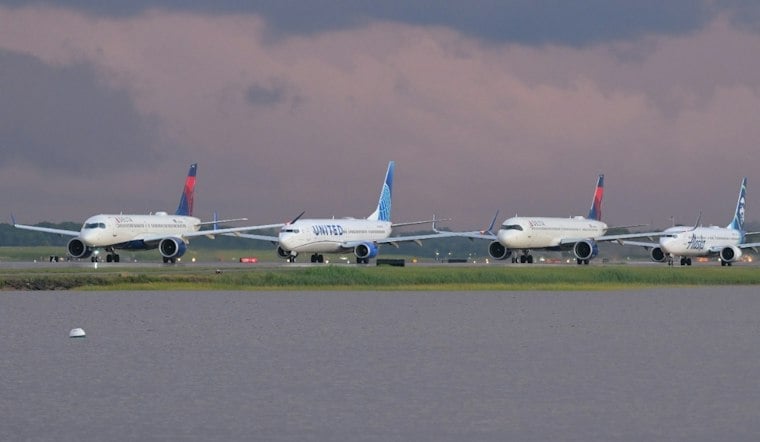
What should have been a straightforward four-hour flight from San Juan, Puerto Rico, to Boston turned into a roughly 30-hour ordeal after a medical emergency forced the Delta Air Lines flight to divert to Bermuda, leaving passengers stuck overnight in an unplanned country and facing hours of customs delays once they finally reached Logan Airport.
The flight was diverted because of a medical emergency onboard, and a Delta spokesperson said the flight crew ultimately timed out, according to WCVB. That meant passengers were placed in Bermuda hotels overnight before returning to the Bermuda airport early Tuesday to continue the journey to Boston. Under Federal Aviation Administration rules in 14 CFR Part 117, flight crews are capped at a maximum duty period of 9 to 14 hours and must get at least 10 consecutive hours of rest, including 8 uninterrupted hours of sleep opportunity, before starting a new shift, according to eCFR.
Damaris Montanez, who is from Springfield, said passengers were stuck on the airplane for almost three hours before they were able to get off, and she didn't reach her hotel until about 3:00 or 3:30 a.m., the station's report notes. Luz Rodriguez, from Lowell, said she reached a hotel at 3:00 a.m. and was told to return to the airport at 6:40 a.m. Rodriguez described a chaotic scene, reporting that passengers were hungry, babies were crying, some passengers lacked diapers, and elderly passengers needed medical attention, per the same account.
Why a Domestic Flight Suddenly Needed a Customs Stop
Because Puerto Rico is a U.S. territory, the passengers traveling to Boston were on what amounted to a domestic itinerary and generally did not carry passports, according to the local context cited by Old San Juan Shore Excursions. But diverting to Bermuda transformed the remainder of the trip into an international arrival, which triggered mandatory U.S. Customs and Border Protection identity verification and clearance once the plane landed back on U.S. soil, per the same source's explanation of the federal rule.
That is exactly what passengers said happened once the flight reached Boston. They could not deplane for hours because of a customs issue, and most of them lacked passports, the WCVB account states. Amanda Cintron, a passenger on the flight, said officials verified her citizenship multiple times before she was allowed to leave the aircraft.
Passengers Call the Experience Disorganized
Passengers described the whole experience as disorganized, even as they said they were glad the flight had landed to help the man in need and felt the overall situation was poorly handled, according to the station's reporting. Delta released a statement addressing customer and crew safety, saying the safety of customers and crew comes before all else.
Because the diversion stemmed from a passenger medical emergency, an event federal regulators classify as outside an airline's control, Delta's obligations for hotel vouchers and delay compensation operate under different standards than they would for a controllable mechanical or scheduling delay, according to rules described by FOX 13 Seattle. Delta's own customer service policy commits the airline to complimentary hotel accommodations and meal vouchers for overnight delays within its control, but specifies that for uncontrollable disruptions such as medical diversions, hotel vouchers are offered only on a discounted or space-available basis, per Delta Air Lines' stated policy. Passengers can still submit out-of-pocket expense reimbursement requests to Delta for post-flight review.
The Federal Rules Behind the Bermuda Layover
The crew's overnight stay wasn't a judgment call Delta could simply override. Under FAA regulation 14 CFR § 117.19, a pilot-in-command may extend a flight duty period by up to two hours for unforeseen circumstances before takeoff, but any extension beyond 30 minutes requires the airline to file a formal report with the FAA within 10 days, according to the federal rule referenced by eCFR. Those duty-time limits were enacted following the 2009 Colgan Air crash specifically to prevent pilot fatigue.
Federal tarmac delay rules also shaped what passengers experienced once the plane sat on the ground. The Department of Transportation requires airlines to offer passengers on an arriving international flight the chance to deplane before reaching four hours on the tarmac, subject to safety, security, or air traffic control exceptions, and carriers must provide adequate food and potable water no later than two hours after a tarmac delay begins, according to the U.S. Department of Transportation. Airlines that fail to adhere to their filed tarmac delay contingency plans can face administrative enforcement actions and civil penalties assessed per affected passenger.




