

























































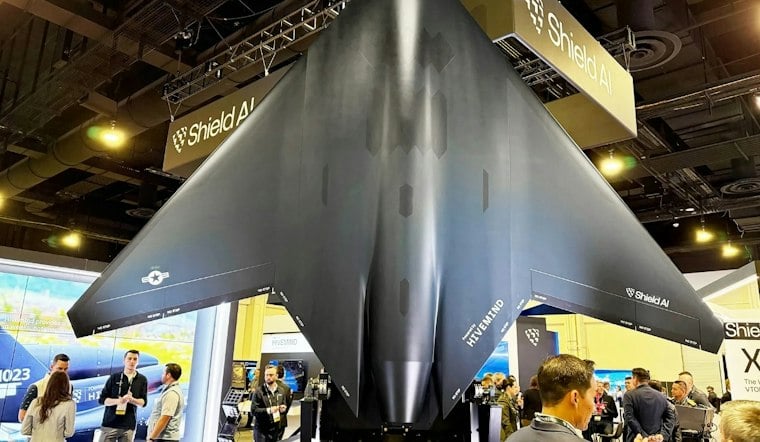
A 420,000-square-foot manufacturing plant rising in the Des Moines Creek Business Park West is about to become ground zero for a new kind of fighter jet: one with no cockpit and no pilot. Shield AI has signed on to build its X-BAT autonomous fighter at 1800 S. 216th St., with the facility, designated X-Forge 3, set for completion in spring 2027.
A Defense Startup Moves Into Boeing's Backyard
The San Diego-based company, according to GeekWire, is already eyeing an additional 1 million square feet of space across the Puget Sound region as it scales up. The industrial building was originally being built on spec by Panattoni Development Company before Shield AI signed its lease partway through construction, the outlet reports. Shield AI estimates its regional workforce will grow to 4,000 employees by the early 2030s as mass production ramps up, planting autonomous military aviation squarely in the geographic hub Boeing has called home for decades.
Locally, the project is expected to bring hundreds of high-paying jobs and more than $300 million in direct investment to Des Moines, according to KOMO News. It marks Shield AI's first site in the Puget Sound region, and the station notes the company plans to begin area hiring as the program moves forward. Des Moines Mayor Yoshiko Grace Matsui said the city is positioned to support a talented workforce entering a new aerospace sector, per the same report.
What the X-BAT Actually Is
The X-BAT itself is a 26-foot-long, runway-independent aircraft capable of vertical takeoff, powered by a GE Aerospace F110 thrust-vectoring engine. It carries a 1,000-nautical-mile combat radius, a service ceiling above 50,000 feet, and an estimated unit price of $27 million — less than a third of the cost of a conventional crewed F-35, GeekWire reports. Full-rate production is planned for the early 2030s, with an initial production start targeted for 2029, per KOMO's reporting.
Shield AI has organized X-BAT development around three sites spread across the country: prototype engineering stays in Frisco, Texas; primary manufacturing lands in Des Moines; and flight testing, acceptance flights, and maintenance happen at X-Forge 2, located at Newton City-County Airport in Kansas. Every aircraft assembled in Washington will travel to Kansas for acceptance flights before being delivered to military customers, according to a release cited by PR Newswire. That release projects the combined Washington-Kansas production and flight-test ecosystem will support roughly 9,800 American jobs by the early 2030s and contribute $78 billion in economic impact through 2046 — distinct from the roughly $73 billion figure KOMO reported specifically for the Seattle-Tacoma-Bellevue regional economy.
Why Des Moines, Why Now
King County's existing aerospace base is central to the pitch: the county hosts more than 45,000 aerospace workers across over 400 companies, giving Shield AI an established supplier network and specialized labor pool already in place. Washington Governor Bob Ferguson welcomed the investment and its thousands of promised good-paying jobs, and announced the creation of a Governor's Space Council on September 29 to advise him on keeping the state competitive in the space economy, according to KOMO's reporting.
The 87-acre Des Moines Creek Business Park land carries its own history. The Port of Seattle acquired the property between 1989 and 1993 under a Federal Aviation Administration noise mitigation program before it was redeveloped into industrial space under a long-term ground lease, the port's own records show.
Navy Money for Hardware, Air Force Money for Software
Shield AI's defense contracts reveal two different military strategies toward uncrewed fighters. In August 2026, the U.S. Navy's Rapid Capabilities Office and the Defense Innovation Unit awarded the company approximately $50 million under the RIMES program to fund X-BAT development and testing, according to MiGFlug. The outlet notes the Navy funded the vertical-takeoff jet specifically for shipboard operations, while the Air Force has concentrated its primary drone funding on conventional runway platforms instead.
Separately, in June 2026 the Air Force awarded Shield AI a production contract to integrate its Hivemind AI mission autonomy software into the Air Force's Collaborative Combat Aircraft program, the company announced. That contract evaluates mission autonomy software on its own terms, apart from any specific aircraft frame, underscoring that Shield AI's footprint in federal defense spending extends well beyond the hardware now headed for Des Moines.
A Company Built on Venture Capital and a Navy SEAL's Resume
Shield AI was founded in 2015 by former Navy SEAL Brandon Tseng, his brother Ryan Tseng, and Andrew Reiter. The company reached a $12.7 billion valuation in 2026 following a $2 billion venture financing round co-led by Advent International and JPMorgan Chase's Security and Resiliency Initiative, GeekWire reports.
Washington has an aerospace industry, cutting-edge technology, and a highly talented workforce, Ferguson said in welcoming the project, according to KOMO. Boeing remains the region's homegrown aerospace anchor, but city and county officials describe the Shield AI venture as a new chapter of economic growth for Des Moines, with the community said to be ready to support it. Open questions remain about how quickly Shield AI will secure the additional 1 million square feet it wants in the region, how traffic near South 216th Street will handle the projected 4,000 workers, and how supply-chain coordination will work between Washington assembly and Kansas flight testing.





