

























































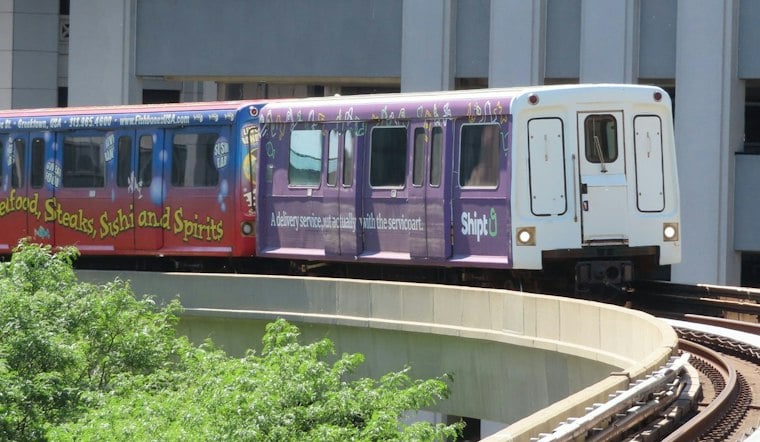
Detroit's elevated People Mover is getting a fleet overhaul, and the state is picking up a big chunk of the tab. The Detroit Transportation Corporation, which runs the free downtown loop, is receiving $10 million to swap its nine aging rail cars for 12 refurbished vehicles that used to run on Toronto's transit system.
The money is part of $12 million in grant funding flowing to two Detroit public transit projects, according to WXYZ 7 News Detroit. Gov. Gretchen Whitmer announced the funding as part of a larger $65 million package of grants distributed statewide through the Infrastructure Projects Authority Fund, with the stated goal of supporting the creation or expansion of transit systems. “From rural to urban communities across the state, these investments will help expand vital public transit services and get people where they need to go,” Whitmer said, per the release cited by the station.
The People Mover 1.5: Rail Car Project builds on work the Detroit Transportation Corporation has already completed, and the new state money will specifically fund the evaluation, reconditioning, systems integration and certification of the refurbished cars before they can carry passengers. The idea, according to the project plan, is to extend the system's life at a fraction of the cost of buying an entirely new fleet — preserving a downtown transit service that remains free and heavily used.
Why Toronto's Old Trains Fit the Bill
The swap isn't a new idea. The Scarborough Rapid Transit cars once used by the Toronto Transit Commission are almost identical to the trains already running on the People Mover, both built on linear induction motor technology, according to reporting by Outlier Media from December 2023. At the time, officials considered the Toronto cars to be in better shape than the People Mover's own aging trains.
Detroit City Council had already allocated $38 million to the Detroit Transportation Corporation to keep the People Mover running through 2029, a sum that included roughly $6 million projected for buying and commissioning the ex-Toronto Transit Commission trainsets, Railway Gazette reported in June 2024. At that point, the transportation corporation hoped the full fleet replacement could wrap up within 18 months.
Once the refurbished cars arrive, they'll be inspected, modified and tested before entering service in Detroit, with new floors, new seats and an updated interior planned for each one, the WXYZ report notes. Detroit Transportation Corporation general manager Robert Cramer has estimated the Toronto cars could extend the fleet's operating life by five to 10 years while saving the agency somewhere between $29 million and $41 million compared with buying new trains outright.
Ridership Climbing as Upgrades Loom
The fleet swap comes as the People Mover's ridership has been surging. The system saw a 150% increase in riders compared with the previous year, a jump the general manager partly credited to the service remaining fare-free, per the same WXYZ account. Separate planning efforts outlined by ClickOnDetroit point to additional station upgrades on the horizon, including better lighting, clearer signage and enhanced accessibility.
Looking further out, an alternative analysis planned for 2027 is expected to study new rail cars alongside potential route extensions, according to ClickOnDetroit's reporting. Routes under consideration for that future study include connections to Michigan Central and Corktown, the Stadium District and Eastern Market, and the west riverfront.
A Separate $2M Study Targets Downtown Transit Gaps
The second Detroit project sharing in the state's $12 million is a $2 million grant to the Regional Transit Authority of Southeast Michigan for a planning and engineering study of potential transit improvements downtown. The study will examine dedicated transit lanes, wayfinding tools and other operational features within Detroit's interior highway loop and across key downtown corridors, the station reported.
Those corridors are served by a patchwork of providers — the Detroit Department of Transportation, SMART, the QLINE and the People Mover itself all operate in the same downtown footprint. The RTA study is meant to evaluate opportunities to consolidate stops, address congestion and better coordinate service among those overlapping systems, rather than leave riders to navigate four separate networks on their own.





