

























































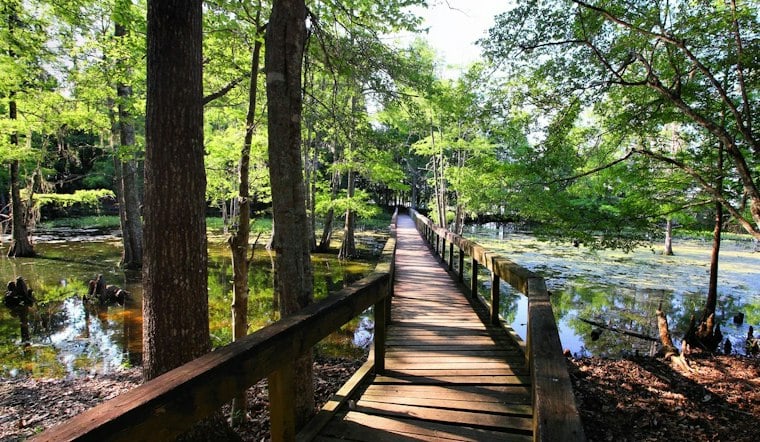
Devil's Sinkhole State Natural Area, about an hour outside Kerrville, is a protected sanctuary in Edwards County spanning 1,860 acres.
The agency announced plans for the trail system this week, and Texas Parks & Wildlife
teased the news on social media, noting that the park, long limited to guided tours, is set to gain its own trails system. According to the
Texas Parks and Wildlife Department
The historic Whitworth Ranch was the first operation in the area to raise sheep before being split up when the state natural area was originally established in 1985.
A Decades-Old Restriction Finally Loosens
For most of its history, Devil's Sinkhole has been one of the hardest Texas state properties to simply walk into. Visitors couldn't wander the grounds on their own; access has required a reservation and an escort. Under the department's development plan, the park will gain an extensive 10-mile trail system over the next few years for birding and hiking, along with long-term proposals for a park headquarters, a maintenance facility, and overnight camping opportunities, the agency's release states.
That shift matters because of just how little traffic this site has historically seen. Due to its guided-tour-only restriction and lack of open public trails, Devil's Sinkhole State Natural Area has ranked as the least-visited facility in the Texas state park system, logging roughly 1,505 annual visitors, according to the state park to Thetravel. The new trail network, once built out, stands to dramatically change that trajectory for a park that has operated more like a scientific preserve than a typical weekend hiking destination.
What's Actually Down in the Sinkhole
The feature that gives the park its name is a geological standout even by Texas standards. Devil's Sinkhole features a 50-foot-wide circular surface opening that drops 140 feet into a cavern reaching a total depth of 350 feet and spanning more than 320 feet across, making it Texas's largest single-chamber cavern and fifth-deepest cave, per Texas Highways. The cavern formed over millions of years as underground water slowly dissolved the limestone beneath the Edwards Plateau.
That same opening also shelters one of the state's largest bat colonies. The sinkhole hosts an estimated 3 million Mexican free-tailed bats from May through October, and the colony consumes roughly 30 tons of moths and agricultural insects every night, according to Live Science. Managing public access around that seasonal bat emergence will be central to how TPWD balances new trails with protecting the cave's most important residents.
How the Expansion Gets Paid For
Texas voters approved a 2019 constitutional amendment dedicating 100 percent of sporting goods sales tax revenue to parks. The amendment provides a dedicated funding stream for park projects statewide.
The site's dark skies also offer potential for stargazing. The department plans to build dedicated stargazing and astronomical observation into its long-term programming for the site, per the same release.
A Long Road From National Landmark to Public Park
Devil's Sinkhole's path toward public access has been a slow one. The site was designated a National Natural Landmark in 1971, purchased by the State of Texas in 1985, and first opened for guided public visitation in 1992, according to the Texas State Historical Association. For more than three decades since, entry has stayed tightly controlled.
Day-to-day visitation and educational programming are handled through a partnership with the Devil's Sinkhole Society, a local volunteer nonprofit founded in 2001 that runs guided tours departing from Rocksprings, according to the Texas Pecos Trail Region. As the state natural area's master plans move forward, that local partnership is expected to remain central to how tour logistics and historic interpretation adapt alongside the new trails, headquarters, and camping amenities still to come.




