

























































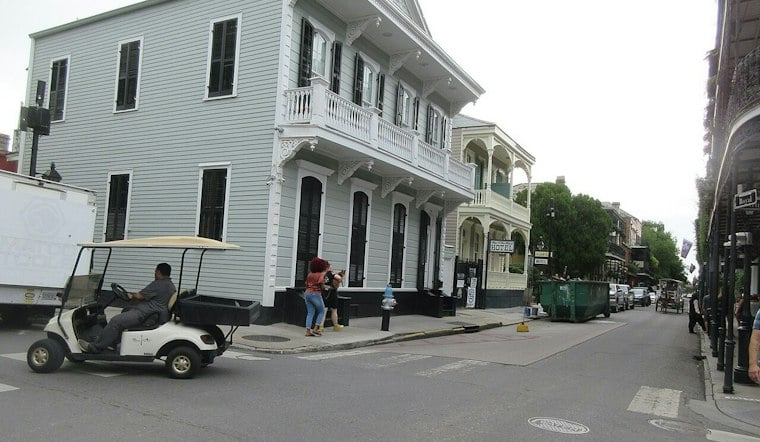
Donaldsonville residents have been cruising around town in golf carts for a while now, technically breaking the law the whole time. That changed Oct. 27, 2026, when the Donaldsonville City Council approved an ordinance allowing golf carts on municipal roads and setting rules for who can drive them and how.
The move follows years of informal use across town, with residents driving golf carts without any formal authorization, according to The Advocate. City officials had been working to legalize golf cart use on municipal streets, and in the meantime, law enforcement had pulled over some residents caught driving them, per city officials cited by the outlet.
Under the new ordinance, golf carts can operate on municipal streets under Donaldsonville's jurisdiction where the posted speed limit is 35 mph or less, as long as the carts comply with state law. Carts can be driven during both daylight and nighttime hours, but they remain barred from sidewalks and pedestrian pathways.
Who Can Get Behind the Wheel
The rules are fairly specific about who qualifies to drive. Operators must be at least 16 years old and hold a valid driver's license, and they're required to follow standard traffic laws just like any other vehicle on the road. Occupancy is capped at the number of designated passenger seats in the cart.
Passengers can't ride on someone else's lap, including children, and nobody is allowed to stand or ride on the rear, sides, roof, running board or any other part of the cart not built for passengers. The ordinance also spells out what it doesn't cover — lawn mowers, tractors, four-wheelers, all-terrain vehicles, utility terrain vehicles, go-karts, electric scooters, electric bicycles and other off-road vehicles are all still excluded.
Permits, Fees and a Potential $500 Fine
Before the ordinance can be fully put into practice, Donaldsonville still has to establish permit procedures, obtain decals for golf carts and install the required road signage. The City Council must also set golf cart permit and renewal fees through a separate resolution, though the fee itself cannot exceed $75.
Anyone convicted of violating the ordinance could face a fine ranging from $100 to $500, imprisonment for up to six months, or both. The council also retains the authority to prohibit or restrict golf cart use on any municipal street, or part of one, when it's deemed reasonably necessary for traffic control or public safety.
The Honest Admission From the Council Chair
Council chair Charles Brown Sr. didn't shy away from the awkward reality that preceded the vote. He said golf cart drivers can now feel comfortable knowing their use is legal, but he also admitted he'd felt bad about breaking the law himself while serving on a legislative body responsible for upholding it, according to The Advocate.
State Highways Remain the Big Obstacle
The ordinance doesn't resolve every question golf cart owners might have. Donaldsonville is still working through how carts can legally cross state highways, a gap that city attorney Spencer Long called the main remaining hurdle to getting around different parts of town. Long said additional legislation is needed to authorize those crossings, and he expects approval for golf cart crossings of state highways will likely come next year.
There's also an open question about registration that the ordinance doesn't fully settle. Louisiana law, per the Louisiana State Legislature, states that golf carts operated on a parish road or municipal street must be registered with the state through the Department of Public Safety and Corrections' Office of Motor Vehicles and display a state-issued decal. A separate statute snippet from the Louisiana State Legislature, meanwhile, describes golf carts and low-speed vehicles being registered with the local governing authority, which issues its own registration decal. The two provisions point to different registration authorities, and it remains unclear which will govern Donaldsonville's permit process as the city finalizes its rules.





