

























































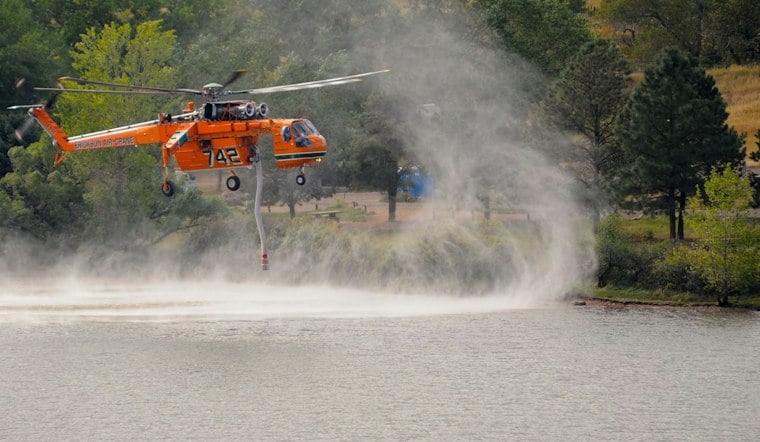
Douglas County is planning a new hangar for its Helitack program, giving the county's firefighting helicopter and crew a permanent home after crews moved the aircraft into a salt and sand storage shed during bad weather.
The project traces back to June, when the Douglas County Board of Commissioners unanimously approved a $4.2 million contract with TCC Corporation to build the facility, according to Denver7. The exact figure approved by commissioners was $4,221,302 for site development and construction, as reported by the Denver Gazette. That outlet noted groundbreaking was expected roughly 90 days after the contract's approval, with the facility projected to open in spring 2027.
Replacing a Storage Shed With a Real Hangar
Until now, the county's firefighting helicopter has been moved into a salt and sand storage shed whenever severe weather rolled in, a workaround that provides protection but can delay takeoff, per the Denver Gazette's reporting. The new hangar is meant to shield the aircraft from weather events like recent hail storms, the paper reported. Denver7 adds that the facility will serve as a home for the county's firefighting crews and aircraft, and that the project marks the first phase in expanding Douglas County's Regional Joint Public Safety Training Center.
Douglas County has described wildfire risk as the No. 1 public safety risk to the community, according to Denver7, and officials point to the county's unusual setup as justification for the investment: Douglas County is unique in having its own Helitack team. The county put $1.5 million toward acquiring access to a Type 2 helicopter for wildfire response, the outlet reported, while a separate report from CBS News Colorado describes the county contracting the Trans-Aero helicopter for exclusive use from June through October, with an option to extend through November if wildfire season drags on. The aircraft can carry more than 300 gallons of water along with a team of firefighters, per that report.
A Team Built for Rapid Response
The Helitack operation runs on eight full-time team members, backed by more than 20 deputies cross-trained in wildland hand-crew firefighting, according to the Castle Pines Connection. Eight Douglas County Sheriff's Office Emergency Services Unit deputies serve as the county's primary helitack firefighters, the outlet reported, and it described the Douglas County Sheriff's Office as operating the only county-sponsored Helitack program in Colorado. The team had responded to 27 fires so far in 2026 as of that report, which also detailed the crew executing 45 water drops in the first four hours of the Penley Fire.
Speed has repeatedly been the headline number in past responses. During the Penley Fire, the county's helicopter reached the scene in less than 10 minutes and made 36 water drops, according to KDVR. In an earlier incident detailed by the Douglas County Sheriff's Office, the chopper was in the air within 10 minutes of the first fire report and completed 88 water drops totaling 26,400 gallons. The sheriff's office separately reported that during one July, the team logged more than 48 hours of flight time and dropped 116,000 gallons of water.
A Resource That Crosses County Lines
The Helitack team's reach extends well beyond Douglas County's borders. CBS News Colorado reported the crew has responded to fires in Jefferson, Teller and El Paso counties, and described a busy weekend in which the helicopter answered calls including a destructive brush fire in Byers in Arapahoe County, a plane's emergency landing and three smoke checks. Figures on the program's total track record vary by source and time frame: the Denver Gazette reported the helicopter had responded to 112 fires over nine years, including 81 in Douglas County, while the Castle Pines Connection reported the team had put out more than 130 fires since 2018 as of August. Those counts appear to reflect different measurement periods and should not be treated as interchangeable.
The county's wildfire strategy extends beyond the aircraft itself. The Castle Pines Connection reported on the Douglas County Wildfire Action Collaborative, a partnership involving Douglas County, the sheriff's office, Pano AI, CORE Electric Cooperative and Xcel Energy, aimed at broader wildfire detection and response. Officials have framed the new hangar as an investment in people, equipment and preparedness, amid broader efforts to protect homes and open space from wildfires across the region.





