

























































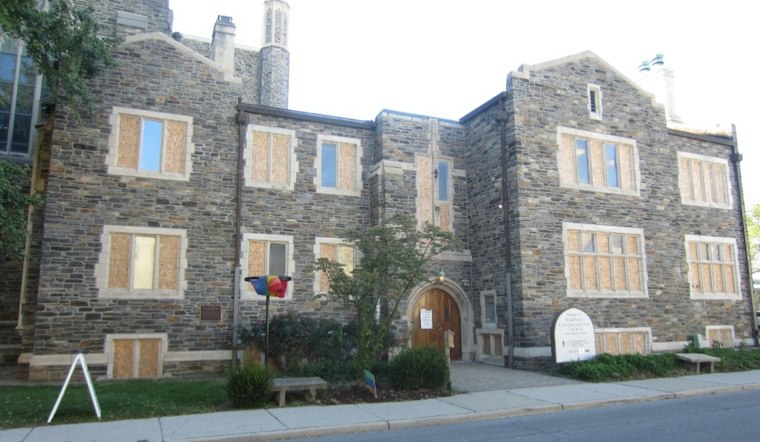
Stone masonry worn by nearly a century of Ohio winters, crumbling front steps and aging stained glass windows are getting a $1 million overhaul at First Congregational Church in downtown Columbus. The historic building, tucked between two of the city's most recognizable civic landmarks, has stood at its East Broad Street address since 1931 and is now the subject of a major preservation effort meant to carry it into its next century.
The project is being funded through a mix of donations, nonprofit grants and fundraising from the church's own congregants, according to WOSU Public Media. The station reports that the National Fund for Sacred Places, the National Trust for Historic Preservation and the Columbus Foundation will together provide $600,000 toward the work, with church members and community partners responsible for raising the remaining costs. A separate project page from the National Fund for Sacred Places describes the funding differently, listing a $250,000 National Fund grant paired with $500,000 in matching funds raised by the congregation for masonry and stained-glass restoration — a discrepancy that has not been resolved between the two accounts.
Berglund Construction is carrying out the physical work, operating under the supervision of the Schooley Caldwell architectural firm, the station's report notes. The scope includes updates to the building's stone masonry, its front steps, its stained glass windows, and new landscaping around the property.
A Church Built Into the City's Civic Core
First Congregational Church sits on East Broad Street in downtown Columbus, positioned between the Columbus Museum of Art and Washington Gladden Social Justice Park — a stretch of the city's cultural corridor that places the church squarely in the public eye. The building dates to 1931, when, per the same account, it was constructed at the East Broad Street site it still occupies today. WOSU's reporting attributes the design to architect John Russell Pope, who also designed the Jefferson Memorial, the National Archives building and the West Building of the National Gallery of Art. A National Park Service record snippet for the property lists a different set of architects — Adams, George; Charles Alston Beaden; L.C. Johnson; and A.J. — though that listing carries low confidence and the discrepancy has not been independently verified.
The church is individually listed on the National Register of Historic Places, according to the National Fund for Sacred Places. Its congregation traces back to the late 1840s and formally organized in 1852, per First Congregational Church's own history page.
A Legacy of Social Justice Advocacy
The congregation supported anti-slavery causes during the Civil War, and its history of activism deepened under pastor Washington Gladden, who led the church from 1882 to 1918, according to the National Fund for Sacred Places. Gladden advocated for civil rights, workers' rights and voting rights during his tenure, a legacy now literally memorialized next door in the park that bears his name.
Sarah Reed, moderator of First Congregational Church, framed the preservation effort as more than a maintenance project. The restoration is about caring for a place where Columbus history was made through interfaith social justice efforts, Reed said, per the station's report.
Part of a Broader National Push
The National Fund for Sacred Places has seen demand for its grants surge in recent years. The fund received nearly 500 applications in 2024, a 31% increase over the prior year, according to the National Trust for Historic Preservation. By October 2024, the fund had awarded or pledged more than $26 million to 138 congregations across 42 states, the District of Columbia and Puerto Rico, spanning 26 faith traditions. That year's program admitted 24 historically significant faith communities into its grantmaking pipeline, placing First Congregational Church's restoration within a much larger national effort to shore up aging sacred spaces.
No completion date or reopening timeline for the Columbus project has been made public. What is clear is that a building shaped by abolitionist roots and decades of civil-rights advocacy is now getting the structural attention its supporters say it needs to keep serving downtown Columbus for generations to come.


