

























































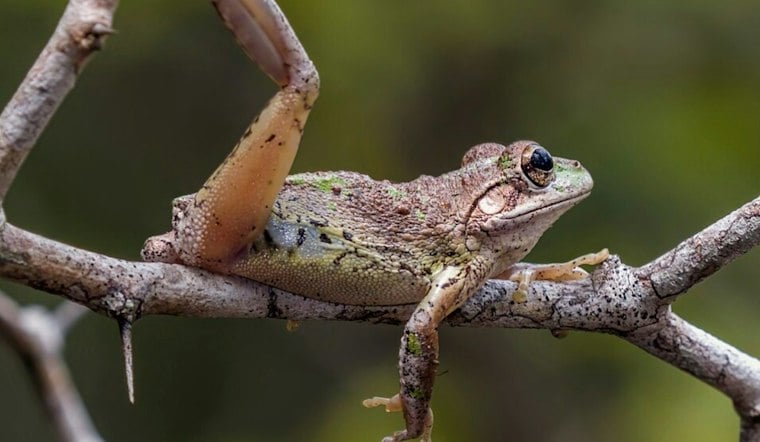
Donna Degregory stepped outside her Orlando home and found dozens of tiny dark spots covering the exterior walls — a scene she and her neighbors soon identified as a swarm of suspected Cuban treefrogs, an invasive species that has spread across Florida for decades. The sudden appearance came after several days of rain soaked the region, and neighbors nearby reported the same unsettling coating of small frogs across their own properties.
A Rain-Triggered Population Explosion
Degregory noticed the spots and identified them as suspected Cuban tree frogs, according to a FOX 35 Orlando report. The timing lines up with how the species reproduces: a single large female Cuban treefrog can lay more than 15,000 eggs in one breeding season between spring and fall, with warm rainfall and tropical weather systems triggering rapid spawning, according to the University of Florida UF/IFAS. Heavy rain creates the temporary standing water the species needs to breed quickly and in large numbers.
The Florida Fish and Wildlife Conservation Commission has reported that Cuban tree frogs are dangerous for the local ecosystem, per the FOX 35 report. The frogs are considered an invasive species found throughout Florida, and they outcompete native frogs for food and space — in some cases eating native frogs outright, the outlet notes.
What the Swarm Means for Pets and People
Ron Magill, a wildlife expert with the ZooMiami Foundation, told FOX 35 that Cuban tree frogs can irritate human skin and eyes but generally pose no serious danger to people or pets. The frogs contain a skin substance that may cause irritation if touched, and Magill said a dog that bites or eats one may develop a mild upset stomach or vomit. He added that the species is less toxic than large cane toads, a distinction echoed by the Pet Emergency & Referral Center, which notes that Cuban treefrog secretions lack the deadly parotoid gland toxins found in invasive cane toads, toxins capable of inducing fatal seizures or cardiac arrest in dogs. Hoodline covered a Bufo toad scare in South Tampa earlier this year involving that more dangerous species.
Magill advised people to avoid handling the frogs if possible, and said large concentrations of young Cuban tree frogs typically disperse on their own within a few days. Experts were unable to confirm the species of the Orlando frogs with complete certainty, attributing the uncertainty to the frogs' young age and the inability to examine them in person, per the same report.
Beyond the Yard: Clogged Drains and Power Outages
The nuisance extends well past a few spots on a wall. Cuban treefrogs frequently invade human structures, clogging sink drains, colonizing birdhouses, and leaving fecal stains on exterior windows and walls, according to WTSP 10 Tampa Bay. The species has also been known to climb power poles and nest inside electrical transformer switch boxes, where their large bodies can bridge contacts and short-circuit power grids, causing utility blackouts across the state, according to UF/IFAS News.
Identifying a young Cuban treefrog without harming a native species can be tricky. Adult Cuban treefrogs reach 5 to 6 inches in length, more than double the size of native green or squirrel treefrogs, but juveniles lack that size difference. Young Cuban treefrogs can instead be distinguished by blue-colored bones visible through the skin on their underside, according to the U.S. Geological Survey.
What Homeowners Are Told to Do
If the frogs remain a problem after a few days, homeowners can contact FWC for help identifying and humanely euthanizing them, per the FOX 35 report. University of Florida Extension guidelines recommend applying a benzocaine- or lidocaine-based ointment to a captured frog's belly to render it unconscious before sealing it in a plastic bag and placing it in the freezer overnight. Releasing captured nonnative animals like Cuban treefrogs back into the wild is illegal under Florida Statutes Section 379.231, classified as a Level Three wildlife violation, according to the Florida Senate.
Removal efforts can make a measurable difference for native wildlife. In controlled South Florida field studies conducted by the USGS and the University of Florida, removing invasive Cuban treefrogs led to significant population recoveries among native squirrel treefrogs and green treefrogs, according to University of Florida Croc Docs. Researchers with the UF Thompson Earth Systems Institute have also projected that warming regional climate trends could eventually allow the species to expand permanently beyond peninsular Florida into the state's north and neighboring states, as hard winter freezes have historically kept the frogs contained to the peninsula.



