

























































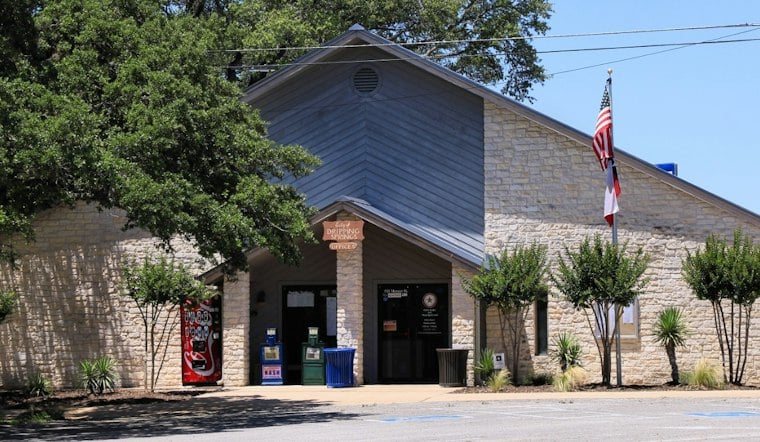
Owners of an average-value homestead may see a small decrease in their city tax bills after officials adopted a $28.6 million budget and a lower-than-originally-planned property tax rate for fiscal year 2026-27 — a rate that almost came in roughly 27 cents higher per $100 of valuation due to a calculation error that a resident caught before the city could adopt it.
A Form Error Nearly Inflated Tax Bills
The Dripping Springs City Council adopted the FY 2026-27 budget and a tax rate of $0.219217 per $100 of valuation, according to Community Impact. That adopted rate is actually a reduction of $0.007483 from the prior fiscal year's rate of $0.2267 per $100, according to the City of Dripping Springs. But the path to that lower number wasn't smooth. City officials had originally proposed a higher rate before a citizen spotted a calculation mistake, per Community Impact's reporting.
The error traced back to Line 18D of state Form 50-856, the state's truth-in-taxation worksheet governing tax increment reinvestment zones, according to the Hays Free Press. A new state legislative rule took effect January 1, 2026, requiring cities to deduct their 50% TIRZ contribution — a step city staff omitted, the paper reports. The mistake made it appear the city had lost $300 million in property valuation and pushed the maximum proposed tax rate up to $0.2729 per $100, per Community Impact and the Hays Free Press.
Council Rescinds and Recalculates
Deputy City Administrator Shawn Cox said a resident brought the error to city officials' attention before they adopted a rate, according to Community Impact's report; the Hays Free Press identified the resident as Heather Oktay. Acting on that tip, the council voted on September 15 to rescind its August 18 tax action and publish corrected truth-in-taxation worksheets ahead of a final rate vote, according to Citizen Portal. City officials had to re-certify the worksheet and correct the number before adopting an accurate rate, per Community Impact. The council then set the revised proposed rate of $0.219217 per $100 for public notice after confirming the error with state and county officials, the outlet reports.
Mayor Bill Foulds Jr. said the budget year was challenging and that city staff devoted substantial time, work and care to reaching this point, according to Community Impact. He added that the city aimed to balance residents' and businesses' financial pressures with providing services and infrastructure, per the same report.
What the Lower Rate Means for Homeowners
The adopted ad valorem rate includes a maintenance and operations component of $0.173100 per $100, which funds daily city operations such as salaries and utilities, and an interest and sinking rate of $0.046117 per $100, which covers debt payments, per Community Impact. The average taxable value of a Dripping Springs homestead is $571,800, up 1.26% from the previous fiscal year. Owners of a home at that average value can expect to pay $1,253 in city taxes — a decrease of $27 from the previous year, according to the outlet's figures.
The FY 2026-27 budget totals $28.6 million and will raise approximately $4.96 million in property tax revenue, exceeding last year's budget revenue by $360,094.72, per Community Impact. The budget includes $16,836,245 in revenue against $16,047,688 in expenditures, with $4,327,235 earmarked for salaries, $259,851 for public improvements and $223,258 for Founders Day, according to the same report.
Fiscal Tightrope Into FY 2028
Adopting the lower rate is projected to reduce the city's general fund balance carryover into FY 2028 from an anticipated $1.4 million down to approximately $200,000, according to the Hays Free Press. That lower carryover does not change approved FY 2026-27 operations, but it significantly limits how much room the city will have for future supplemental budget requests, the paper notes.
The city's adopted rate includes an interest and sinking component to pay debt, according to Community Impact.
During budget review workshops, city officials prioritized a list of departmental funding requests, including $184,000 for an Archer 8-Barrier Trailer, $85,000 for a maintenance coordinator position, and $150,000 to build out a maintenance facility bay, according to the Hays Free Press.
Growth Pressures Behind the Budget
The tight budget math comes against a backdrop of rapid growth. That expansion has strained local roads, utilities and municipal services, Hoodline's earlier reporting on the city's wastewater woes noted.
In February, city leaders selected engineering and financial advisors to restart planning on a long-stalled South Regional Wastewater System expansion meant to close a $51.5 million funding gap and lift service connection caps, following an April 2025 Texas Supreme Court ruling that cleared legal barriers to the project. Commercial growth is also helping offset the residential tax burden: in January, Target closed on a 10.5-acre purchase along U.S. 290 to build a 145,000-square-foot store anchoring a new retail center in the city, Hoodline's coverage of that deal noted.
Separately, the Dripping Springs Independent School District Board of Trustees adopted a lower-than-expected overall tax rate of $1.0985 per $100 of valuation for FY 2026-27 on September 28, resulting in an estimated $6,179.58 school tax bill for an average homestead valued at $562,547, according to the Hays Free Press. The school district's tax rate also contributes to residents' property tax bills, meaning the city's modest reduction is only one piece of the overall property tax picture for Dripping Springs residents.



