

























































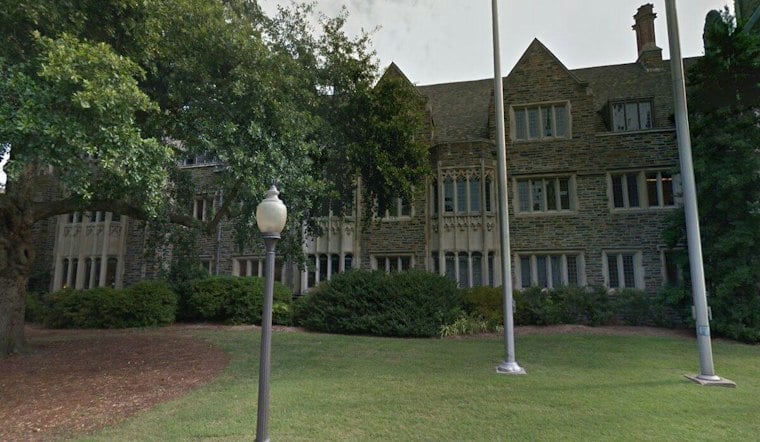
Student organizers in Durham spent more than a month trying to hold a pro-worker rally at Duke University this fall, only to cancel it at the last minute after administrators ordered the approved event moved to an obscure corner of campus the night before it was set to happen. The episode has reignited a long-running fight over Duke's protest registration rules, which require students to seek the university's approval before they can demonstrate against the university itself.
A Rally Approved, Then Relocated Overnight
The rally was organized by Sunrise Duke in coalition with Durham Rising, a Duke worker coalition, according to the Raleigh News & Observer. Duke initially approved the pro-worker rally for a date in September, but the night before the event, the university required organizers to relocate to a little-known campus location, the paper reports. Student organizers ultimately canceled the rally rather than hold it at the new site.
Isa Cheng, one of the student organizers, told the outlet that Duke's protest policy is frustrating, horrible, and repressive. Cheng said students did not want university support for the demonstration or to register it in the first place, arguing that registering a protest effectively turns it into a university-approved event rather than an independent act of dissent. Duke administrators had also reviewed Sunrise Duke's Instagram posts about the planned rally and objected to the prominence of Durham Rising's logo in the rally graphic, and at one point asked whether rally attendees would be participating as workers or as community members, per the same report.
How Duke's Registration Rules Work
Under Duke's Pickets, Protests and Demonstrations policy, students must register any protest more than two weeks before it occurs, providing the anticipated crowd size, noise levels, a protest plan, a site map, and a designated point of contact. Microphones or speakers are permitted only between noon and 1 p.m., and the university treats every protest as an event subject to pre-registration, with the authority to approve or deny requests. Duke made its event registration requirements more stringent in 2024, though a version of the protest policy itself has existed since the 1970s, according to the News & Observer's reporting. Students who hold unregistered protests may face disciplinary action, though Duke has reported that no students were found responsible for violating the policy in the last two years.
Duke executive vice provost Mohamed Noor defended the framework, saying the event procedures provide a structure for reasonable resources and planning. Noor also said some campus protests grow quickly, become unsafe, and have at times resulted in serious injury or violence elsewhere. Duke maintains that its approval process focuses on logistics — location, staffing, venue availability, and public safety — rather than the content of the speech itself, and the university has said it remains committed to academic freedom and free speech.
Legal Scholars Split on First Amendment Limits
Jeff Powell argued that Duke's two-week registration deadline could allow the school to punish students for spontaneous protests, and said such a policy would not survive at public UNC-Chapel Hill, which as a public university is bound by the First Amendment. Stuart Benjamin countered that the First Amendment protections Powell described simply do not apply to private Duke University, which retains broad legal discretion over its own campus. Emily Rogers went further, describing Duke's protest policy as arguably one of the most repressive in the country and questioning whether Duke administrators use the policy to discriminate against disfavored speech.
That private-public divide is written into state law. Public North Carolina universities, including UNC-Chapel Hill, are governed by the 2017 North Carolina Restore Free Speech Act, which legally bars public campus administrations from restricting peaceful assembly or outdoor speech based on content, according to UNC-Chapel Hill. That statute does not reach private institutions like Duke, leaving the school full control over how it treats on-campus demonstrations.
Faculty Pushed for Overhaul, Administration Yet to Act
A Duke faculty committee that studied 10 peer schools concluded Duke is an outlier in treating protest as an event requiring registration at all. The committee recommended a complete overhaul of the university's protest policy, including designating campus spaces for open expression without pre-registration. The Duke administration has not taken action on that recommendation, though Noor said university leadership is working with faculty governance to determine next steps, and that Duke aims to make its expressive-activity policies accessible, clear, predictable, and focused on safety and operational continuity.
The faculty committee's conclusion echoes a broader campaign that has been building for more than a year. In late 2024, more than 140 Duke faculty members signed a petition organized by Duke Faculty for Institutional Neutrality and Free Speech urging the administration to adopt neutrality on off-campus political issues while protecting non-disruptive student protest, a push that drew support from more than 60 percent of surveyed faculty. More recently, in March, the advocacy group Duke Academics and Staff for Justice in Palestine issued a formal statement calling for the complete abolition of the Pickets, Protests and Demonstrations policy, asserting that pre-registration requirements suppress spontaneous collective action.
A Policy Tested Before — and Overturned
The current fight is not the first time Duke's protest rules have been put to the test. In November 2024, seven Duke students and faculty members, known as the “Duke 7,” faced formal disciplinary charges under the revised policy following a nonviolent demonstration on West Campus during a visit by former Israeli Attorney General Avichai Mandelblit, according to Muslim Advocates. In April 2025, Duke's University Judicial Board cleared all seven of them, finding no evidence their actions caused disruption or violated specific university rules — a result organizers called an unprecedented use of the judicial process for campus speech.
Duke's history with unregistered, spontaneous protest runs even deeper. In 1969, between 45 and 75 Black students from the Duke Afro-American Society occupied the Allen Building to demand the creation of a Black Studies department, a standoff that ended with state police using tear gas on campus quad crowds, according to historian Theodore D. Segal; the occupation directly led to the founding of Duke's Black Studies program. In 2016, Duke students occupied administrative space over wages and working conditions, per TIME. Duke's campus minimum wage eventually reached $15 an hour by 2019 following continued activism.
Where Duke Ranks Nationally
Duke's current climate for student expression has drawn national scrutiny. In the Foundation for Individual Rights and Expression's 2027 College Free Speech Rankings, published in September, Duke ranked 50th among 261 evaluated U.S. colleges and received a D+ climate grade, with the group citing declining student comfort in expressing controversial ideas — even as Duke retained a nominal green light rating for its written policies, according to FIRE. Public North Carolina universities dominated the top of those same rankings, with Appalachian State placing 8th and UNC-Greensboro 11th, while Duke led the state's private colleges at 50th, per Carolina Public Press.
Duke's policy also carries hard physical limits that apply regardless of registration status. The university explicitly bans all pickets, protests, demonstrations, and mass assemblies inside or directly surrounding any Duke University Health System building, a restriction meant to ensure uninterrupted medical operations. For now, student organizers like Cheng say the registration system itself remains the core grievance — not the destination of a rally, but the fact that holding one at all requires Duke's own sign-off.



