

























































At Hager Park in Georgetown Township, visitors can walk from the Pacific coast to the Atlantic — all without leaving Ottawa County. The park's sprawling relief map of the United States, complete with state lines, rivers and mountain ranges rendered in raised berms and gravel outlines, has drawn families for decades. But after more than 50 years of exposure to Michigan weather, the landmark had fallen into disrepair, until a local teenager decided to bring it back.
Wyatt Nance, a 17-year-old Eagle Scout with Troop 354, led the restoration of the map last year as his Eagle Scout project, according to MLive.com. Hager Park serves as the home park for Troop 354, and its scouts have long played an annual game across the map's oversized states and mountain ranges, per the same report. Nance told the outlet he measured the extent of the damage by overlaying a standard U.S. map onto aerial imagery of the attraction before planning the repair work.
Years of Wear Blurred the Borders
Weather and wear had faded the map's borders, let grass obscure its rivers, and made some sections difficult to recognize, MLive.com reported. A fundraiser organized by Nance described the damage in similar terms, noting that “the edges are overgrown, the rivers are grassy, and the borders are indistinguishable,” according to the GoFundMe campaign he launched for the project. That same fundraiser noted the map is more than 50 years old and is not in the best condition.
The campaign explained that contributions would cover materials for the Eagle Scout project as well as resources for volunteers, including canopies and water. In the end, the restoration was funded by community donations and involved more than 50 volunteers working over multiple days in the summer of 2025, MLive.com reported. Those volunteers restored the map's borders and geographic features and cleaned up the surrounding site, while restoration funds purchased stone and landscaping materials, including limestone used to highlight the map's lakes and waterways, per the outlet's account.
A Park Built for Wandering
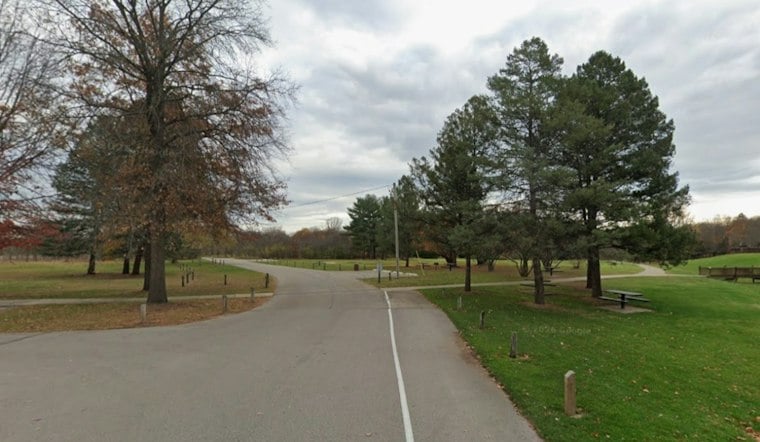
Hager Park itself is a 104-acre family park with extensive picnic areas, nature trails and a mature hardwood forest, according to Ottawa County's park department. The relief map sits near the Age of Discovery playground, which overlooks the terrain feature, and the county notes there are no entry or launch fees to visit. The Ticket 95.3 has described the map as a place where a coast-to-coast walk is entirely possible, writing simply, “you can certainly do that here.”
Reports differ on the map's exact street address: WGRD lists Hager Park at 1834 28th Ave. in Ottawa County, while The Ticket 95.3 has reported the address as 8212 28th Avenue in Georgetown Township. WGRD also describes how raised berms and gravel outlines mark state boundaries along with features like mountain ranges and rivers across the walkable terrain.
Families Finding Their Own Map Memories
For some visitors, the map is less about geography lessons and more about personal history. Ryan Boersen visited Hager Park with his wife and four children and told MLive.com the map brought back memories of his own childhood. His kids, meanwhile, used the map to recall family trips to Florida and Tennessee, and pointed out family homes in Georgia and Tennessee as well as hunting trips to Idaho, according to the outlet's report.
MLive.com frames the attraction as an interactive geography-learning tool for children, one that turns an afternoon outing into a tactile lesson in state lines and river systems. Ottawa County's park department notes that the adjacent Age of Discovery playground overlooks the terrain map.
What Comes Next for the Landmark
Nance told MLive.com he hopes scouts will continue caring for the landmark going forward. He said he would like to see Troop 354 scouts formally adopt the map as an ongoing community service project, ensuring the restoration work doesn't fade the way the original map eventually did. For a landmark that's already outlasted half a century of Michigan seasons, that kind of standing commitment could be what keeps the coast-to-coast walk open for the next generation of park visitors.





