

























































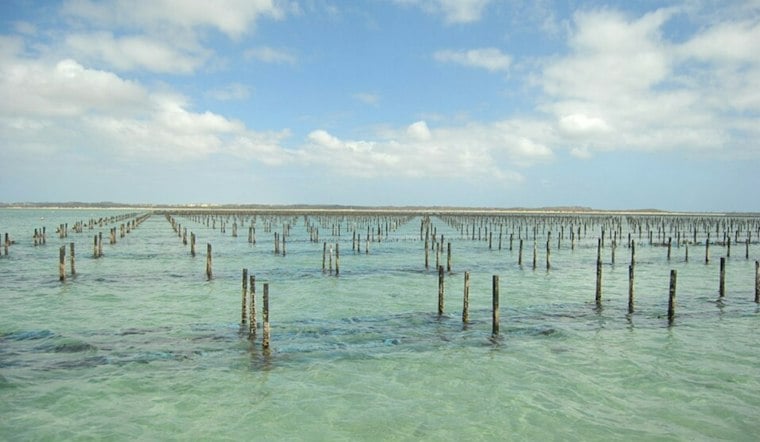
Alex Lambert watched a harmful algal bloom wipe out nearly his entire 4,000-basket oyster farm on Hungars Creek in Northampton County last month, a loss he estimates at roughly $400,000. The farm salvaged only about 10 percent of its baskets after the bloom triggered total mortality across most of its stock.
Lambert Shellfish, founded in 2018 after Alex Lambert left a finance career in New York, had grown to produce nearly 1 million oysters annually along Hungars Creek before the bloom hit, according to Virginia Water Trails. The entire growing operation sits within 150 yards of the family dock. As reported by The Virginian-Pilot, a local grower first alerted Lambert on September 17 after spotting discolored water in nearby creeks, prompting his crew to rush and move about 500,000 smaller oysters to shore. Those oysters appeared healthy at the time, but the farm went on to lose about 250,000 of its 1- to 2-inch oysters as the bloom's effects became evident. Nearby growers survived the same bloom, and the newspaper reports this marks the farm's most widespread loss to date.
A Bloom That Changed Character Twice in Two Months
The outbreak didn't start as the species that ultimately devastated Lambert's farm. Per the Pilot's reporting, a bloom of Margalefidinium polykrikoides, nicknamed “Marge” and carrying no known attributed toxin, began in the Lafayette and York rivers in July before populations appeared near Tangier Island in September. By September 12, the bloom had transitioned into Alexandrium monilatum, known as “Alex,” with bioluminescence reported near Tangier Island the same day. Unlike Marge, Alex produces a toxin that directly harms shellfish and fish, with disastrous effects specifically on oysters, the outlet notes.
Researchers attribute the bloom's transport down the bay to a meteorological phenomenon, and the Pilot reports the algae reached the Eastern Shore on September 17 — the same day the local grower called Lambert. Old Dominion University researcher Margaret Mulholland told the paper the exact trigger initiating the bloom remains unknown, while fellow researcher Hamish Small noted that Alex does not bloom every year; the last large Alex bloom in the Chesapeake Bay occurred in 2017, and this was the first time one reached Lambert's farm specifically.
Scientists Map the Bloom's Reach Across Eastern Shore Creeks
Researchers from William & Mary's Virginia Institute of Marine Science documented a near-continuous bloom stretching from Cape Charles north to south of Nassawadox Creek in September, with elevated activity in Hungars, Nassawadox, and Cherrystone creeks. Water samples confirmed dense bloom concentrations directly surrounding Lambert Shellfish's location on Hungars Creek. VIMS explains that Alexandrium monilatum thrives in water temperatures reaching at least 28°C and salinities above 20 parts per thousand, forming blue-green bioluminescence at night while producing a lipophilic toxin called goniodomin A that harms marine organisms as it reproduces rapidly in warm late-summer waters.
The species was first conclusively identified in Chesapeake Bay waters in 2007 in the York River and has reoccurred almost annually during late summer months since, according to VIMS, after historically blooming along the Gulf Coast before expanding into the mid-Atlantic. Laboratory toxicity bioassays detailed in W&M ScholarWorks research showed that 96-hour unfed exposure to the organism caused 67 percent mortality in triploid Eastern oysters, with gill and mantle tissue erosion found in 94 percent of exposed specimens, while shorter 48-hour exposures produced lower immediate impacts.
The Virginia Department of Health issued a public health advisory on September 21 warning the public and pets to avoid contact with reddish-brown discolored water along the southern tip of the Eastern Shore because of potential skin irritation, according to the Cape Charles Mirror. Health officials noted that decomposing algae created severe dissolved-oxygen drops in local creeks, and the bloom led to reported fish kills across at least seven Eastern Shore creeks as dying algal cells decomposed and created hypoxic dead zones affecting both wild finfish and benthic invertebrates.
Federal Lawmakers Push for Emergency Relief
The economic stakes extend well beyond one farm. Commercial seafood and shellfish aquaculture in Northampton County generates approximately $97.4 million in total economic output and supports 987 local jobs, per VIMS figures, making the industry a primary driver of household income on the Eastern Shore. Statewide, direct farm sales for Virginia shellfish aquaculture reached $81 million in 2024, a 52 percent increase from $53 million in 2018, with Virginia ranking first nationally in both hard clam and Eastern oyster production.
U.S. Representatives Jen Kiggans and Rob Wittman sent a letter in September to Agriculture Secretary Brooke Rollins urging the USDA to provide emergency relief and financial assistance to Eastern Shore shellfish growers facing catastrophic harvest losses, the Cape Charles Mirror reports. The request came as severe oyster mortality and fish kills spread across Northampton County.
Lambert Pushes for an Early-Warning System
Researchers now believe the bloom has dissipated, with last month's nor'easter contributing to its breakup, per the Pilot's account. But the threat hasn't necessarily passed for good — Alex may have settled into sediment and formed cysts with the potential to later disperse, leaving the door open for future outbreaks when temperatures and salinity rise again.
Lambert Shellfish has about a month and a half to place oyster seed before winter growth ends, and the farm tested one liter of oyster seed in its farm waters before beginning seeding the week of October 5. Alex Lambert said the event exposed communication gaps in Virginia's oyster industry and is advocating for an algal-bloom warning protocol. He told the Pilot that two days of warning could have saved all of the farm's seed.



