

























































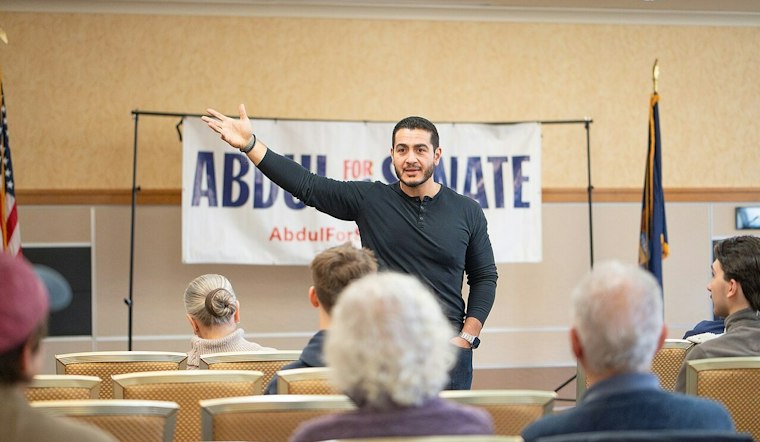
Democratic Senate nominee Abdul El-Sayed and his former primary rival, Rep. Haley Stevens, are set to appear together at a Detroit church on Sunday, just days after Stevens publicly criticized his campaign and her own fiancé announced he would vote for El-Sayed's Republican opponent. The planned joint appearance, two calendar days before Michigan voters decide the general election, would mark the first time the two have campaigned together since El-Sayed narrowly beat Stevens in August's bruising Democratic primary.
According to The New York Times, Stevens and El-Sayed are scheduled to appear at a Black church in Detroit on Sunday as part of a “souls to the polls” get-out-the-vote event, and Stevens has said she was asked to participate alongside El-Sayed and Rep. Jim Clyburn of South Carolina, who backed her during the primary. El-Sayed defeated Stevens in that August primary by just one percentage point, a margin so thin it has shadowed Democrats' efforts to unite behind him ever since, as CNN has reported. A spokeswoman for El-Sayed declined to elaborate on details of the event, and the identity of whoever extended the invitation was unclear, per the Times.
Fox 2 Detroit reports that the Sunday appearance, with Fox 2 Detroit noting Clyburn is expected to join, would be El-Sayed and Stevens's first public appearance together since a Democratic unity breakfast held days after the Aug. 4 primary. The Associated Press also reported on the planned joint appearance, underscoring how closely watched the reunion has become in the campaign's closing days.
Stevens Pledges Her Vote While Pressing El-Sayed on Ads
Stevens has said repeatedly in recent days that she still wants El-Sayed to win, telling reporters, “I still very much want our Democratic nominee, his name is Abdul, to win this race,” according to the Detroit News. Yet the same report notes she told CNN that El-Sayed should “do the right thing” and denounce two ads she described as hateful, and have them removed. The combination of her public pledge to vote for him alongside her pointed criticism has, per the Washington Post, reopened divisions among Michigan Democrats and stirred internal party concerns just ahead of Tuesday's election.
Complicating the picture further, Stevens's fiancé, Jason Turkish, told the Detroit News flatly, “I'm going to vote for Mike Rogers,” referring to El-Sayed's Republican opponent. The outlet reported that Turkish attended a Rogers campaign event Wednesday evening at the Townsend Hotel in Birmingham, and noted separately that he has given nearly $200,000 to federal Democratic candidates and committees this election cycle.
A Primary Scarred by Tens of Millions in Attack Ads
The fight to unify Democrats comes after an unusually expensive and contentious primary season. More than $280 million has been spent on television advertisements in Michigan since the midterm cycle began, per CNN. Accounts of how much of that money targeted El-Sayed specifically differ: WSB Radio reported that nearly $60 million was spent on ads attacking him, including $30 million from the American Israel Public Affairs Committee, while the American Prospect separately reported that he weathered more than $60 million in attack ads overall, without specifying the AIPAC figure.
Black Voter Support Remains a Central Question
Black voters in and around Detroit largely aligned behind Stevens during the primary, CNN reported, and some political leaders have since questioned whether there is sufficient enthusiasm for El-Sayed among that bloc heading into Tuesday. Both El-Sayed and Rogers have been actively courting Black voters, particularly in Wayne County, according to the report from WSB Radio.
The American Prospect has described how El-Sayed has had to push Democrats to coalesce around his campaign and heal scars from the contentious primary, noting there is a history in Michigan of friction between Arab American and Black communities that complicates his effort to build a broader coalition. The Times reported that El-Sayed has acknowledged those longstanding tensions directly, even as he has made significant efforts to appeal to Black voters since securing the nomination, including hosting former Vice President Kamala Harris for her first midterm-election campaign stop.




