

























































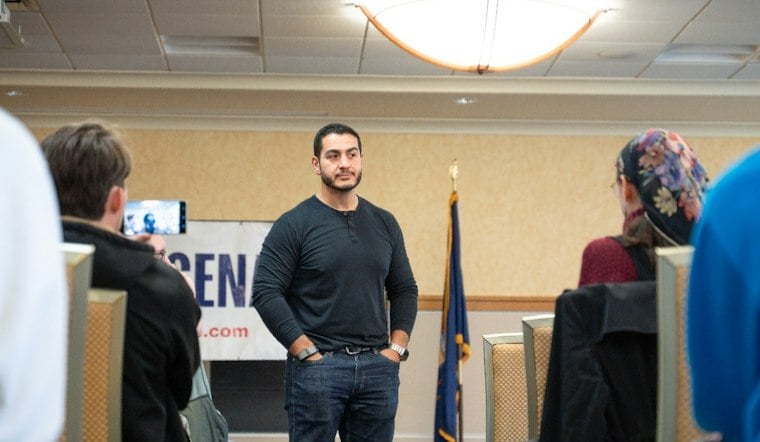
Democratic U.S. Senate nominee Dr. Abdul El-Sayed is calling artificial intelligence the existential crisis of our time, and he says the government needs to get serious about it before it's too late. The Michigan candidate is calling for a ban on superintelligent AI, a ban on recursive self-improvement in AI systems, and a new cabinet-level agency to regulate the fast-moving industry.
El-Sayed's comments come as part of his push to release a detailed AI platform, a move detailed by Tim Balk of The New York Times. He warned that delay could make it too late to act, telling the paper that voters regularly bring up concerns about AI when he's out campaigning and that neither party has been sufficiently focused on the issue. Recursive self-improvement, per the same report, refers to the process of using AI to develop more sophisticated AI models — a loop that researchers worry could spiral beyond human control.
The warning isn't coming from nowhere. AI researchers raised alarms in September about the technology's potentially existential risks, and AI industry executives themselves called for a slowdown in development around the same time, the Times reports. Dario Amodei, a top executive at Anthropic, has said he worried AI might take over the internet within the next year — a comment that underscores just how seriously even industry insiders are taking the risk.
A Platform Built for a Primary, Now Facing the General
El-Sayed's AI stance isn't new to this race. He formally unveiled a 22-point “AI Under Democracy” policy platform in June, proposing mandatory public benefit charters, utility-style regulation, and public equity stakes in AI corporations, according to Bridge Michigan. That approach helped carry him through a crowded Democratic primary field in August, when he defeated U.S. Representative Haley Stevens and State Senator Mallory McMorrow, with primary turnout topping 1.5 million voters compared to roughly 934,000 in the state's 2024 Democratic Senate primary, per PBS News.
According to the Times, El-Sayed is the only Democrat in a highly competitive Senate race publicly calling for a pause on AI development or laying out a comprehensive regulatory program. If elected, the 41-year-old epidemiologist — who led the Detroit Health Department from 2015 to 2017 and served as Wayne County Health Director from 2023 to 2025 — would become the first Muslim member of the U.S. Senate in American history.
Sanders' Fingerprints and a National Progressive Push
El-Sayed's regulatory instincts echo a broader national progressive push. Senator Bernie Sanders, the Vermont independent, introduced the American AI Sovereign Wealth Fund Act in June, proposing a one-time 50 percent stock tax on AI companies with more than $200 million in annual AI-related receipts to fund an estimated $7 trillion public trust, according to Forbes. Sanders has also called for a pause on AI development and a ban on superintelligent AI, and he campaigned last week with Troy Jackson, the Democratic Senate nominee in Maine — though Jackson, unlike El-Sayed, has not made AI a focus of his own campaign, the Times notes. Speaking in Lewiston, Maine, on Sunday, Sanders said the planet should perhaps be run by human beings and not AI.
Rogers Warns of National Security Risk, Skips a Platform
Republican nominee Mike Rogers, who represented Michigan's 8th Congressional District from 2001 to 2015 and chaired the House Permanent Select Committee on Intelligence, has taken a different tack — supporting AI infrastructure expansion while framing technological leadership as a national security imperative, according to WJR-AM. Per the Times, Rogers has warned that AI presents a national security threat and has vowed to prioritize AI regulation if elected, even though he has not released his own AI policy platform. Trump has expressed interest in public-private participation in AI.
The contrast appears to be resonating with voters on at least one slice of the issue: El-Sayed led Rogers by 11 points on who would better handle AI data centers in a New York Times-Siena University poll. In Michigan, local opposition to data centers and concerns among Senate candidates about AI's effects on employment have also featured in the debate.
Michigan's Data Center Boom Fuels the Debate at Home
The AI fight isn't just theoretical in Michigan — it's already playing out in local debates over data-center construction. By September, more than 50 Michigan municipalities — including Dearborn, Oxford Township, Flint, and Garfield Township — had enacted local moratoriums or temporary freezes to study environmental and grid impacts before allowing new construction, Michigan Public has reported.
Attorney General Dana Nessel appealed in August the Michigan Public Service Commission's approval of DTE Energy's power contracts for a 1.4-gigawatt AI data center in Washtenaw County, arguing the commission's ex parte process risked forcing residential utility customers to subsidize corporate power costs, per the Michigan Attorney General's Office.
The debate sets the stage for a race where AI policy — not just campaign rhetoric — could shape how Michigan regulates an industry still expanding faster than many local governments can track.





