

























































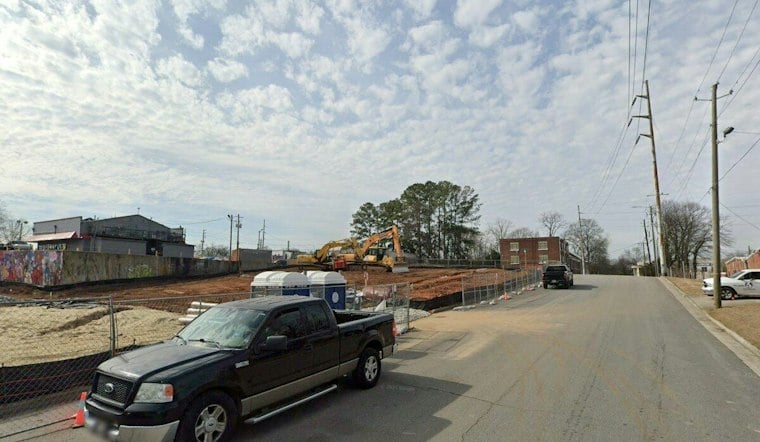
The Proctor is a 137-unit mixed-income building planned for 698 Oliver St. in Atlanta's English Avenue neighborhood. Vertical construction has been paused since January 2026, at about 20 percent completion, leaving the project's path to completion dependent on closing a $5 million budget gap. The developer's account, reported by Urbanize Atlanta, comes less than two years after the project broke ground at a ceremony with the mayor.
Windsor Stevens Holdings now needs $45 million in private capital to complete the building, up from the $40 million previously budgeted, according to Urbanize Atlanta. The outlet reported that managing member Rod Mullice cited fuel costs, general inflation, and tariffs on lumber, concrete, aluminum, and steel. It also reported U.S. diesel averaging almost $6.40 per gallon and annual inflation at roughly 3.5 percent.
Those pressures aren't unique to The Proctor. A survey of 60 leading development and multifamily construction firms by the National Multifamily Housing Council found that 29 percent of respondents reported fewer construction starts, more than half had repriced deals, and about one in four reported increased labor costs as of September 2026, per the same Urbanize Atlanta report. Half of survey respondents also reported unchanged material costs, even as roughly half expect construction conditions to improve over the next six to 12 months and 12 percent expect them to decline.
A $55.6 Million Capital Stack Under Strain
The project's financial closing marked Atlanta Housing's first use of the U.S. Department of Housing and Urban Development's streamlined Local, Non-Traditional/Moving to Work process for mixed-income housing, according to Atlanta Housing. The process is intended to speed federal approvals for voucher-backed private projects.
Mullice has since agreed on terms with lenders to fill the funding gap, per Urbanize Atlanta's reporting, though government partners aren't expected to formally approve the arrangement until mid-November. Windsor Stevens Holdings plans to restart construction in January 2027. Mullice said he's confident he isn't the only builder-developer facing these challenges, a sentiment echoed by Atlanta Housing CEO Terri Lee, who said in June 2026 that surging construction, labor, and insurance expenses have created $5 million to $10 million capital shortfalls per project across the city's affordable housing pipelines, as Hoodline previously reported.
What's Planned for the Building
When finished, The Proctor will rise eight stories with 137 apartments, a three-story parking deck, and roughly 11 for-sale retail units, plus 10,000 square feet of street-level retail space that developer Windsor Stevens has designated specifically for health, wellness, and beauty businesses. The building was designed by Atlanta-based architectural firm Niles Bolton Associates using Type 3, 4, and 5 construction methods.
The affordability component includes 41 units capped for residents earning at most 50 percent of area median income and 55 units capped at 80 percent of area median income, alongside 46 market-rate apartments. Atlanta Housing plans to reserve the rent-capped units for Housing Choice Voucher participants, with those apartments remaining affordable for at least 30 years. Planned amenities include a pool deck, a fitness and yoga room, a dog spa, and a chill room with a full kitchen.
What the Income Limits Mean
As a general benchmark—not a project-specific eligibility determination—the FY 2026 income limits for the Atlanta-Sandy Springs-Roswell HUD Metro FMR Area are $58,900 for a four-person household at 50 percent of area median income and $94,250 at 80 percent, according to Henry County's income-limits summary, sourced to HUD Exchange.
Part of a Bigger Westside Push
The site sits about one block south of the Westside BeltLine Connector, a greenway trail linking the main Atlanta BeltLine loop directly to downtown, and immediately west of Brock Built Homes' 30-unit Oliver Street Townhomes. WS Proctor Co. purchased the assemblage of properties for $3.75 million in March 2022 before Mullice's firm, which he founded, broke ground in December 2024 alongside Mayor Andre Dickens at a ceremonial groundbreaking.
That event fit into a broader citywide campaign: the Dickens administration reported in May 2026 that more than 11,000 affordable housing units were completed or under construction toward the city's goal of 20,000 units by 2030, while Atlanta Housing had reached 8,830 units toward its own 10,000-unit benchmark. Atlanta Housing has called The Proctor a visionary and monumental step forward in creating attainable housing.
English Avenue has become a hotspot for exactly this kind of reinvestment. Nearby, the 201-unit Legacy at Herndon Square Phase II has already opened on the former Herndon Homes site, and the planned 54-unit The 404 @ Oliver Street affordable housing project is also moving forward in the same corridor. Mullice said Windsor Stevens, its partners, and its team remain committed to the project, which would join that wave of residential growth in the neighborhood if construction resumes as planned.
Roots in Liberty County
Windsor Stevens itself carries a personal history. Mullice named the firm after his 19th-century ancestor, a Liberty County, Georgia native born into slavery who successfully filed a $266 property claim with the federal government for livestock confiscated during the Civil War. The company launched in 2015 with The Pad on Harvard, a $20.9 million apartment complex adjacent to the College Park MARTA station that represented College Park's first new multifamily build in 40 years.
Atlanta Urban Development, a nonprofit that develops underused public land into mixed-income housing, has been among the partners tied to the broader Westside push. For now, The Proctor stands as a visible marker of how far rising material and fuel costs can stretch even a well-capitalized affordable housing deal, with its next milestone resting on government sign-off expected in mid-November.





