

























































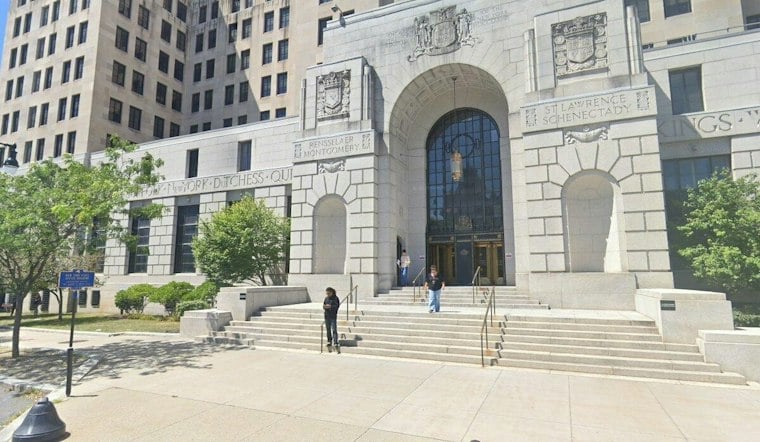
The East Greenbush Police Department has resubmitted Peter E. Lavin’s separation paperwork as a removal for cause, a classification that could lead the state to revoke the former officer’s basic police training certificate. The state Division of Criminal Justice Services rejected the department’s Aug. 12 submission because Lavin’s employment status was incorrectly reported. Lavin, the son of a former department chief, was arrested on stalking charges before resigning.
A Resignation Reported, Then Rejected
Lavin was arrested by state police in July on stalking charges, according to the Times Union. Police said Lavin, who was 40 at the time of his arrest, sent messages to his estranged wife through a court-ordered co-parenting smartphone application in March, and that those messages caused her to fear for her safety. He was arrested July 28, 2026, and arraigned in Schodack Town Court on misdemeanor stalking charges that same day.
Ten days after his arrest, on Aug. 7, Lavin submitted his resignation to town supervisor Jack Conway, citing personal reasons and making it effective at the close of business that day. Conway has said he and town police officials knew about the criminal accusations against Lavin when he resigned.
Why the Paperwork Classification Matters
Under New York law, an interruption in a peace officer's employment is treated differently depending on how it is classified. A removal for cause means the officer's departure is connected to allegations of misconduct, while other separations — including a leave of absence, resignation, or removal not for cause — are treated as an interruption rather than a cause-based exit, according to New York state law. Officers who resign amid misconduct allegations can face the loss of their basic training certificate. Decertified peace officers can return to peace-officer work after completing required training. State law has barred departments from hiring officers decertified on or after Oct. 16, 2021.
The department submitted Lavin’s resignation to the state Division of Criminal Justice Services on Aug. 12, but DCJS rejected the submission because his employment status had been incorrectly reported, the Times Union reports. East Greenbush resubmitted the paperwork as a standard removal on Sept. 28, and the state agency recommended it be filed as a removal for cause. State-agency spokeswoman Kirstan Conley said DCJS received the department’s newest submission on Wednesday.
Conway Says He Made the Call
Conway said he accepted Lavin’s resignation because he wanted him off the department’s payroll and roster. “I made the decision, so I think it’s on me,” Conway said, according to the Times Union.
Conway accepted the resignation after telling the police union, Council 82, that he was considering terminating Lavin’s employment. The union said termination could lead to a three-month legal battle because it had an obligation to grieve any termination. Council 82 officials did not respond to requests for comment for the Times Union’s report.
A Familiar Pattern in East Greenbush
This isn't the first time a departure from the East Greenbush department has run into decertification complications. Former officer Matthew C. Wyld resigned on Aug. 16, 2017, six days after then-Chief Christopher Lavin — Peter Lavin's father — suspended him amid an internal misconduct investigation, according to the Times Union's earlier reporting. Christopher Lavin retired as chief in June 2019 after overseeing that investigation.
The department initially asked DCJS to revoke Wyld's certification, but later withdrew the request. Conway later called that decision a mistake, noting that Wyld went on to apply to roughly four or five other police agencies after avoiding decertification.
State Rules Meant to Close a Loophole
New York first amended its police certification regulations in 2016 to prevent officers under misconduct investigation from resigning or retiring simply to dodge discipline and seek work elsewhere. The state's decertification process itself dates to 2016, according to a report from The NewsHouse. The Professional Policing Act of 2021 went further, permanently barring officers who lost their basic training certificates from reapplying for certification through a new agency.
That gap in accountability isn't unique to East Greenbush. A 2016 New York Times investigation found that some experts believed thousands of law enforcement officers nationwide may have drifted between departments even after being fired, forced to resign, or convicted of a crime, according to The New York Times. That same reporting found smaller or understaffed departments were most likely to hire applicants with troubled pasts if those applicants had completed state-mandated training. A separate 2026 joint investigation identified a dozen police and peace officers statewide who were decertified but later retained or regained law enforcement jobs anyway.
As of this week, Lavin does not appear on the DCJS public decertification list, which was last updated Oct. 15. DCJS maintains that public list as part of its oversight role, though the state database has faced scrutiny before; Central Current's investigation found a related decertification database had gone unupdated for months at a time.
What certification records can—and cannot—show
A joint investigation by the Newhouse School, Central Current and USA TODAY Network-New York reported that thousands of New York law enforcement officers had misconduct cases warranting revocation of their training certification over the past decade. That is a count of cases the investigation said warranted revocation, not a count of officers actually decertified or a rate; examples included officers fired for excessive force and college security workers deemed unfit for their jobs, according to the investigation. Its reporting also described Ryan Zarnowski's work as a jail deputy in Oswego County and required training for rehired peace officers. That case involved a different role and circumstances from Lavin’s resignation reclassification, the investigation reported. The IADLEST National Decertification Index says its records are supplied by participating state agencies and should be verified with the contributing authority; inclusion in the index does not necessarily prevent someone from being appointed as an officer, according to the National Decertification Index.
A Department Without a Permanent Chief
The uncertainty around Lavin’s case comes as the East Greenbush Police Department operates without a formally designated chief. Elaine Rudzinski retired as chief in June 2026 but was rehired by the town in July for temporary services overseeing several public safety projects already in progress, including a shared services training center, a firing range and a new police station.
Rudzinski and Lt. James Condo are sharing responsibility for department affairs, including planning and budgeting, public relations, field supervision and public records requests. Town supervisor Conway has said Rudzinski is functioning as chief and is expected to be named deputy police commissioner. The town is searching for a new chief, but Conway has not announced a timeline for the appointment.





