

























































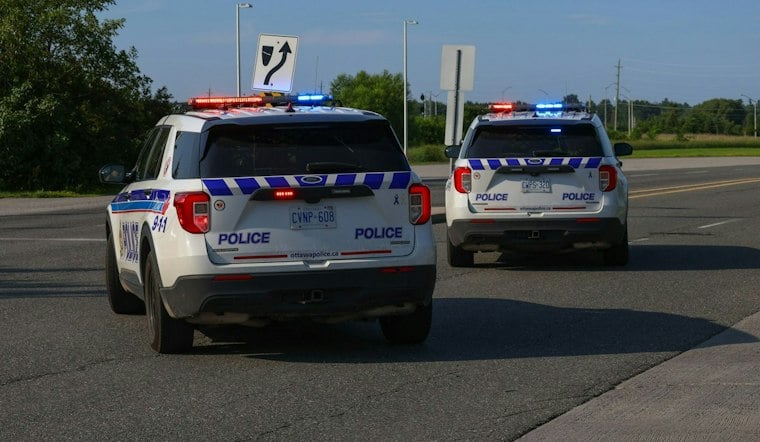
Police descended on the University of Rhode Island campus early Friday morning after 911 calls reported a suspicious individual walking near a building called Hunter Hall. There is one problem: URI has no building by that name. State police are now treating the calls as a suspected swatting incident.
According to WJAR, Rhode Island State Police and several municipalities received the 911 calls describing the suspicious person near Hunter Hall, according to a university spokesperson. Officers from URI police, North Kingstown, South Kingstown, and Rhode Island State Police all responded to the South Kingstown campus, converging on Hutchinson Hall and Heathman Hall. Officers who searched those buildings found nothing suspicious, and patrols remained in the area even after the scene was cleared.
Notably, URI's own 911 dispatch never received a call about the reported suspicious individual, per the same report. A university spokesperson said residence halls did not need to be evacuated during the response. State police are treating the Hunter Hall calls as a swatting incident, according to the university.
What Swatting Looks Like, and Why It Works
Swatting is the practice of calling emergency responders with a fabricated report in order to trigger a large law-enforcement response, as Axios has explained. Perpetrators can be hard to trace because the tactic often relies on AI-generated voices, caller ID spoofing, and masking a caller's IP address, the outlet reports.
In August 2025, roughly a dozen colleges were tricked by hoax calls, including the University of Colorado Boulder.
A Pattern Playing Out at Other Rhode Island Sites
URI has previously faced a false alarm. In an earlier lockdown, police responded to a report of an active shooter at Chafee Hall on campus and ultimately recovered a Nerf gun, according to Fun 107. State police said in that incident there was no evidence an active shooter or firearm had ever been on campus.
Rhode Island has also seen a hospital targeted by a similar hoax. South County Hospital in South Kingstown reopened on a Monday afternoon after nearly five hours in lockdown following a false report of an active shooter, The Boston Globe reported. South Kingstown Police Chief Matthew Moynihan said someone called 911 that day to report an active shooter at the hospital, but when officers arrived they found no evidence of a shooter or any victims; Moynihan said the call appeared to be a swatting incident.
College campuses outside Rhode Island have faced the same scramble. Villanova University, a Catholic school in Pennsylvania, was hit with two false shooting reports in the span of a week, including one that interrupted an orientation Mass for incoming students, according to The Washington Post. Axios separately reported that an online group calling itself Purgatory claimed responsibility for alerts at the University of Colorado Boulder, Villanova, and the University of Tennessee at Chattanooga, though Axios said it could not independently verify those claims.
What the Law Says About False 911 Reports
Rhode Island law addresses false emergency calls directly. Under Title 39 of the state's general laws, a person may not knowingly call or cause a 911 call to make a false alarm or complaint, or report false information that could result in the dispatch of emergency services from a public agency, according to the Rhode Island General Assembly. It remains unclear how, or whether, that statute would apply to Friday's calls, and no information on potential penalties was available.
Who placed the Hunter Hall calls and why remains unknown. No arrests, charges, or identified motive have been reported in connection with the URI incident, and it is not established whether Friday's calls are connected to the earlier Chafee Hall lockdown or the South County Hospital scare.



