

























































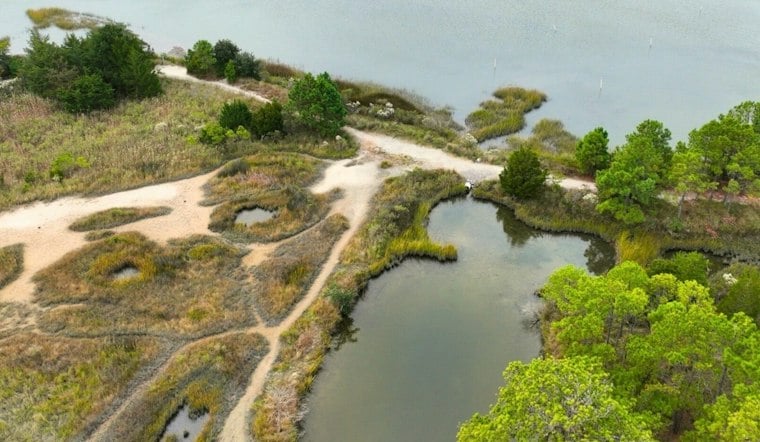
A federal judge has dismissed a lawsuit brought by four Virginia Beach residents who tried to stop construction at Pleasure House Point, ruling the case moot now that the controversial wetlands project is already built. The decision closes out a fight that began after contractors cleared more than 5,200 trees from roughly eight acres of maritime forest to make way for the city's $12 million tidal marsh restoration.
U.S. District Judge Elizabeth W. Hanes granted the Army Corps of Engineers' motion to dismiss on September 24, according to court records, finding that the plaintiffs' legal claims were moot because physical construction was already complete. The judge also denied the residents' request to amend their complaint, effectively ending the case in its current form, as reported by 13News Now. The Army Corps had notified the City of Virginia Beach that construction was finished back in February, according to the same report.
The lawsuit, *Bell et al. v. Avichal et al.*, was filed in May 2025 against Norfolk District Army Corps Commander Col. Sonny B. Avichal under the Administrative Procedure Act. Plaintiffs Julia Bell, Windy Crutchfield, Kim Mayo, and Walt Stone represented themselves pro se in federal district court, challenging the permit issued for the project, per the court filing. According to court documents, the plaintiffs alleged the project destroyed publicly accessible areas, trails, trees, and wildlife habitat.
A Forest Cleared for Marsh Restoration
Contractors working for the city cleared loblolly pines, live oaks, and other trees across the site in March 2025, a move that drew widespread opposition from neighbors, according to WHRO. The city has framed the removal as a necessary step to restore tidal wetlands that were buried decades earlier, rather than destruction of pristine habitat. The site once served as an Army Corps dredge disposal area in 1971 and 1972, when more than 1 million cubic yards of sediment from the Lynnhaven Inlet were deposited over the original tidal wetlands, according to the Ocean Park Civic League.
Karen Forget, executive director of Lynnhaven River NOW, said she believed the dismissal was fair, noting the Pleasure House Point project aims to revive wetlands and preserve the area for the future and was included in the property's original 2012 management plan. She also described how a berm was built to contain dredge material that had smothered the wetlands, with thousands of cubic yards of material involved, she said.
Even so, Forget acknowledged the process left some neighbors feeling shut out. She said community members felt they had too little time to weigh in on the plans, adding that the project came up suddenly and was pushed through rapidly.
From Condo Site to Mitigation Bank
Pleasure House Point's broader history stretches back to 2012, when the City of Virginia Beach, the Trust for Public Land, and the Chesapeake Bay Foundation jointly acquired the 118-acre property for $13 million, rescuing it from a foreclosed 1,100-unit condominium development called Indigo Dunes, according to the Trust for Public Land. A 10-acre slice of that land later became home to the Chesapeake Bay Foundation's $21 million Brock Environmental Center, a net-zero energy and water demonstration facility that opened in November 2014.
The restoration project itself was designed as a municipal mitigation bank, generating tidal wetland credits that state and federal regulations require public agencies to hold before disturbing wetlands elsewhere during flood control and infrastructure work, per WHRO's reporting. In January 2025, the Virginia Beach City Council voted unanimously to redirect $6.6 million in capital improvement funds, temporarily shifted from beach replenishment and Rudee Inlet projects, to complete financing for the $12 million restoration, with officials pledging to replace the reallocated money in later budget cycles.
Trust Issues Linger Beyond the Courtroom
Even as the federal case wraps up, friction between residents and city officials hasn't fully subsided. In June, local activists publicly criticized the city for omitting resident comments from a social-media recap video of a public hearing on the project, prompting officials to note that full unedited recordings remained posted on YouTube, according to 13News Now.
The stakes behind projects like this one extend beyond a single Virginia Beach neighborhood. State environmental modeling in the Virginia Coastal Resilience Master Plan forecasts the state could lose up to 89 percent of its existing tidal wetlands by 2080 without active wetland migration and nature-based coastal protection efforts, a trend Hoodline previously reported is driving similar restoration work across the region.
As of publication, neither the Army Corps of Engineers nor the City of Virginia Beach had responded to requests for comment on the dismissal, per 13News Now's reporting. With the lawsuit unable to proceed in its current form, the legal fight over Pleasure House Point appears to be over, even as questions about community input on the project's rollout remain unresolved.




