

























































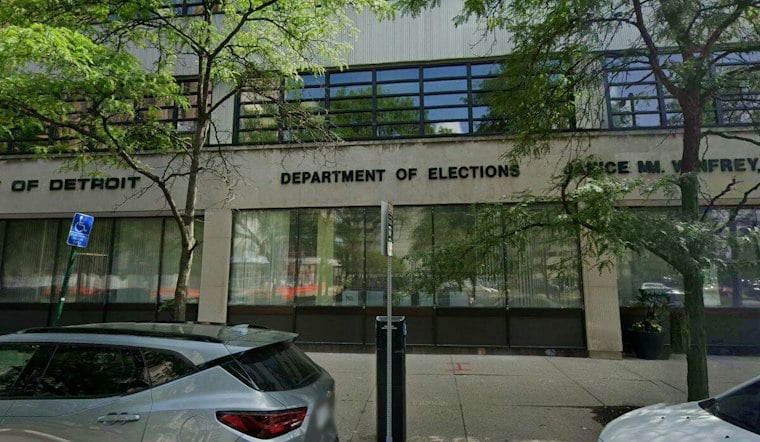
Federal election monitors are headed to polling places in seven Michigan cities on Nov. 3, after the U.S. Department of Justice notified Detroit, East Lansing, Flint, Grand Rapids, Hamtramck, Lansing and Warren that its staff would be on hand for Election Day. State officials are calling the move routine, even as one of the listed cities says it never got official word.
DOJ Notices Land Days Before the Midterm
The notices went out Oct. 21, according to CBS News Detroit, which reported that the Justice Department intends to place federal election monitors in the seven cities during the November midterm. Federal election monitors are typically federal attorneys and other Justice Department staff, the outlet noted, and they are not new to Michigan — monitors were present during the 2024 election and again during Michigan's August 2026 primary, when they showed up in Detroit, Lansing, Hamtramck and East Lansing.
Flint's city clerk office confirmed it received notice of the monitors, per MLive, and reaffirmed its commitment to safe, secure and transparent local elections. But Hamtramck officials told CBS News Detroit the city has not received anything official from the DOJ despite being named among the seven cities slated for monitoring — a discrepancy that remains unresolved as Election Day approaches.
State Leaders Frame It as Standard Practice
Michigan Attorney General Dana Nessel said DOJ monitors are a standard part of the state's election process, according to the CBS News Detroit report, and added that residents should know the monitors are expected to follow state and federal law. Nessel also said Michigan law allows monitors, observers and challengers to witness elections at local polling places, even though monitors are not expressly provided for in federal law. She said her office is ready to hold accountable anyone who unlawfully interferes with or intimidates Michigan voters or election workers.
Gov. Gretchen Whitmer struck a similar note, telling CBS News Detroit that the presence of federal election monitors is an expected part of the process, as it has been for years, while affirming that Michigan will protect the fundamental right to vote. Aghogho Edevbie said state and local election officials have been in regular contact with the DOJ about its plans for this election, according to ABC12.
What Monitors Can and Cannot Do
Per the state, DOJ monitors cannot speak with voters, touch election equipment or ballots, or otherwise interfere with election administration — though they may observe elections at polling places as members of the public. The Justice Department has said its monitors help assess compliance with federal voting rights laws, including the Voting Rights Act of 1965, and NPR reports the department routinely observes elections for that purpose. During Michigan's August primary, monitors did not interfere with election proceedings, according to Votebeat, which reported the monitors mostly asked questions about assistance technology for voters with disabilities and about provisional ballots. The DOJ also sent monitors to Arizona's July 21 primary, including Maricopa County, and those visits were similarly described as uneventful.
Part of a Record-Setting National Effort
The Michigan deployment is a small piece of a much larger operation. The DOJ plans to deploy roughly 1,000 monitors to polls across all 50 states on Election Day, a figure described by the Detroit News as roughly triple the number used in the last midterm and potentially the largest observation effort in the department's history. By comparison, the DOJ monitored just 64 jurisdictions across 24 states on Election Day in 2022, and it monitored hundreds of polling places in 11 states during this year's primary elections.
Michigan's elections are carried out by more than 1,600 local Republican, Democratic and nonpartisan election clerks spread across the state's 1,521 cities and townships, underscoring how local the actual vote-counting remains even as federal attention intensifies.
A Battleground State With High Stakes
Michigan remains a battleground state with closely watched races this cycle. Voters will elect a U.S. senator, U.S. House members, a governor, secretary of state, attorney general, state legislators and local officials on Nov. 3, and the open Senate and House seats could help determine which party controls Congress. In an MLive reader survey that drew responses from hundreds of Michigan voters, nearly 44% of the 832 respondents ranked election integrity or voter access among their top five issues shaping how they'll vote.
State officials are encouraging voters to visit mi.gov/vote to view a sample ballot, learn more about election security and find their polling location ahead of Nov. 3.





