

























































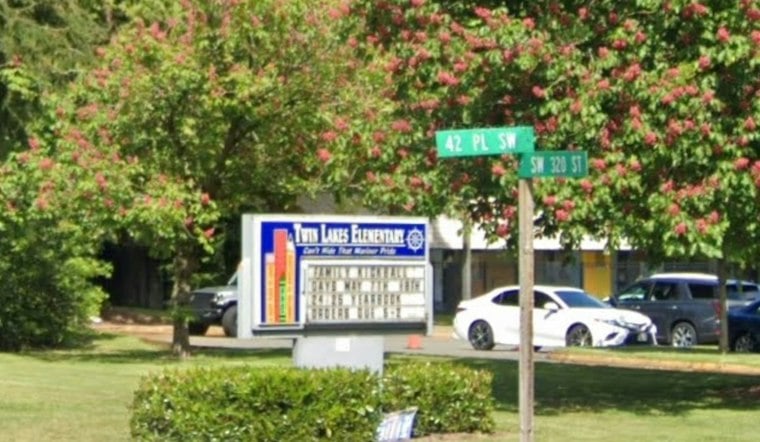
Federal Way drivers who roll through school zones late at night or on weekends are about to get caught on camera no matter what time it is. Starting Nov. 1, 2026, the city says it will flip four existing school-zone speed cameras to full 24/7 operation, enforcing a 20 mph limit during school hours and 35 mph the rest of the time.
The city identified the new enforcement schedule in a news release Wednesday, confirming that cameras currently limited to citing drivers for exceeding 20 mph only when flashing beacons are active will soon watch the roads around the clock. As The Seattle Times reports, the change is meant to close a gap where speeding outside school hours previously went unchecked at these same intersections. Two of the four locations are 1st Avenue South at Panther Lake Elementary School and Southwest 320th Street at Twin Lakes Elementary School, while the other two cameras sit at Southwest Campus Drive and 21st Avenue Southwest, both near TAF@Saghalie.
Drivers won't be hit with fines the moment the clocks flip. A one-month warning period begins when the cameras switch on Nov. 1, during which anyone caught speeding outside posted school-zone hours will get a warning rather than a ticket. Speeding during actual school hours, however, will continue to result in citations straight through the grace period, according to KOMO News.
What Tickets Will Cost Once Enforcement Resumes
Once the warning period ends Dec. 1, camera-detected speeding will result in full citations again. KOMO reports that violations captured by the cameras beginning that date will carry civil infractions of no more than $290, excluding late fees. A city FAQ page, however, describes Federal Way's photo-violation fines in school zones as ranging from $210 to no more than $250, excluding late fees — a discrepancy the available city materials don't fully reconcile.
City officials have framed the expansion as a straightforward safety move. The change is intended, per KOMO's reporting, to improve safety and reduce speeding in high-risk areas. That framing echoes comments from Police Chief Andy Wong, who told the council that extending enforcement hours would align Federal Way's local code with state law while cutting down on excessive speeding near schools, according to CitizenPortal.
Council Action Behind the Switch
The push toward round-the-clock cameras has been moving through Federal Way's City Council in recent weeks. Council Bill 947, which would authorize continuous automated speed-camera enforcement in qualifying school-walk zones, was forwarded for a second reading at the council's Oct. 20 meeting, according to the same CitizenPortal report.
Part of a Broader Washington Shift
Federal Way isn't moving alone. Washington cities including Seattle have installed speed cameras around school zones over the last few years, and several are now extending those systems to run full-time. Seattle plans to add its first full-time, 24/7 speed cameras at four locations in 2027, including stretches of Rainier Avenue South and East Marginal Way South, with Sand Point Way Northeast also planned, according to The Urbanist. Exact cross streets for those cameras are still being worked out, the outlet notes.
Seattle's push follows its own 2025 traffic data, which the same report says found 15 percent of drivers at all four planned camera locations traveling at least 10 mph over the posted limit — in areas transportation officials described as having histories of excessive speeding and deadly crashes. Edmonds has already converted cameras at four schools to 24/7 operation, and Bellevue installed four new sets of full-time cameras near hospitals, parks and school walk zones in August, per the same account.
State law gives cities fairly broad authority to deploy these systems. Under RCW 46.63.260, automated traffic-safety cameras are permitted at certain intersections, railroad grade crossings, school speed zones, school walk zones, public-park speed zones, hospital speed zones and midblock arterial locations — the same legal framework cities like Federal Way are now leaning on to justify always-on enforcement.


