

























































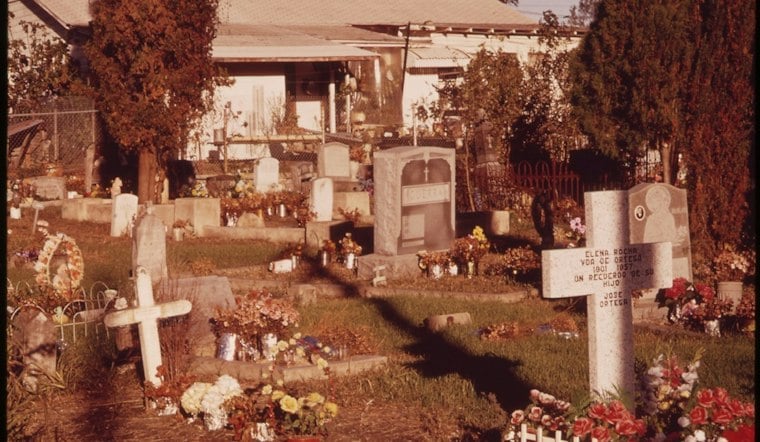
Nearly every night, feral hogs are tearing through Mission Park Cemetery on San Antonio's Southeast Military Drive, leaving behind torn-up grass, disturbed ground and damaged gravesite surroundings as they dig for grubs and worms. The rooting has become routine enough that families visiting loved ones now expect to find hoofprints and churned dirt waiting for them.
David Thompson knows the pattern well. He visits the cemetery every day to tend to his wife's grave, who died nearly three years ago, and he has taken to raking up the damaged grass and piling it aside just to keep the grounds looking presentable, according to KENS 5. The hogs reportedly began showing up at the cemetery in 2025 and have only grown bolder since, leaving tracks and disturbed ground across the property.
The timing has been especially painful for families preparing for Dia de los Muertos. A woman named Theresa visited the cemetery the Sunday before to get ready for her family's traditional holiday gathering, but she and her husband had trouble even locating a relative's grave because its headstone was completely buried. Thompson ended up pointing out the plot for them. Theresa said the hogs had destroyed the grave area, and that she wanted the cemetery made presentable before her extended family arrived, noting that burial there already costs a lot of money.
Owner Says Help From the City Hasn't Come
Dick Tips, who owns Mission Park Cemetery, says his family's connection to the property spans five generations, and he's frustrated that repeated requests for help from the city have gone nowhere. Tips tried hiring a trapper to work the cemetery grounds directly, but the effort has had little success, largely because the hogs simply retreat onto land he doesn't own once they're spooked.
The geography works against him. The cemetery's immediate neighbors include the City of San Antonio, the San Antonio River Authority and the federal government, according to property records cited by KENS 5, and the San Antonio River forms the eastern boundary of the property. Those adjacent parcels give hogs daytime shelter and essentially unobstructed access to the cemetery grounds. Flooding along that stretch also makes fencing off the property impractical, compounding the problem.
As of Monday morning, the cemetery had just one small corn-baited box trap set at the property's far southern end, an operation on a far smaller scale than the hundreds of acres the animals can roam. Adding to the difficulty, Texas Parks and Wildlife allows hog hunting 365 days a year, but San Antonio's own city code prohibits hunting with firearms inside city limits, closing off one of the most common rural control methods.
City Says the Problem Stretches Across the County
The office of District 3 Councilwoman Phyllis Viagran confirmed to KENS 5 that the city works with contractors to trap hogs, but emphasized that the issue extends well beyond one cemetery and affects the entire county. San Antonio Parks and Recreation has used feral-hog trappers on city-owned land since 2019, and the city has previously reported trapping more than 850 hogs since then, mostly in natural park areas — though the city did not provide a current, up-to-date trapping total for this story. A city parks representative said staff are working with a contractor and will assess the cemetery area in question.
Viagran's office also warned that people should never approach feral hogs, which can be aggressive and carry diseases that can spread to humans and pets. That caution lines up with guidance from the USDA, which notes that feral swine can pose risks to people through attacks or vehicle collisions, in addition to disease transmission.
San Antonio has leaned on contracted trappers elsewhere in the city too. The San Antonio Report has reported that the City Council approved an annual $35,000 contract with LMR Hog Trappers, with two one-year renewal options pushing the total estimated cost to $175,000. City officials have said the animals have damaged city property and pose a health and safety concern to the community. Separately, KSAT has reported that hogs have also turned up at the Medina River Natural Area, Friedrich Wilderness Park and the Greenway Trail System, where they can grow to several hundred pounds and threaten local ecosystems as well as park visitors.
A Familiar Scene at a Dallas Cemetery
San Antonio isn't alone in this fight. NBC 5 Dallas-Fort Worth has reported that relatives of people buried at Lincoln Memorial Cemetery in far Southeast Dallas have complained of wild hogs still damaging graves there despite more than a year of containment efforts. That cemetery sits near Interstate 20 along the Trinity River, where hogs run wild, and lacks a fence, according to a Dallas City Council member quoted by the station.
Volunteers from Hogs for A Cause Texas trapped a dozen hogs there in May 2021 after starting the effort a month earlier, but the group's traps and camera equipment were stolen twice, and the losses eventually became too great to continue. A cemetery manager later told NBC 5 that a new corral trap captured a dozen hogs in a single Thursday night, suggesting larger-scale traps can work when they're left in place.
The scope of the problem statewide is enormous, even if the exact number is disputed. KSAT has cited an estimate of more than 2.5 million feral hogs in Texas, while the San Antonio Report has put the figure above 2.6 million, and the Texas A&M Natural Resources Institute has estimated the population at more than 3 million. Texas A&M's research also shows feral pigs now occupy 250 of the state's 254 counties and cause an estimated $670 million in crop damage annually, plus another $200 million in control and mitigation costs. Under Texas law, a resident landowner — or someone with the landowner's consent — can legally take feral hogs on that private land without obtaining a hunting license, according to the Texas Legislature's statutes, though that provision does little to help a cemetery whose hogs keep retreating onto land it does not control.





