

























































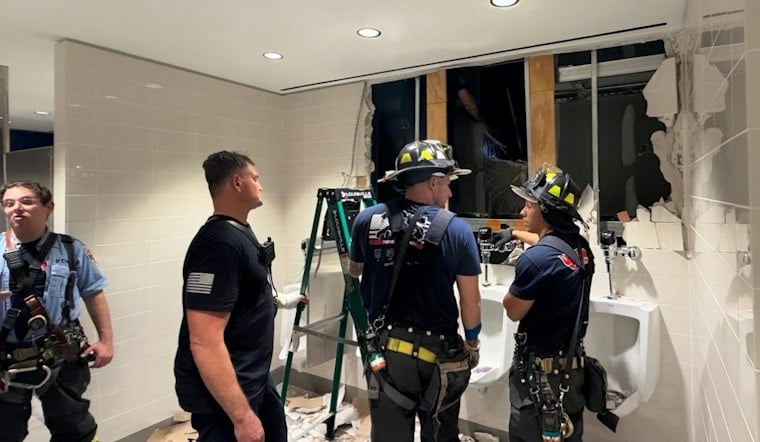
Five people trapped inside an elevator stuck in a blind shaft near the 32nd floor of 3 World Trade Center were freed Wednesday evening after firefighters were lowered roughly 175 feet on rope down the shaft and broke through a bathroom wall to reach them. Two firefighters and one of the trapped civilians suffered minor injuries during the operation, which stretched from the building's 47th floor down through nearly eighteen stories of shaft space.
According to the FDNY
, crews responded to the elevator rescue in Manhattan after five people became trapped in a car with no direct access from any landing door, a configuration known in the fire service as a blind shaft. Two firefighters entered the shaft from the 47th floor and were lowered on rope roughly 175 feet to reach the stalled car, the department said. With no door to open where the elevator had stopped, FDNY members breached a bathroom wall on the 32nd floor to finally gain access to the car itself.
Before the bathroom wall was breached, firefighters brought one civilian up by rope. Members then removed the four remaining occupants through the opening on the 32nd floor. One civilian and two firefighters sustained minor injuries in the course of the rescue. The department credited the operation to specialized training, technical expertise and teamwork, framing it as the kind of challenging emergency its technical-rescue members are built to handle.
Why a Stuck Elevator Becomes a Rope Rescue
Blind shafts are a defined hazard in high-rise firefighting: continuous elevator-shaft runs of three or more floors without landing doors, which means a standard forced-entry rescue through a hallway door simply is not possible, as past Hoodline coverage of a similar incident has explained. Firehouse's guidance on high-rise operations notes that crews responding to these buildings need a working understanding of elevator type and design, which banks serve which floors, and when it is appropriate to use an elevator at all during an emergency. A car stopped in a blind shaft may have no landing door offering direct access.
How Other Cities Have Handled the Same Hazard
New York's rescue echoes a string of similar blind-shaft operations in other major cities over the past decade. In Boston, firefighters lifted five people trapped in an elevator at 60 State Street out one by one through more than a dozen stories of shaft, according to CBS Boston, lowering two firefighters roughly 200 feet from the 18th floor before hoisting everyone to safety with no injuries reported. Boston's deputy fire chief called that kind of rope rescue risky and dangerous but said the department's specially trained technical-rescue firefighters managed to make it as safe as possible. A separate Boston rescue at 53 State Street used ropes, harnesses and a tripod system to lift a trapped man about 70 feet to an opening on the 21st floor, per WCVB.
Chicago crews faced a version of the same problem in 2016, when Tower Ladder 10 responded to four girls stuck on an elevator in a high-rise on North Halsted, as Fire Engineering reported. After lowering a firefighter down the shaft, crews found the girls in good spirits after being trapped for two hours and brought them up by rope to the fourth floor. In Cleveland, firefighters from Technical Rescue 1 rigged ropes and hoisted a Terminal Tower rider roughly five stories to safety, with the person walking away uninjured, Hoodline previously reported. And in Atlanta, two children trapped in a stalled, blind-shaft elevator were freed in 15 to 20 minutes after rescuers lowered themselves on ropes and used the same lines to lift the kids out, according to WSB-TV.
These rescues used ropes, while some also involved harnesses or specialized crews. In Manhattan, firefighters brought one civilian up by rope and removed the four remaining occupants through a breached wall.


