

























































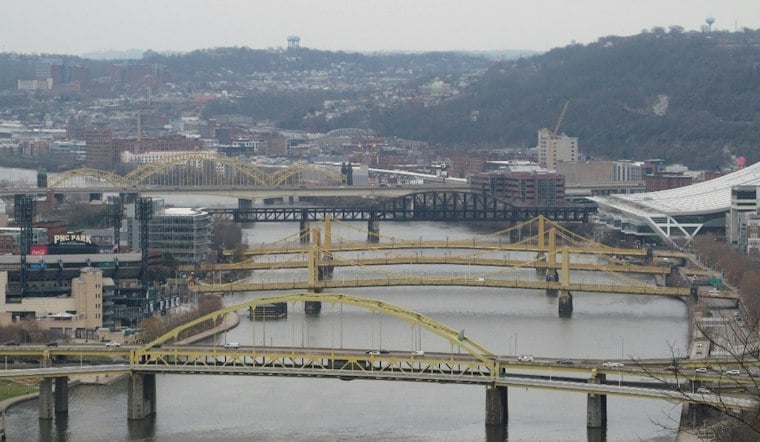
A patch of native plants is now growing in the middle of the Allegheny River, rooted not in soil but in a floating platform anchored near Pittsburgh's North Shore. The Western Pennsylvania Conservancy has unveiled the installation as a living filter for the river, built into an open notch of Riverlife's Shore Thing barge near the Sister Bridges downtown.
The project pairs the Western Pennsylvania Conservancy with Riverlife's floating barge platform, as CBS News reported, with KDKA-TV's Barry Pintar covering the unveiling. The floating wetland garden was designed in partnership with the conservancy based on research from Chicago-based Urban Rivers, and it was funded through a grant from the Garden Club of Allegheny County, which supports native plant and aquatic habitat restoration across southwestern Pennsylvania.
Shore Thing itself is a 4,800-square-foot modular platform built from 10 interconnected barges, engineered by Riverlife to create on-the-water public gathering space along the Allegheny, according to the Urban Land Institute. The wetland occupies a dedicated open notch within that structure, putting the plantings in direct contact with river water rather than on a sealed deck.
How the Root Systems Clean the Water
The science behind the installation relies on the submerged root networks of native perennial vegetation, which extract surplus nitrogen and phosphorus from the water, trap suspended sediments, and provide structural habitat for aquatic life, all without altering the shoreline itself, per research published through MDPI. That design makes floating wetlands an increasingly common tool in urban waterways where shorelines have already been armored or paved over with industrial infrastructure, as is the case along much of Pittsburgh's riverfront.
The installation also carries an educational mission. On October 13, Riverlife, the Western Pennsylvania Conservancy, and the Council of Three Rivers American Indian Center hosted a joint public panel aboard Shore Thing to discuss Allegheny River ecology and native plant species. The event framed native riverfront restoration around Indigenous ecological knowledge alongside modern urban river stewardship.
A Small Garden Against a 9-Billion-Gallon Problem
The timing of the wetland's debut lands against the backdrop of a far larger water quality challenge. Combined sewer overflows in Pittsburgh discharge an estimated 9 billion gallons of untreated sewage and stormwater into local rivers every year during heavy rain events, according to CBS News, because older municipal infrastructure routes both rainwater runoff and household sewage through the same underground pipes.
The Allegheny County Sanitary Authority, known as ALCOSAN, began work this year on a $4.5 billion Clean Water Plan to build 16 miles of deep underground tunnels beneath Pittsburgh's three rivers to capture wet-weather overflows, with the system designed to cut annual sewer overflows by roughly 7 billion gallons once finished, per the same CBS News report. A 2019 federal consent decree modification between the EPA, Pennsylvania regulators, and ALCOSAN explicitly opened the door for green stormwater infrastructure like floating wetlands to work alongside that tunnel system, updating an earlier 2008 agreement to give the region's 83 local municipalities more flexibility in meeting Clean Water Act standards.
The Organizations Behind the Platform
The Western Pennsylvania Conservancy, established in 1932, has conserved more than 290,000 acres of land, helped create 11 Pennsylvania state parks, restored more than 3,000 miles of rivers and streams, and preserves Frank Lloyd Wright's Fallingwater, according to the Western Pennsylvania Conservancy. Riverlife, founded in 1999, directs urban planning and development across Pittsburgh's 15-mile riverfront park system, working to connect communities with reclaimed industrial waterfronts, the Urban Land Institute notes.
Shore Thing itself has already drawn outside recognition, winning a 2026 Urban Land Institute Americas Award for Excellence for its architectural design, community programming, and environmental resiliency on the Allegheny River. The new wetland adds a visible, hands-on piece to that larger platform, giving Pittsburghers a close-up look at how small-scale green infrastructure can work in tandem with the region's massive tunnel investments to nudge the Allegheny, Monongahela, and Ohio rivers toward cleaner water.





