

























































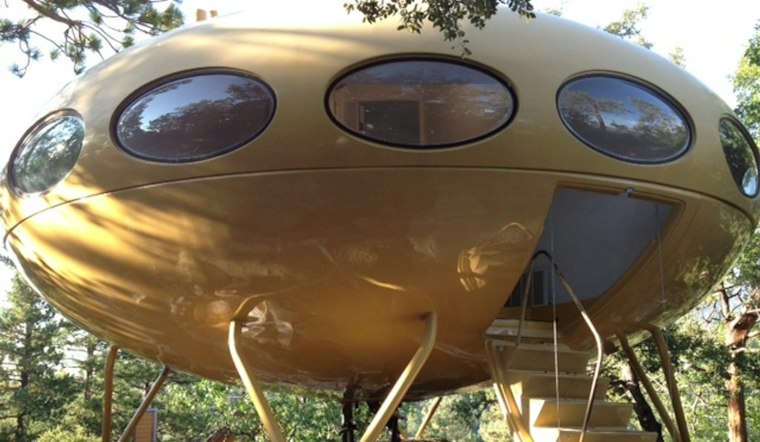
A real flying saucer has landed on the real estate market near Idyllwild, and it comes with a $1,495,000 asking price. The Donaldson Futuro, a circular, space-age prefab built in 1969, sits on a granite outcrop in the forested San Jacinto Mountains, its fiberglass hull perched on steel legs painted to match. It's one of the rarest residential structures in the country, and its decades-long restoration story is as unusual as its shape.
The one-bedroom, one-bathroom home spans approximately 793 square feet and was listed for sale on Oct. 6, 2026, according to the property listing on Compass. The home has been extensively restored inside and out and is in excellent condition. That figure differs from an earlier account by Fox 5 San Diego, which described the structure as a 520-square-foot vacation home — a discrepancy the available record doesn't resolve. The listing is held by Timothy McTavish of Desert Sotheby's International Realty, according to The Press-Enterprise.
A Saucer Built for a Different Era
The Futuro design dates to the 1960s, when Finnish architect Matti Suuronen created the self-contained unit, which was manufactured under the particular model built by Futuro Enterprises in Philadelphia, per the Press-Enterprise's reporting. The round shell reflected a broader postwar fascination with prefabricated and mobile housing built from new materials, according to the Eichler Network, which noted that “people were dreaming in the postwar years of low-cost prefabricated housing, of mobile housing, of housing built using the latest technologies and materials.”
Futuro houses were sold fully assembled for $14,000, though buyers still had to arrange their own transport, Fox 5 San Diego reported. The fiberglass-reinforced polyester shell could be broken into panels for shipping and reassembly, and Eichler Network reported the structure could be put back together by two people and a crane in just two days. Production didn't last long: by the mid-1970s, Futuros stopped being built, as the oil embargo pushed petroleum prices higher and made plastic construction less economical, per Fox 5 San Diego. Estimates of how many were ever built vary — the Press-Enterprise reported a Wall Street Journal estimate of between 50 and 60 globally, as well as an estimate of roughly 100 made worldwide. The Donaldson Futuro is counted among just 19 survivors still standing in the United States, per Atomic Ranch, as cited by the Press-Enterprise, and was the first Futuro to arrive in California in 1969, according to Heritage Architecture & Planning, which also says it's the only Futuro approved for residential occupancy.
From Wrecking Ball to Restoration
The home's survival owes almost entirely to Milford Wayne Donaldson, a preservation architect who studied historic architecture in Sweden during the 1960s and later founded Heritage Architecture and Planning in San Diego in 1978 — a firm that went on to help spearhead the revitalization of the city's historic Gaslamp Quarter, per the Press-Enterprise. Donaldson rescued the plastic UFO-shaped structure from a parking lot behind the San Diego Design Center in the late 1970s after it had been damaged by a wrecking ball, according to the Press-Enterprise account. Fox 5 San Diego reported that he bought the neglected Futuro for $15,000 and initially relocated it to a local boatyard, where he and specialists spent two years refinishing its exterior. The broader restoration effort lasted several decades, according to the Press-Enterprise.
In February 2003, Donaldson and his wife, Laurie, bought a half-acre lot in Pine Cove for $70,000, per the Press-Enterprise. The Futuro's eventual move to that mountain site became an event in itself: the Eichler Network reported the relocation took five hours in December 2004, with the California Highway Patrol escorting the 11,900-pound structure as it blocked three lanes of traffic along the way. Heritage Architecture & Planning put the distance at 130 miles from San Diego, while Eichler Network reported it as 150 miles to Pine Cove near Idyllwild — accounts that diverge on exact mileage. A crane ultimately helped set the saucer onto its Pine Cove site.
Historic Status and a Distinguished Résumé
Donaldson's preservation credentials extend well beyond his own home. He served as California's State Historic Preservation Officer under Gov. Arnold Schwarzenegger starting in 2004, and later as chairman of the Advisory Council on Historic Preservation after being appointed by President Barack Obama, according to DOCOMOMO Journal. Those credentials likely helped secure the Futuro's own place in the historical record: the home is listed on the National Register of Historic Places and carries the formal name the Donaldson Futuro, as recognized by the National Park Service and the State of California, the Compass listing states. It's also designated as California Historical Landmark No. 1062, per the Press-Enterprise, and the property includes a stone monument bearing two bronze plaques.
Inside, the circular floor plan retains much of its original space-age character: bubble windows, 16 custom acrylic portals, and a retractable airplane-hatch entry door original to the Futuro concept. A skylight now occupies what was once the structure's flue opening, while a gold-flecked, non-asbestos popcorn ceiling covers the interior. The compact lime-green kitchen features custom cabinetry, the lounge and dining area include built-in seating, and a bedroom and bathroom are framed off by privacy walls — all details drawn from the Press-Enterprise's description of the listing.
Donaldson and his wife now live near Sacramento, according to the Press-Enterprise, putting some distance between the couple and the mountain retreat they spent decades bringing back to life. Whatever becomes of the saucer's next chapter, its journey from a damaged relic behind a San Diego design center to a nationally recognized landmark remains one of the more unusual tales in Inland Empire real estate.



