

























































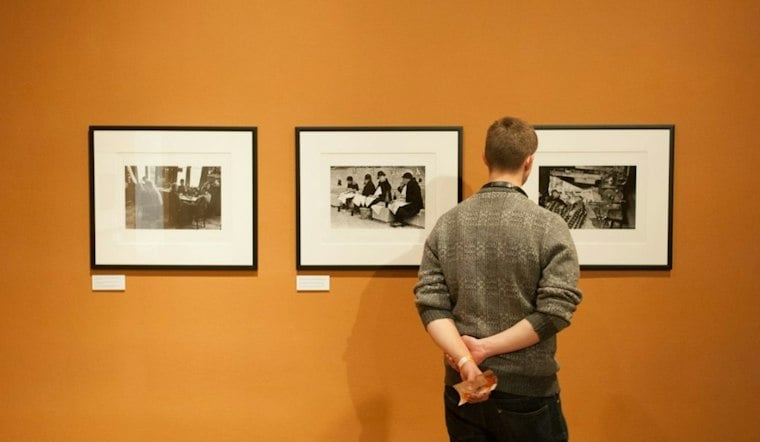
The Kimbell Art Museum in Fort Worth is opening the doors on something it has never done before: an entire exhibition devoted to photography. Starting Sunday, visitors can walk through nearly a century of images pulled from France's national library, tracing the medium from its earliest scientific experiments to its arrival as fine art.
Photography's First Century: Masterworks from the Bibliothèque nationale de France is, according to the museum, “The Kimbell's first-ever exhibition celebrating the art of photography,” as described on kimbellart.org. It opens Oct. 4 and runs through Jan. 17, per the same source, spanning the rise of daguerreotypes and calotypes in the 1840s through the age of modernism between the World Wars. As Fort Worth Report notes, the show marks the first time this material has traveled to the United States since 1980, when a similar collaboration brought French photography to New York's Metropolitan Museum of Art.
From Niépce's First Image to Modernist Experiments
The exhibition's timeline stretches back to the very invention of the medium. Fort Worth Report reports that Nicéphore Niépce captured the oldest surviving image in 1827, a milestone the Harry Ransom Center separately describes as “the earliest photograph produced with the aid of the camera obscura known to survive today,” according to hrc.utexas.edu. Louis Daguerre later invented daguerreotypes in France using a copper plate polished with silver, while William Henry Fox Talbot created calotypes using paper negatives — a process Fort Worth Magazine says he perfected into “the first paper-negative process to produce multiple prints” in the early 1840s, per fwtx.com.
By the mid-1850s, Gustave Le Gray was pushing the medium's limits, capturing seascapes and combining two negatives to render water and clouds in a single print, according to Fort Worth Report. The show also includes portraits of Victor Hugo and Alexandre Dumas from photography's first 50 years, when sitting for a studio portrait was itself a cultural event. Later sections document the 1860s construction of Paris' Garnier Opera House and the early 20th-century life of artist Sonia Delaunay, while 1920s photographers experimented with solarization, a technique that creates bright halo-like areas within an image.
Scale and Scope Described Differently Across Sources
Just how big the exhibition is depends on who's describing it. The Kimbell itself calls it “this survey of more than 170 images,” while the Bibliothèque nationale de France characterizes it as comprising 120 works, according to bnf.fr. Fort Worth Magazine, meanwhile, reports the show contains more than 150 pieces pulled exclusively from the BnF's archives. Whatever the precise count, the works are drawn from a library that holds more than 5 million photographs, Fort Worth Report notes.
The artists on view span the medium's first century, including Henri Le Secq, Gustave Le Gray, Nadar, Édouard Baldus, Edgar Degas, Eugène Atget, Sonia Delaunay and Man Ray, per the Kimbell's own listing. Among the individual works are Le Gray's The Great Wave, Sète, dated 1857; Nadar's portrait of Alexandre Dumas, dated 1855; and Man Ray's Sleeping Woman, dated 1931, as cited on kimbellart.org. The exhibition is organized by the BnF and the Kimbell in collaboration with Manifesto Expo, with curators Sylvie Aubenas and Flora Triebel of the BnF overseeing the selection.
A Cross-Atlantic Loan Decades in the Making
The last time a major exhibition of BnF photographs crossed the Atlantic was nearly half a century ago. That 1980 show, a joint effort between the Bibliothèque Nationale and the Metropolitan Museum of Art, featured the work of 100 photographers covering French photographic production from 1848 to 1900, according to metmuseum.org. It ran first at the Petit Palais in Paris from September to November 1980, then at the Met from December 1980 into February 1981.
Moving historic photographic prints internationally involves more than shipping logistics. A June notice in the Federal Register stated that objects imported for temporary display in the Kimbell exhibition were determined to be of cultural significance, and that their display in the United States was in the national interest, according to federalregister.gov.
Planning a Visit
Photography's First Century is housed in the Renzo Piano Pavilion at the Kimbell Art Museum, 3333 Camp Bowie Blvd. in Fort Worth, according to Fort Worth Report. The museum is open 10 a.m. to 5 p.m. Tuesday through Thursday and Saturday, noon to 8 p.m. Friday, and noon to 5 p.m. Sunday.
Admission to the exhibition is priced at $18 for adults, $16 for seniors and students, and $14 for children ages 6 to 11, with children under 6 admitted free, Fort Worth Magazine reports. Kimbell members receive unlimited free admission to all special exhibitions, and the museum offers half-price special-exhibition admission Tuesdays from 10 a.m. to 5 p.m. and Fridays from 5 p.m. to 8 p.m., according to kimbellart.org. Kimbell Art Museum Director Eric M. Lee and Deputy Director George Shackelford oversee the institution, which Fort Worth Report notes has been a financial supporter of the publication. The article was written by David Moreno, the outlet's arts and culture reporter.




